

PROBLEMS
16.1 Calculate the resonance frequency of a proton in a magnetic field of (a) 7 T and (b) 20 T.
16.2 Calculate the resonance frequency of a
14 N nucleus in a magnetic field of (a) 20 T and
(b) 9 T.
16.3 If the mass of a proton was only 4 × 10
−29 kg, what would nuclear magneton become?
16.4 Explain what usually causes a large chemical shift.
16.5 Explain what a shielding constant is.
16.6 Why are high magnetic fields normally useful in NMR experiments?
16.7 For two coupled protons, what is the value of the lowest-energy state in the presence of
a magnetic field?
16.8 How many lines are present when a proton interacts with four protons?
16.9 What type of magnetic field is used in an MRI experiment?
16.10 When a spin pulse is applied to the sample with the direction of its magnetic field perpendicular to the external magnetic field, what happens to the spins?
16.11 How many lines are present when a proton interacts with a
14 N nucleus?
16.12 How many lines are present when a proton interacts with another proton?
16.13 Describe the expected two-dimensional NMR spectrum of methionine.
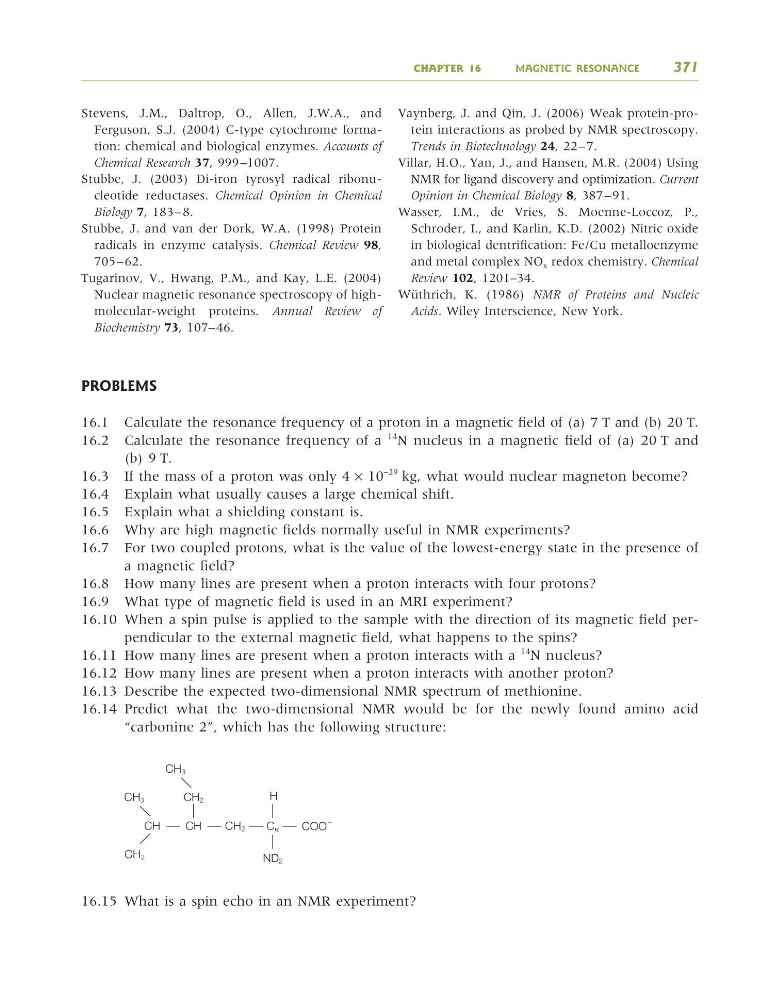
16.14 Predict what the two-dimensional NMR would be for the newly found amino acid
“carbonine 2”, which has the following structure:
16.15 What is a spin echo in an NMR experiment?
H
CH 2
CH2
CH3
CH 3
Cα
COO
Ϫ
CH3
CH
CH
ND2
CHAPTER 16
MAGNETIC RESONANCE
371
Stevens, J.M., Daltrop, O., Allen, J.W.A., and
Ferguson, S.J. (2004) C-type cytochrome formation: chemical and biological enzymes. Accounts of
Chemical Research 37, 999–1007.
Stubbe, J. (2003) Di-iron tyrosyl radical ribonucleotide reductases. Chemical Opinion in Chemical
Biology 7, 183–8.
Stubbe, J. and van der Dork, W.A. (1998) Protein
radicals in enzyme catalysis. Chemical Re9iew 98,
705–62.
Tugarinov, V., Hwang, P.M., and Kay, L.E. (2004)
Nuclear magnetic resonance spectroscopy of highmolecular-weight proteins. Annual Re9iew of
Biochemistry 73, 107–46.
Vaynberg, J. and Qin, J. (2006) Weak protein-protein interactions as probed by NMR spectroscopy.
Trends in Biotechnology 24, 22–7.
Villar, H.O., Yan, J., and Hansen, M.R. (2004) Using
NMR for ligand discovery and optimization. Current
Opinion in Chemical Biology 8, 387–91.
Wasser, I.M., de Vries, S. Moenne-Loccoz, P.,
Schroder, I., and Karlin, K.D. (2002) Nitric oxide
in biological dentrification: Fe/Cu metalloenzyme
and metal complex NO x redox chemistry. Chemical
Re9iew 102, 1201–34.
Wüthrich, K. (1986) NMR of Proteins and Nucleic
Acids. Wiley Interscience, New York.
9781405124362_4_016.qxd 4/29/08 10:45 Page 371
16.1 Calculate the resonance frequency of a proton in a magnetic field of (a) 7 T and (b) 20 T.
16.2 Calculate the resonance frequency of a
14 N nucleus in a magnetic field of (a) 20 T and
(b) 9 T.
16.3 If the mass of a proton was only 4 × 10
−29 kg, what would nuclear magneton become?
16.4 Explain what usually causes a large chemical shift.
16.5 Explain what a shielding constant is.
16.6 Why are high magnetic fields normally useful in NMR experiments?
16.7 For two coupled protons, what is the value of the lowest-energy state in the presence of
a magnetic field?
16.8 How many lines are present when a proton interacts with four protons?
16.9 What type of magnetic field is used in an MRI experiment?
16.10 When a spin pulse is applied to the sample with the direction of its magnetic field perpendicular to the external magnetic field, what happens to the spins?
16.11 How many lines are present when a proton interacts with a
14 N nucleus?
16.12 How many lines are present when a proton interacts with another proton?
16.13 Describe the expected two-dimensional NMR spectrum of methionine.
16.14 Predict what the two-dimensional NMR would be for the newly found amino acid
“carbonine 2”, which has the following structure:
16.15 What is a spin echo in an NMR experiment?
H
CH 2
CH2
CH3
CH 3
Cα
COO
Ϫ
CH3
CH
CH
ND2
CHAPTER 16
MAGNETIC RESONANCE
371
Stevens, J.M., Daltrop, O., Allen, J.W.A., and
Ferguson, S.J. (2004) C-type cytochrome formation: chemical and biological enzymes. Accounts of
Chemical Research 37, 999–1007.
Stubbe, J. (2003) Di-iron tyrosyl radical ribonucleotide reductases. Chemical Opinion in Chemical
Biology 7, 183–8.
Stubbe, J. and van der Dork, W.A. (1998) Protein
radicals in enzyme catalysis. Chemical Re9iew 98,
705–62.
Tugarinov, V., Hwang, P.M., and Kay, L.E. (2004)
Nuclear magnetic resonance spectroscopy of highmolecular-weight proteins. Annual Re9iew of
Biochemistry 73, 107–46.
Vaynberg, J. and Qin, J. (2006) Weak protein-protein interactions as probed by NMR spectroscopy.
Trends in Biotechnology 24, 22–7.
Villar, H.O., Yan, J., and Hansen, M.R. (2004) Using
NMR for ligand discovery and optimization. Current
Opinion in Chemical Biology 8, 387–91.
Wasser, I.M., de Vries, S. Moenne-Loccoz, P.,
Schroder, I., and Karlin, K.D. (2002) Nitric oxide
in biological dentrification: Fe/Cu metalloenzyme
and metal complex NO x redox chemistry. Chemical
Re9iew 102, 1201–34.
Wüthrich, K. (1986) NMR of Proteins and Nucleic
Acids. Wiley Interscience, New York.
9781405124362_4_016.qxd 4/29/08 10:45 Page 371