

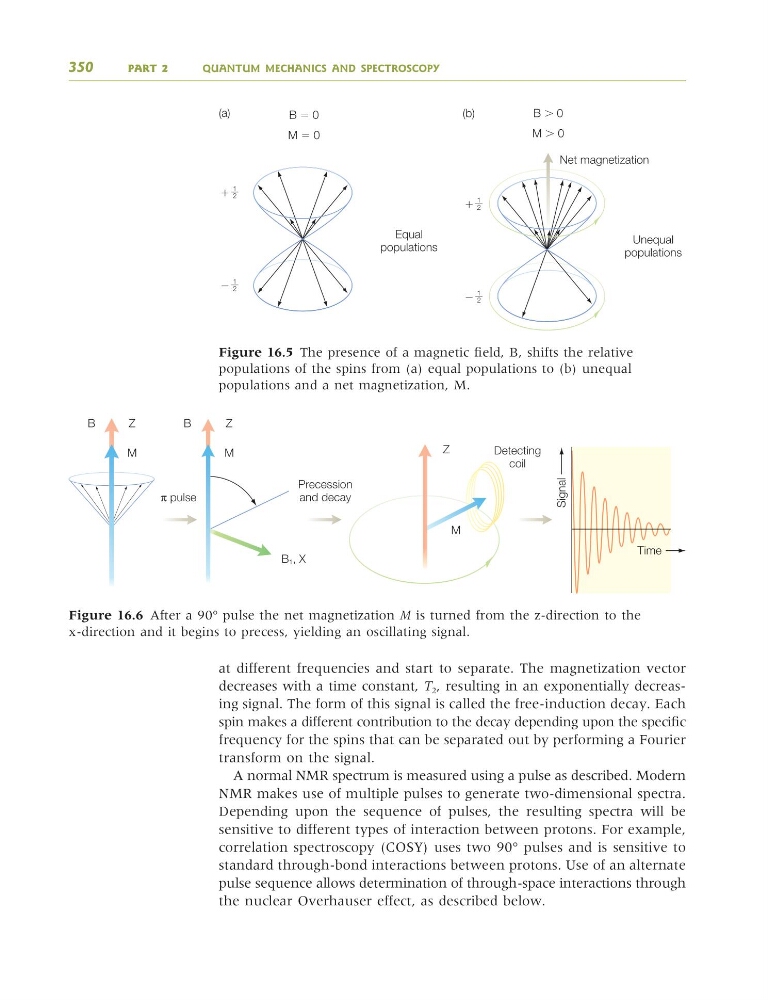
at different frequencies and start to separate. The magnetization vector
decreases with a time constant, T 2 , resulting in an exponentially decreasing signal. The form of this signal is called the free-induction decay. Each
spin makes a different contribution to the decay depending upon the specific
frequency for the spins that can be separated out by performing a Fourier
transform on the signal.
A normal NMR spectrum is measured using a pulse as described. Modern
NMR makes use of multiple pulses to generate two-dimensional spectra.
Depending upon the sequence of pulses, the resulting spectra will be
sensitive to different types of interaction between protons. For example,
correlation spectroscopy (COSY) uses two 90° pulses and is sensitive to
standard through-bond interactions between protons. Use of an alternate
pulse sequence allows determination of through-space interactions through
the nuclear Overhauser effect, as described below.
350
PART 2
QUANTUM MECHANICS AND SPECTROSCOPY
Detecting
coil
Z
M
π pulse
Precession
and decay
Z
M
Z
B
B
B 1, X
Time
Signal
M
Equal
populations
B ϭ 0
M ϭ 0
(a)
ϩ
1
2
Ϫ
1
2
B Ͼ 0
(b)
M Ͼ 0
Net magnetization
Unequal
populations
ϩ
1
2
Ϫ
1
2
Figure 16.5 The presence of a magnetic field, B, shifts the relative
populations of the spins from (a) equal populations to (b) unequal
populations and a net magnetization, M.
Figure 16.6 After a 90° pulse the net magnetization M is turned from the z-direction to the
x-direction and it begins to precess, yielding an oscillating signal.
9781405124362_4_016.qxd 4/29/08 10:45 Page 350
decreases with a time constant, T 2 , resulting in an exponentially decreasing signal. The form of this signal is called the free-induction decay. Each
spin makes a different contribution to the decay depending upon the specific
frequency for the spins that can be separated out by performing a Fourier
transform on the signal.
A normal NMR spectrum is measured using a pulse as described. Modern
NMR makes use of multiple pulses to generate two-dimensional spectra.
Depending upon the sequence of pulses, the resulting spectra will be
sensitive to different types of interaction between protons. For example,
correlation spectroscopy (COSY) uses two 90° pulses and is sensitive to
standard through-bond interactions between protons. Use of an alternate
pulse sequence allows determination of through-space interactions through
the nuclear Overhauser effect, as described below.
350
PART 2
QUANTUM MECHANICS AND SPECTROSCOPY
Detecting
coil
Z
M
π pulse
Precession
and decay
Z
M
Z
B
B
B 1, X
Time
Signal
M
Equal
populations
B ϭ 0
M ϭ 0
(a)
ϩ
1
2
Ϫ
1
2
B Ͼ 0
(b)
M Ͼ 0
Net magnetization
Unequal
populations
ϩ
1
2
Ϫ
1
2
Figure 16.5 The presence of a magnetic field, B, shifts the relative
populations of the spins from (a) equal populations to (b) unequal
populations and a net magnetization, M.
Figure 16.6 After a 90° pulse the net magnetization M is turned from the z-direction to the
x-direction and it begins to precess, yielding an oscillating signal.
9781405124362_4_016.qxd 4/29/08 10:45 Page 350