

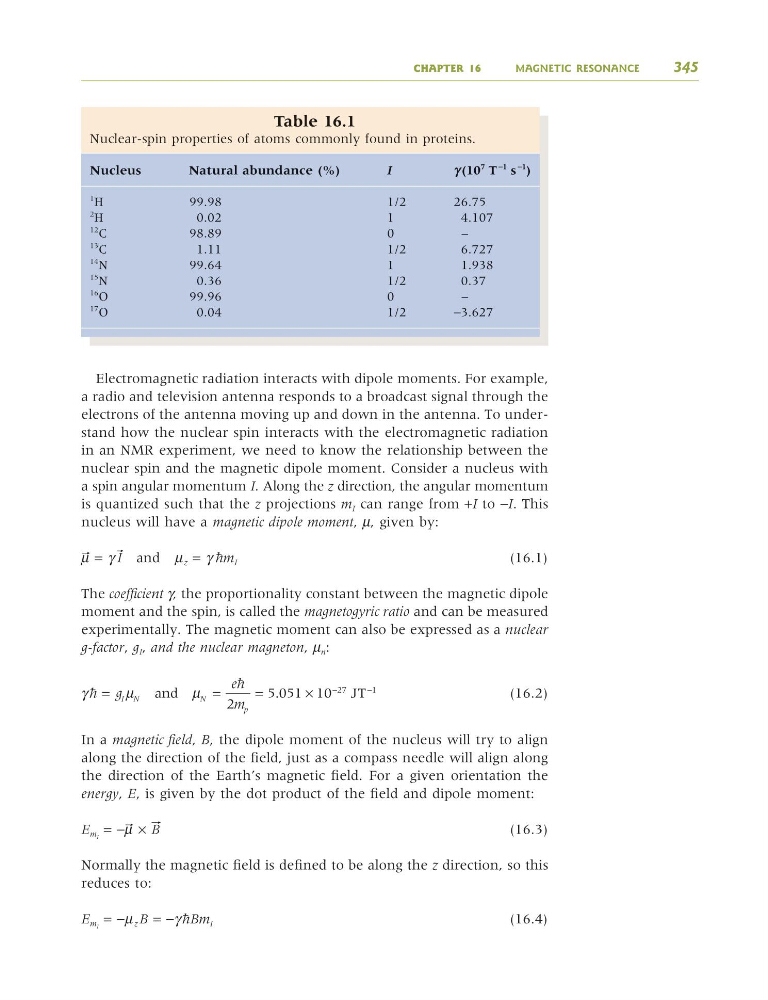
Electromagnetic radiation interacts with dipole moments. For example,
a radio and television antenna responds to a broadcast signal through the
electrons of the antenna moving up and down in the antenna. To understand how the nuclear spin interacts with the electromagnetic radiation
in an NMR experiment, we need to know the relationship between the
nuclear spin and the magnetic dipole moment. Consider a nucleus with
a spin angular momentum I. Along the z direction, the angular momentum
is quantized such that the z projections m I can range from +I to −I. This
nucleus will have a magnetic dipole moment, μ, given by:
G = γ M and μ z = γ Zm I
(16.1)
The coefficient γ, the proportionality constant between the magnetic dipole
moment and the spin, is called the magnetogyric ratio and can be measured
experimentally. The magnetic moment can also be expressed as a nuclear
g-factor, g I , and the nuclear magneton, μ n :
(16.2)
In a magnetic field, B, the dipole moment of the nucleus will try to align
along the direction of the field, just as a compass needle will align along
the direction of the Earth’s magnetic field. For a given orientation the
energy, E, is given by the dot product of the field and dipole moment:
E m I = −G × K
(16.3)
Normally the magnetic field is defined to be along the z direction, so this
reduces to:
E m I = −μ z B = −γ ZBm I
(16.4)
γ
μ
μ
Z
Z
.
=
=
=
×
−
−
g
e
m
I N
N
p
and
JT
2
5 051 10
27
1
CHAPTER 16
MAGNETIC RESONANCE
345
Table 16.1
Nuclear-spin properties of atoms commonly found in proteins.
Nucleus
Natural abundance (%)
I
γ γ (10
7 T
− −1 s
− −1
)
1
H
99.98
1/2
26.75
2
H
0.02
1
4.107
12
C
98.89
0
–
13
C
1.11
1/2
6.727
14
N
99.64
1
1.938
15
N
0.36
1/2
0.37
16
O
99.96
0
–
17
O
0.04
1/2
−3.627
9781405124362_4_016.qxd 4/29/08 10:45 Page 345
a radio and television antenna responds to a broadcast signal through the
electrons of the antenna moving up and down in the antenna. To understand how the nuclear spin interacts with the electromagnetic radiation
in an NMR experiment, we need to know the relationship between the
nuclear spin and the magnetic dipole moment. Consider a nucleus with
a spin angular momentum I. Along the z direction, the angular momentum
is quantized such that the z projections m I can range from +I to −I. This
nucleus will have a magnetic dipole moment, μ, given by:
G = γ M and μ z = γ Zm I
(16.1)
The coefficient γ, the proportionality constant between the magnetic dipole
moment and the spin, is called the magnetogyric ratio and can be measured
experimentally. The magnetic moment can also be expressed as a nuclear
g-factor, g I , and the nuclear magneton, μ n :
(16.2)
In a magnetic field, B, the dipole moment of the nucleus will try to align
along the direction of the field, just as a compass needle will align along
the direction of the Earth’s magnetic field. For a given orientation the
energy, E, is given by the dot product of the field and dipole moment:
E m I = −G × K
(16.3)
Normally the magnetic field is defined to be along the z direction, so this
reduces to:
E m I = −μ z B = −γ ZBm I
(16.4)
γ
μ
μ
Z
Z
.
=
=
=
×
−
−
g
e
m
I N
N
p
and
JT
2
5 051 10
27
1
CHAPTER 16
MAGNETIC RESONANCE
345
Table 16.1
Nuclear-spin properties of atoms commonly found in proteins.
Nucleus
Natural abundance (%)
I
γ γ (10
7 T
− −1 s
− −1
)
1
H
99.98
1/2
26.75
2
H
0.02
1
4.107
12
C
98.89
0
–
13
C
1.11
1/2
6.727
14
N
99.64
1
1.938
15
N
0.36
1/2
0.37
16
O
99.96
0
–
17
O
0.04
1/2
−3.627
9781405124362_4_016.qxd 4/29/08 10:45 Page 345