

CHAPTER 15
X-RAY DIFFRACTION AND EXAFS
339
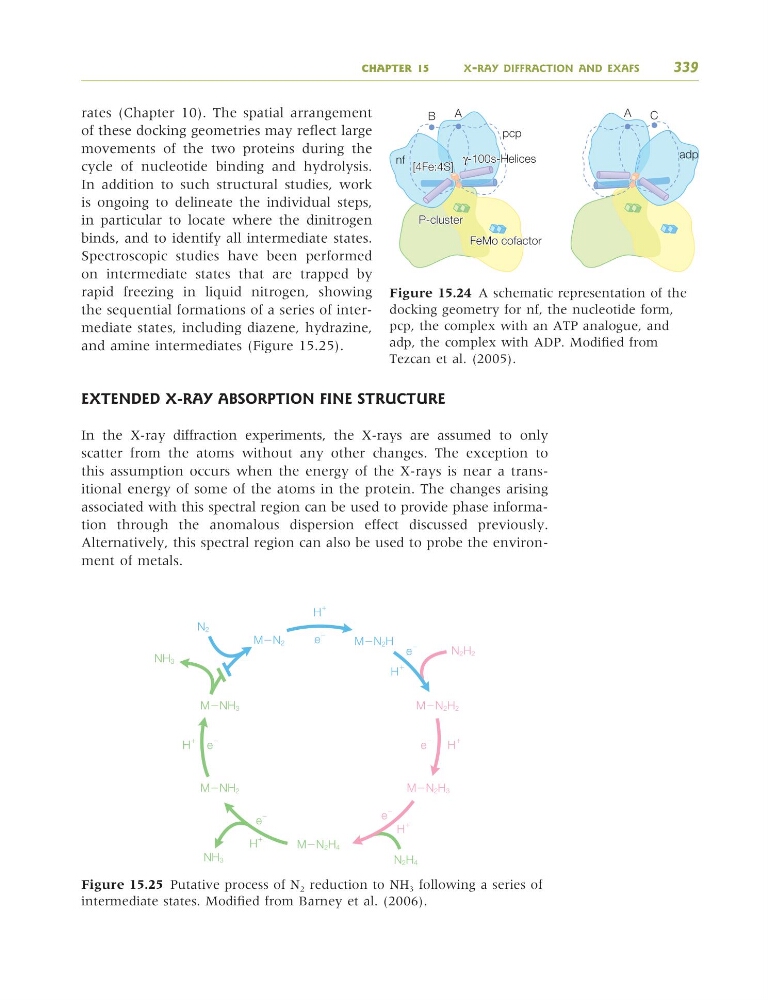
rates (Chapter 10). The spatial arrangement
of these docking geometries may reflect large
movements of the two proteins during the
cycle of nucleotide binding and hydrolysis.
In addition to such structural studies, work
is ongoing to delineate the individual steps,
in particular to locate where the dinitrogen
binds, and to identify all intermediate states.
Spectroscopic studies have been performed
on intermediate states that are trapped by
rapid freezing in liquid nitrogen, showing
the sequential formations of a series of intermediate states, including diazene, hydrazine,
and amine intermediates (Figure 15.25).
EXTENDED X-RAY ABSORPTION FINE STRUCTURE
In the X-ray diffraction experiments, the X-rays are assumed to only
scatter from the atoms without any other changes. The exception to
this assumption occurs when the energy of the X-rays is near a transitional energy of some of the atoms in the protein. The changes arising
associated with this spectral region can be used to provide phase information through the anomalous dispersion effect discussed previously.
Alternatively, this spectral region can also be used to probe the environment of metals.
Figure 15.25 Putative process of N 2 reduction to NH 3 following a series of
intermediate states. Modified from Barney et al. (2006).
MϪN2
MϪN2H
N2H2
N2H4
NH3
N2
NH3
MϪNH3
MϪNH2
MϪN2H3
MϪN2H2
MϪN2H4
H
ϩ
H
ϩ
H
ϩ
H
ϩ
H
ϩ
H
ϩ
e
Ϫ
e
Ϫ
e
Ϫ
e
Ϫ
e
Ϫ
e
Ϫ
[4Fe:4S]
B
nf
pcp
adp
[4Fe:4S]
P-cluster P-cluster
FeMo cofactor
FeMo cofactor
γ-100s-Helices γ-100s-Helices
A
A
C
Figure 15.24 A schematic representation of the
docking geometry for nf, the nucleotide form,
pcp, the complex with an ATP analogue, and
adp, the complex with ADP. Modified from
Tezcan et al. (2005).
9781405124362_4_015.qxd 4/29/08 9:13 Page 339
X-RAY DIFFRACTION AND EXAFS
339
rates (Chapter 10). The spatial arrangement
of these docking geometries may reflect large
movements of the two proteins during the
cycle of nucleotide binding and hydrolysis.
In addition to such structural studies, work
is ongoing to delineate the individual steps,
in particular to locate where the dinitrogen
binds, and to identify all intermediate states.
Spectroscopic studies have been performed
on intermediate states that are trapped by
rapid freezing in liquid nitrogen, showing
the sequential formations of a series of intermediate states, including diazene, hydrazine,
and amine intermediates (Figure 15.25).
EXTENDED X-RAY ABSORPTION FINE STRUCTURE
In the X-ray diffraction experiments, the X-rays are assumed to only
scatter from the atoms without any other changes. The exception to
this assumption occurs when the energy of the X-rays is near a transitional energy of some of the atoms in the protein. The changes arising
associated with this spectral region can be used to provide phase information through the anomalous dispersion effect discussed previously.
Alternatively, this spectral region can also be used to probe the environment of metals.
Figure 15.25 Putative process of N 2 reduction to NH 3 following a series of
intermediate states. Modified from Barney et al. (2006).
MϪN2
MϪN2H
N2H2
N2H4
NH3
N2
NH3
MϪNH3
MϪNH2
MϪN2H3
MϪN2H2
MϪN2H4
H
ϩ
H
ϩ
H
ϩ
H
ϩ
H
ϩ
H
ϩ
e
Ϫ
e
Ϫ
e
Ϫ
e
Ϫ
e
Ϫ
e
Ϫ
[4Fe:4S]
B
nf
pcp
adp
[4Fe:4S]
P-cluster P-cluster
FeMo cofactor
FeMo cofactor
γ-100s-Helices γ-100s-Helices
A
A
C
Figure 15.24 A schematic representation of the
docking geometry for nf, the nucleotide form,
pcp, the complex with an ATP analogue, and
adp, the complex with ADP. Modified from
Tezcan et al. (2005).
9781405124362_4_015.qxd 4/29/08 9:13 Page 339