

CHAPTER 15
X-RAY DIFFRACTION AND EXAFS
331
MODEL BUILDING
Once the phases have been determined
then it is possible to calculate the electron
density. The atoms present in a protein,
C, N, and O, cannot be distinguished but
rather a continuous electron density is
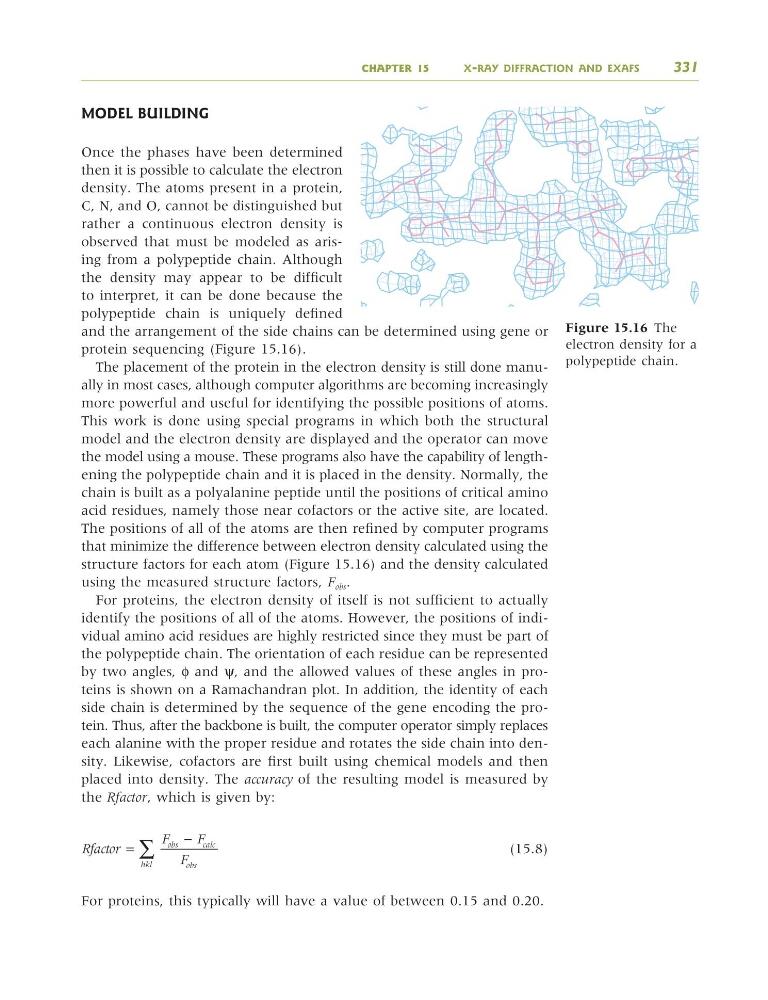
observed that must be modeled as arising from a polypeptide chain. Although
the density may appear to be difficult
to interpret, it can be done because the
polypeptide chain is uniquely defined
and the arrangement of the side chains can be determined using gene or
protein sequencing (Figure 15.16).
The placement of the protein in the electron density is still done manually in most cases, although computer algorithms are becoming increasingly
more powerful and useful for identifying the possible positions of atoms.
This work is done using special programs in which both the structural
model and the electron density are displayed and the operator can move
the model using a mouse. These programs also have the capability of lengthening the polypeptide chain and it is placed in the density. Normally, the
chain is built as a polyalanine peptide until the positions of critical amino
acid residues, namely those near cofactors or the active site, are located.
The positions of all of the atoms are then refined by computer programs
that minimize the difference between electron density calculated using the
structure factors for each atom (Figure 15.16) and the density calculated
using the measured structure factors, F obs .
For proteins, the electron density of itself is not sufficient to actually
identify the positions of all of the atoms. However, the positions of individual amino acid residues are highly restricted since they must be part of
the polypeptide chain. The orientation of each residue can be represented
by two angles, φ and ψ, and the allowed values of these angles in proteins is shown on a Ramachandran plot. In addition, the identity of each
side chain is determined by the sequence of the gene encoding the protein. Thus, after the backbone is built, the computer operator simply replaces
each alanine with the proper residue and rotates the side chain into density. Likewise, cofactors are first built using chemical models and then
placed into density. The accuracy of the resulting model is measured by
the Rfactor, which is given by:
(15.8)
For proteins, this typically will have a value of between 0.15 and 0.20.
Rfactor
F
F
F
obs
calc
obs
hkl
=
−
∑
Figure 15.16 The
electron density for a
polypeptide chain.
9781405124362_4_015.qxd 4/29/08 9:13 Page 331
X-RAY DIFFRACTION AND EXAFS
331
MODEL BUILDING
Once the phases have been determined
then it is possible to calculate the electron
density. The atoms present in a protein,
C, N, and O, cannot be distinguished but
rather a continuous electron density is
observed that must be modeled as arising from a polypeptide chain. Although
the density may appear to be difficult
to interpret, it can be done because the
polypeptide chain is uniquely defined
and the arrangement of the side chains can be determined using gene or
protein sequencing (Figure 15.16).
The placement of the protein in the electron density is still done manually in most cases, although computer algorithms are becoming increasingly
more powerful and useful for identifying the possible positions of atoms.
This work is done using special programs in which both the structural
model and the electron density are displayed and the operator can move
the model using a mouse. These programs also have the capability of lengthening the polypeptide chain and it is placed in the density. Normally, the
chain is built as a polyalanine peptide until the positions of critical amino
acid residues, namely those near cofactors or the active site, are located.
The positions of all of the atoms are then refined by computer programs
that minimize the difference between electron density calculated using the
structure factors for each atom (Figure 15.16) and the density calculated
using the measured structure factors, F obs .
For proteins, the electron density of itself is not sufficient to actually
identify the positions of all of the atoms. However, the positions of individual amino acid residues are highly restricted since they must be part of
the polypeptide chain. The orientation of each residue can be represented
by two angles, φ and ψ, and the allowed values of these angles in proteins is shown on a Ramachandran plot. In addition, the identity of each
side chain is determined by the sequence of the gene encoding the protein. Thus, after the backbone is built, the computer operator simply replaces
each alanine with the proper residue and rotates the side chain into density. Likewise, cofactors are first built using chemical models and then
placed into density. The accuracy of the resulting model is measured by
the Rfactor, which is given by:
(15.8)
For proteins, this typically will have a value of between 0.15 and 0.20.
Rfactor
F
F
F
obs
calc
obs
hkl
=
−
∑
Figure 15.16 The
electron density for a
polypeptide chain.
9781405124362_4_015.qxd 4/29/08 9:13 Page 331