

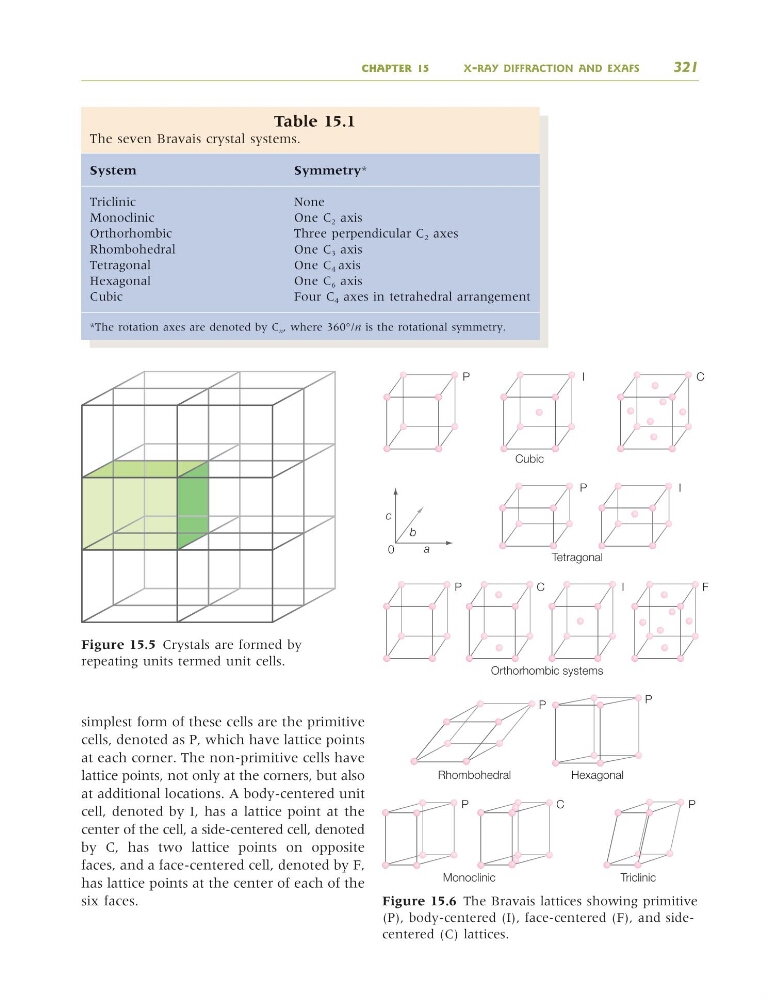
simplest form of these cells are the primitive
cells, denoted as P, which have lattice points
at each corner. The non-primitive cells have
lattice points, not only at the corners, but also
at additional locations. A body-centered unit
cell, denoted by I, has a lattice point at the
center of the cell, a side-centered cell, denoted
by C, has two lattice points on opposite
faces, and a face-centered cell, denoted by F,
has lattice points at the center of each of the
six faces.
CHAPTER 15
X-RAY DIFFRACTION AND EXAFS
321
Figure 15.5 Crystals are formed by
repeating units termed unit cells.
Rhombohedral
Hexagonal
Orthorhombic systems
Cubic
P
I
C
P
P
P
P
P
C
P
C
I
F
I
Monoclinic
Triclinic
Tetragonal
c
b
a
0
Table 15.1
The seven Bravais crystal systems.
System
Symmetry*
Triclinic
None
Monoclinic
One C 2 axis
Orthorhombic
Three perpendicular C 2 axes
Rhombohedral
One C 3 axis
Tetragonal
One C 4 axis
Hexagonal
One C 6 axis
Cubic
Four C 4 axes in tetrahedral arrangement
*The rotation axes are denoted by C n , where 360°/n is the rotational symmetry.
Figure 15.6 The Bravais lattices showing primitive
(P), body-centered (I), face-centered (F), and sidecentered (C) lattices.
9781405124362_4_015.qxd 4/29/08 9:13 Page 321
cells, denoted as P, which have lattice points
at each corner. The non-primitive cells have
lattice points, not only at the corners, but also
at additional locations. A body-centered unit
cell, denoted by I, has a lattice point at the
center of the cell, a side-centered cell, denoted
by C, has two lattice points on opposite
faces, and a face-centered cell, denoted by F,
has lattice points at the center of each of the
six faces.
CHAPTER 15
X-RAY DIFFRACTION AND EXAFS
321
Figure 15.5 Crystals are formed by
repeating units termed unit cells.
Rhombohedral
Hexagonal
Orthorhombic systems
Cubic
P
I
C
P
P
P
P
P
C
P
C
I
F
I
Monoclinic
Triclinic
Tetragonal
c
b
a
0
Table 15.1
The seven Bravais crystal systems.
System
Symmetry*
Triclinic
None
Monoclinic
One C 2 axis
Orthorhombic
Three perpendicular C 2 axes
Rhombohedral
One C 3 axis
Tetragonal
One C 4 axis
Hexagonal
One C 6 axis
Cubic
Four C 4 axes in tetrahedral arrangement
*The rotation axes are denoted by C n , where 360°/n is the rotational symmetry.
Figure 15.6 The Bravais lattices showing primitive
(P), body-centered (I), face-centered (F), and sidecentered (C) lattices.
9781405124362_4_015.qxd 4/29/08 9:13 Page 321