

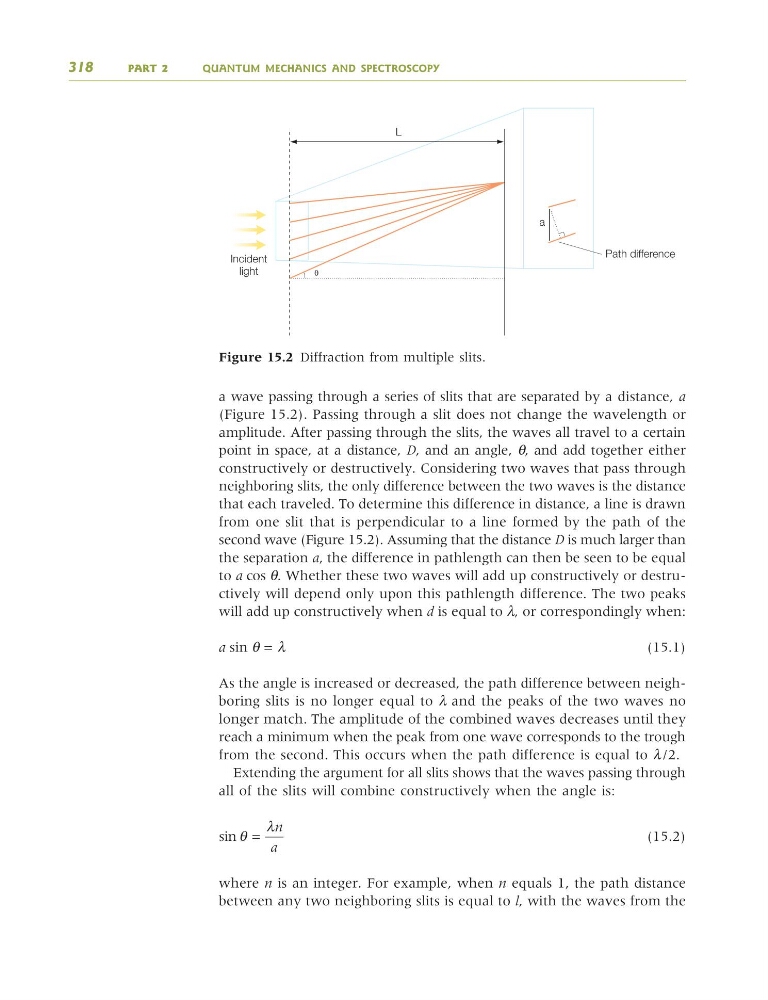
a wave passing through a series of slits that are separated by a distance, a
(Figure 15.2). Passing through a slit does not change the wavelength or
amplitude. After passing through the slits, the waves all travel to a certain
point in space, at a distance, D, and an angle, θ, and add together either
constructively or destructively. Considering two waves that pass through
neighboring slits, the only difference between the two waves is the distance
that each traveled. To determine this difference in distance, a line is drawn
from one slit that is perpendicular to a line formed by the path of the
second wave (Figure 15.2). Assuming that the distance D is much larger than
the separation a, the difference in pathlength can then be seen to be equal
to a cos θ. Whether these two waves will add up constructively or destructively will depend only upon this pathlength difference. The two peaks
will add up constructively when d is equal to λ, or correspondingly when:
a sin θ = λ
(15.1)
As the angle is increased or decreased, the path difference between neighboring slits is no longer equal to λ and the peaks of the two waves no
longer match. The amplitude of the combined waves decreases until they
reach a minimum when the peak from one wave corresponds to the trough
from the second. This occurs when the path difference is equal to λ/2.
Extending the argument for all slits shows that the waves passing through
all of the slits will combine constructively when the angle is:
(15.2)
where n is an integer. For example, when n equals 1, the path distance
between any two neighboring slits is equal to l, with the waves from the
sin θ
λ
=
n
a
Figure 15.2 Diffraction from multiple slits.
318
PART 2
QUANTUM MECHANICS AND SPECTROSCOPY
Path difference
a
Incident
light
L
θ
9781405124362_4_015.qxd 4/29/08 9:13 Page 318
(Figure 15.2). Passing through a slit does not change the wavelength or
amplitude. After passing through the slits, the waves all travel to a certain
point in space, at a distance, D, and an angle, θ, and add together either
constructively or destructively. Considering two waves that pass through
neighboring slits, the only difference between the two waves is the distance
that each traveled. To determine this difference in distance, a line is drawn
from one slit that is perpendicular to a line formed by the path of the
second wave (Figure 15.2). Assuming that the distance D is much larger than
the separation a, the difference in pathlength can then be seen to be equal
to a cos θ. Whether these two waves will add up constructively or destructively will depend only upon this pathlength difference. The two peaks
will add up constructively when d is equal to λ, or correspondingly when:
a sin θ = λ
(15.1)
As the angle is increased or decreased, the path difference between neighboring slits is no longer equal to λ and the peaks of the two waves no
longer match. The amplitude of the combined waves decreases until they
reach a minimum when the peak from one wave corresponds to the trough
from the second. This occurs when the path difference is equal to λ/2.
Extending the argument for all slits shows that the waves passing through
all of the slits will combine constructively when the angle is:
(15.2)
where n is an integer. For example, when n equals 1, the path distance
between any two neighboring slits is equal to l, with the waves from the
sin θ
λ
=
n
a
Figure 15.2 Diffraction from multiple slits.
318
PART 2
QUANTUM MECHANICS AND SPECTROSCOPY
Path difference
a
Incident
light
L
θ
9781405124362_4_015.qxd 4/29/08 9:13 Page 318