

CHAPTER 14
OPTICAL SPECTROSCOPY
293
THE BEER–LAMBERT LAW
The amount of light that is absorbed by a sample
depends upon several factors including the concentration of the absorber, c (not the speed of light
in this context), the pathlength of the sample, l, the
intensity of the incident light, I, and the intrinsic
ability of the sample to absorb light. The relationship among these parameters is given by the
Beer–Lambert law, named after the astronomer
Wilhelm Beer and the mathematician Johann
Heinrich Lambert.
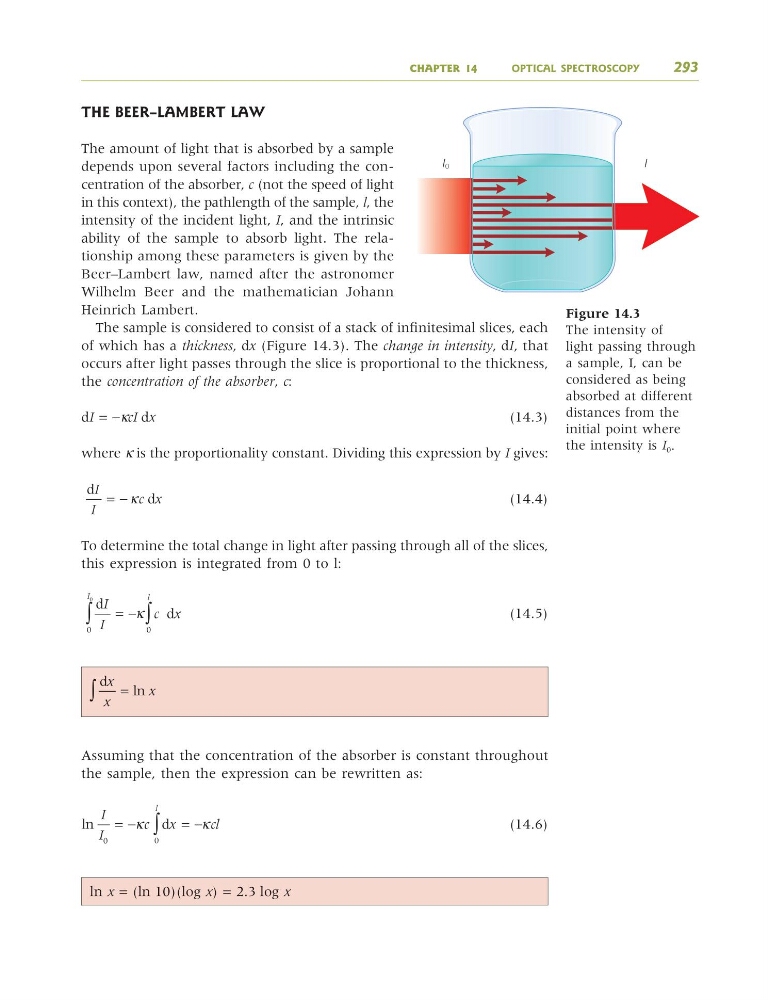
The sample is considered to consist of a stack of infinitesimal slices, each
of which has a thickness, dx (Figure 14.3). The change in intensity, dI, that
occurs after light passes through the slice is proportional to the thickness,
the concentration of the absorber, c:
dI = −κcI dx
(14.3)
where κ is the proportionality constant. Dividing this expression by I gives:
(14.4)
To determine the total change in light after passing through all of the slices,
this expression is integrated from 0 to l:
(14.5)
Assuming that the concentration of the absorber is constant throughout
the sample, then the expression can be rewritten as:
(14.6)
ln x = (ln 10)(log x) = 2.3 log x
ln
I
I
c x
cl
l
0
0
= −
= −
∫
κ
κ
d
dx
x
x
∫ = ln
d
d
I
I
c x
I
l
0
0
0
∫
∫
= −κ
d
d
I
I
c x
= − κ
I0
I
Figure 14.3
The intensity of
light passing through
a sample, I, can be
considered as being
absorbed at different
distances from the
initial point where
the intensity is I 0 .
9781405124362_4_014.qxd 4/30/08 20:26 Page 293
OPTICAL SPECTROSCOPY
293
THE BEER–LAMBERT LAW
The amount of light that is absorbed by a sample
depends upon several factors including the concentration of the absorber, c (not the speed of light
in this context), the pathlength of the sample, l, the
intensity of the incident light, I, and the intrinsic
ability of the sample to absorb light. The relationship among these parameters is given by the
Beer–Lambert law, named after the astronomer
Wilhelm Beer and the mathematician Johann
Heinrich Lambert.
The sample is considered to consist of a stack of infinitesimal slices, each
of which has a thickness, dx (Figure 14.3). The change in intensity, dI, that
occurs after light passes through the slice is proportional to the thickness,
the concentration of the absorber, c:
dI = −κcI dx
(14.3)
where κ is the proportionality constant. Dividing this expression by I gives:
(14.4)
To determine the total change in light after passing through all of the slices,
this expression is integrated from 0 to l:
(14.5)
Assuming that the concentration of the absorber is constant throughout
the sample, then the expression can be rewritten as:
(14.6)
ln x = (ln 10)(log x) = 2.3 log x
ln
I
I
c x
cl
l
0
0
= −
= −
∫
κ
κ
d
dx
x
x
∫ = ln
d
d
I
I
c x
I
l
0
0
0
∫
∫
= −κ
d
d
I
I
c x
= − κ
I0
I
Figure 14.3
The intensity of
light passing through
a sample, I, can be
considered as being
absorbed at different
distances from the
initial point where
the intensity is I 0 .
9781405124362_4_014.qxd 4/30/08 20:26 Page 293