

272
PART 2
QUANTUM MECHANICS AND SPECTROSCOPY
Operators (Table 9.1)
r → r
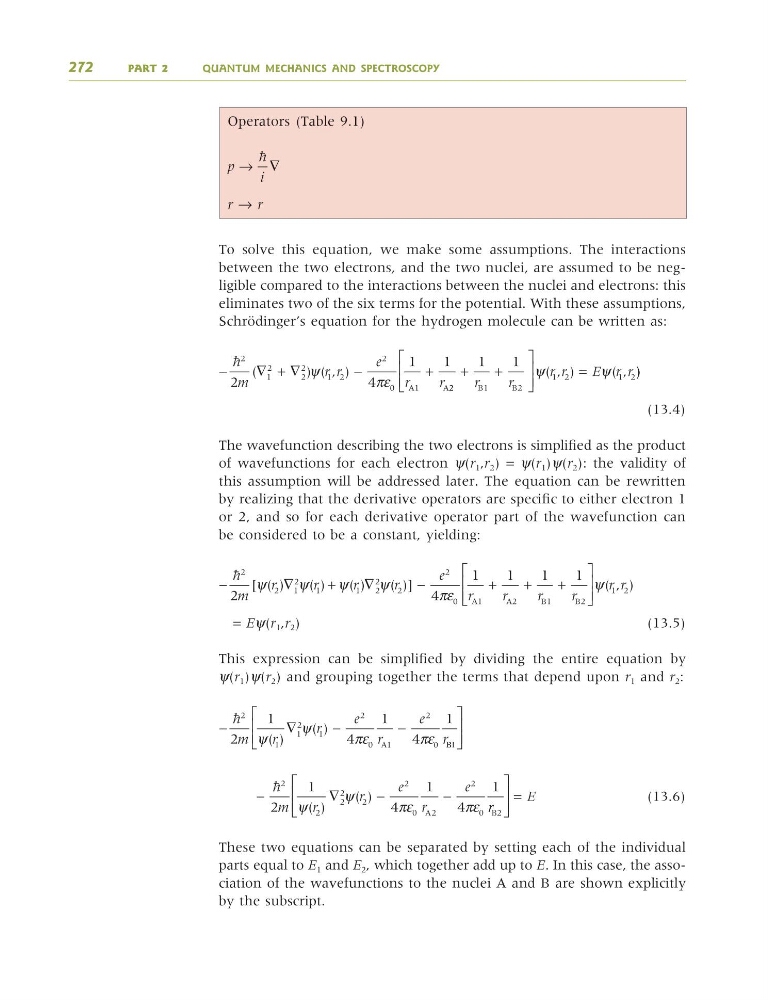
To solve this equation, we make some assumptions. The interactions
between the two electrons, and the two nuclei, are assumed to be negligible compared to the interactions between the nuclei and electrons: this
eliminates two of the six terms for the potential. With these assumptions,
Schrödinger’s equation for the hydrogen molecule can be written as:
(13.4)
The wavefunction describing the two electrons is simplified as the product
of wavefunctions for each electron ψ(r 1 ,r 2 ) = ψ(r 1 )ψ(r 2 ): the validity of
this assumption will be addressed later. The equation can be rewritten
by realizing that the derivative operators are specific to either electron 1
or 2, and so for each derivative operator part of the wavefunction can
be considered to be a constant, yielding:
= Eψ(r 1 ,r 2 )
(13.5)
This expression can be simplified by dividing the entire equation by
ψ(r 1 )ψ(r 2 ) and grouping together the terms that depend upon r 1 and r 2 :
(13.6)
These two equations can be separated by setting each of the individual
parts equal to E 1 and E 2 , which together add up to E. In this case, the association of the wavefunctions to the nuclei A and B are shown explicitly
by the subscript.
−
∇
−
−
( )
( )
Z
2
2
2
2
2
2
0
2
2
0
2
1
4
1
4
1
m
r
r
e
r
e
ψ
ψ
πε
πε
A
r r
E
B2
⎡
⎣
⎢
⎢
⎤
⎦
⎥
⎥
=
−
∇
−
−
Z
2
1
1
2
1
2
0
1
2
0
2
1
4
1
4
1
m
r
r
e
r
e
r
ψ
ψ
πε
πε
( )
( )
A
B B1
⎡
⎣
⎢
⎢
⎤
⎦
⎥
⎥
−
∇
+
∇
−
Z
2
2
1
2
1
1
2
2
2
2
0
2
4
m
r
r
r
r
e
[ ( )
( )
( )
( )]
ψ
ψ
ψ
ψ
πε
1 1
1
1
1
1 2
r
r
r
r
r r
A1
A2
B1
B2
( , )
+
+
+
⎡
⎣
⎢
⎢
⎤
⎦
⎥
⎥
ψ
−
∇ + ∇
−
+
Z
2
1
2
2
2
1 2
2
0
2
4
1
1
m
r r
e
r
r
(
) ( , )
ψ
πε A1
A2 2
B 1
B 2
( , )
( ,
+
+
⎡
⎣
⎢
⎢
⎤
⎦
⎥
⎥
=
1
1
1 2
1 2
r
r
r r
E r r
ψ
ψ
) )
p
i
→ ∇
Z
9781405124362_4_013.qxd 4/30/08 20:26 Page 272
PART 2
QUANTUM MECHANICS AND SPECTROSCOPY
Operators (Table 9.1)
r → r
To solve this equation, we make some assumptions. The interactions
between the two electrons, and the two nuclei, are assumed to be negligible compared to the interactions between the nuclei and electrons: this
eliminates two of the six terms for the potential. With these assumptions,
Schrödinger’s equation for the hydrogen molecule can be written as:
(13.4)
The wavefunction describing the two electrons is simplified as the product
of wavefunctions for each electron ψ(r 1 ,r 2 ) = ψ(r 1 )ψ(r 2 ): the validity of
this assumption will be addressed later. The equation can be rewritten
by realizing that the derivative operators are specific to either electron 1
or 2, and so for each derivative operator part of the wavefunction can
be considered to be a constant, yielding:
= Eψ(r 1 ,r 2 )
(13.5)
This expression can be simplified by dividing the entire equation by
ψ(r 1 )ψ(r 2 ) and grouping together the terms that depend upon r 1 and r 2 :
(13.6)
These two equations can be separated by setting each of the individual
parts equal to E 1 and E 2 , which together add up to E. In this case, the association of the wavefunctions to the nuclei A and B are shown explicitly
by the subscript.
−
∇
−
−
( )
( )
Z
2
2
2
2
2
2
0
2
2
0
2
1
4
1
4
1
m
r
r
e
r
e
ψ
ψ
πε
πε
A
r r
E
B2
⎡
⎣
⎢
⎢
⎤
⎦
⎥
⎥
=
−
∇
−
−
Z
2
1
1
2
1
2
0
1
2
0
2
1
4
1
4
1
m
r
r
e
r
e
r
ψ
ψ
πε
πε
( )
( )
A
B B1
⎡
⎣
⎢
⎢
⎤
⎦
⎥
⎥
−
∇
+
∇
−
Z
2
2
1
2
1
1
2
2
2
2
0
2
4
m
r
r
r
r
e
[ ( )
( )
( )
( )]
ψ
ψ
ψ
ψ
πε
1 1
1
1
1
1 2
r
r
r
r
r r
A1
A2
B1
B2
( , )
+
+
+
⎡
⎣
⎢
⎢
⎤
⎦
⎥
⎥
ψ
−
∇ + ∇
−
+
Z
2
1
2
2
2
1 2
2
0
2
4
1
1
m
r r
e
r
r
(
) ( , )
ψ
πε A1
A2 2
B 1
B 2
( , )
( ,
+
+
⎡
⎣
⎢
⎢
⎤
⎦
⎥
⎥
=
1
1
1 2
1 2
r
r
r r
E r r
ψ
ψ
) )
p
i
→ ∇
Z
9781405124362_4_013.qxd 4/30/08 20:26 Page 272