

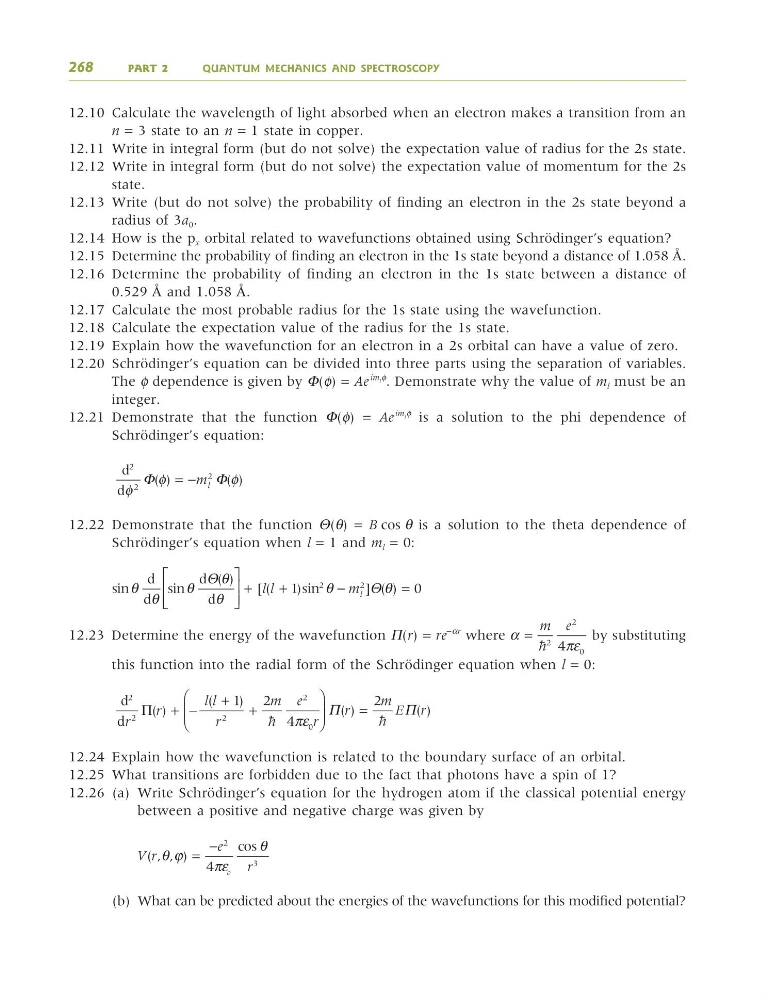
12.10 Calculate the wavelength of light absorbed when an electron makes a transition from an
n = 3 state to an n = 1 state in copper.
12.11 Write in integral form (but do not solve) the expectation value of radius for the 2s state.
12.12 Write in integral form (but do not solve) the expectation value of momentum for the 2s
state.
12.13 Write (but do not solve) the probability of finding an electron in the 2s state beyond a
radius of 3a 0 .
12.14 How is the p x orbital related to wavefunctions obtained using Schrödinger’s equation?
12.15 Determine the probability of finding an electron in the 1s state beyond a distance of 1.058 Å.
12.16 Determine the probability of finding an electron in the 1s state between a distance of
0.529 Å and 1.058 Å.
12.17 Calculate the most probable radius for the 1s state using the wavefunction.
12.18 Calculate the expectation value of the radius for the 1s state.
12.19 Explain how the wavefunction for an electron in a 2s orbital can have a value of zero.
12.20 Schrödinger’s equation can be divided into three parts using the separation of variables.
The φ dependence is given by Φ(φ) = Ae
im l φ . Demonstrate why the value of m l must be an
integer.
12.21 Demonstrate that the function Φ(φ) = Ae
im l φ is a solution to the phi dependence of
Schrödinger’s equation:
12.22 Demonstrate that the function Θ(θ) = B cos θ is a solution to the theta dependence of
Schrödinger’s equation when l = 1 and m l = 0:
12.23 Determine the energy of the wavefunction Π(r) = re
−αr where
by substituting
this function into the radial form of the Schrödinger equation when l = 0:
12.24 Explain how the wavefunction is related to the boundary surface of an orbital.
12.25 What transitions are forbidden due to the fact that photons have a spin of 1?
12.26 (a) Write Schrödinger’s equation for the hydrogen atom if the classical potential energy
between a positive and negative charge was given by
(b) What can be predicted about the energies of the wavefunctions for this modified potential?
V r
e
r
o
( , , )
cos
θ ϕ
πε
θ
=
−
2
3
4
d
d
2
2
2
2
0
1
2
4
r
r
l l
r
m e
r
Π( )
(
)
+ −
+ +
⎛
⎝
⎜ ⎜
⎞
⎠
⎟
Z πε ⎟ ⎟
=
Π
Π
( )
( )
r
m E r
2
Z
α
πε
=
m e
Z
2
2
0
4
sin
sin
( )
[ (
)sin
θ θ
θ
θ
θ
θ
d
d
d
d
Θ
⎡
⎣
⎢
⎢
⎤
⎦
⎥
⎥
+
+
l l 1
2
− −
=
m l
2
0
] ( )
Θ θ
d
d
2
2
2
φ
φ
φ
Φ
Φ
( )
( )
= −m l
268
PART 2
QUANTUM MECHANICS AND SPECTROSCOPY
9781405124362_4_012.qxd 4/29/08 9:11 Page 268
n = 3 state to an n = 1 state in copper.
12.11 Write in integral form (but do not solve) the expectation value of radius for the 2s state.
12.12 Write in integral form (but do not solve) the expectation value of momentum for the 2s
state.
12.13 Write (but do not solve) the probability of finding an electron in the 2s state beyond a
radius of 3a 0 .
12.14 How is the p x orbital related to wavefunctions obtained using Schrödinger’s equation?
12.15 Determine the probability of finding an electron in the 1s state beyond a distance of 1.058 Å.
12.16 Determine the probability of finding an electron in the 1s state between a distance of
0.529 Å and 1.058 Å.
12.17 Calculate the most probable radius for the 1s state using the wavefunction.
12.18 Calculate the expectation value of the radius for the 1s state.
12.19 Explain how the wavefunction for an electron in a 2s orbital can have a value of zero.
12.20 Schrödinger’s equation can be divided into three parts using the separation of variables.
The φ dependence is given by Φ(φ) = Ae
im l φ . Demonstrate why the value of m l must be an
integer.
12.21 Demonstrate that the function Φ(φ) = Ae
im l φ is a solution to the phi dependence of
Schrödinger’s equation:
12.22 Demonstrate that the function Θ(θ) = B cos θ is a solution to the theta dependence of
Schrödinger’s equation when l = 1 and m l = 0:
12.23 Determine the energy of the wavefunction Π(r) = re
−αr where
by substituting
this function into the radial form of the Schrödinger equation when l = 0:
12.24 Explain how the wavefunction is related to the boundary surface of an orbital.
12.25 What transitions are forbidden due to the fact that photons have a spin of 1?
12.26 (a) Write Schrödinger’s equation for the hydrogen atom if the classical potential energy
between a positive and negative charge was given by
(b) What can be predicted about the energies of the wavefunctions for this modified potential?
V r
e
r
o
( , , )
cos
θ ϕ
πε
θ
=
−
2
3
4
d
d
2
2
2
2
0
1
2
4
r
r
l l
r
m e
r
Π( )
(
)
+ −
+ +
⎛
⎝
⎜ ⎜
⎞
⎠
⎟
Z πε ⎟ ⎟
=
Π
Π
( )
( )
r
m E r
2
Z
α
πε
=
m e
Z
2
2
0
4
sin
sin
( )
[ (
)sin
θ θ
θ
θ
θ
θ
d
d
d
d
Θ
⎡
⎣
⎢
⎢
⎤
⎦
⎥
⎥
+
+
l l 1
2
− −
=
m l
2
0
] ( )
Θ θ
d
d
2
2
2
φ
φ
φ
Φ
Φ
( )
( )
= −m l
268
PART 2
QUANTUM MECHANICS AND SPECTROSCOPY
9781405124362_4_012.qxd 4/29/08 9:11 Page 268