

motion is termed spin–orbit coupling. One expression of the coupling
makes use of the total angular momentum of the system, N, which is the
vector sum of the contributions from the spin, P, and the orbital angular
momentum, O:
Total angular momentum N = O + P
(12.64)
The total angular momentum can be described using the quantum numbers
j and m j , where j = l + 1/2 or j = l − 1/2 (the spin angular momentum is
either aligned or opposite to the orbital angular momentum). For the s
orbitals, l = 0 and the total angular momentum is simply the spin angular
momentum. For the p orbitals, l = 1 and the total angular momentum is
either 3/2 or 1/2. In this case, the energies of the two states are different
as the j = 1/2 state, with the two moments in opposite directions, will
have a lower energy than the j = 3/2 state, with the two moments aligned.
This splitting gives rise to what is termed fine structure in atomic emission
spectra. The splitting of the 2p
1 state allows two distinct transitions to the
2s state and a corresponding two lines in spectrum, which are very close.
For example, sodium has lines at 589.16 and 589.76 nm.
PERIODIC TABLE
We are now in a position to understand how quantum mechanics
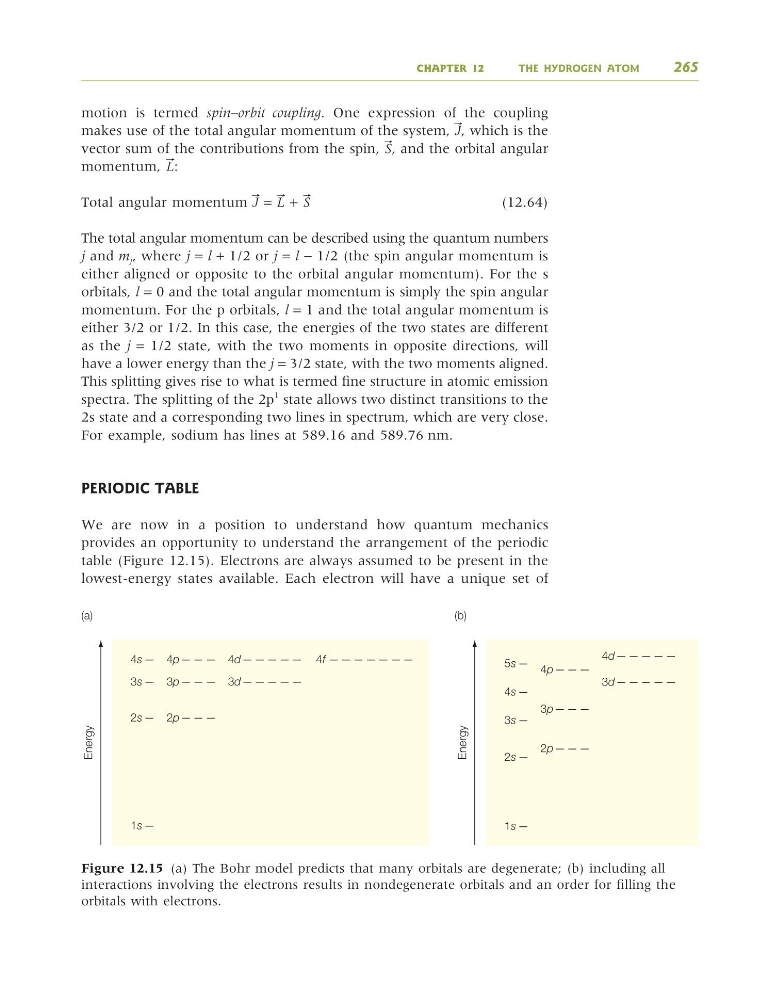
provides an opportunity to understand the arrangement of the periodic
table (Figure 12.15). Electrons are always assumed to be present in the
lowest-energy states available. Each electron will have a unique set of
Figure 12.15 (a) The Bohr model predicts that many orbitals are degenerate; (b) including all
interactions involving the electrons results in nondegenerate orbitals and an order for filling the
orbitals with electrons.
CHAPTER 12
THE HYDROGEN ATOM
265
4f
4d
3d
4p
3p
2p
4s
3s
2s
1s
(a)
Energy
4d
3d
4p
3p
2p
5s
4s
3s
2s
1s
(b)
Energy
9781405124362_4_012.qxd 4/29/08 9:11 Page 265
makes use of the total angular momentum of the system, N, which is the
vector sum of the contributions from the spin, P, and the orbital angular
momentum, O:
Total angular momentum N = O + P
(12.64)
The total angular momentum can be described using the quantum numbers
j and m j , where j = l + 1/2 or j = l − 1/2 (the spin angular momentum is
either aligned or opposite to the orbital angular momentum). For the s
orbitals, l = 0 and the total angular momentum is simply the spin angular
momentum. For the p orbitals, l = 1 and the total angular momentum is
either 3/2 or 1/2. In this case, the energies of the two states are different
as the j = 1/2 state, with the two moments in opposite directions, will
have a lower energy than the j = 3/2 state, with the two moments aligned.
This splitting gives rise to what is termed fine structure in atomic emission
spectra. The splitting of the 2p
1 state allows two distinct transitions to the
2s state and a corresponding two lines in spectrum, which are very close.
For example, sodium has lines at 589.16 and 589.76 nm.
PERIODIC TABLE
We are now in a position to understand how quantum mechanics
provides an opportunity to understand the arrangement of the periodic
table (Figure 12.15). Electrons are always assumed to be present in the
lowest-energy states available. Each electron will have a unique set of
Figure 12.15 (a) The Bohr model predicts that many orbitals are degenerate; (b) including all
interactions involving the electrons results in nondegenerate orbitals and an order for filling the
orbitals with electrons.
CHAPTER 12
THE HYDROGEN ATOM
265
4f
4d
3d
4p
3p
2p
4s
3s
2s
1s
(a)
Energy
4d
3d
4p
3p
2p
5s
4s
3s
2s
1s
(b)
Energy
9781405124362_4_012.qxd 4/29/08 9:11 Page 265