

determine the total spin and z projection of spin according to the relationships:
(12.40)
Electrons, protons, and neutrons all have a fixed value s
of 1/2, yielding a total spin of
. The allowed values
of the z projection are restricted to m s equal to +1/2 and
−1/2, corresponding to spin values of ±Z/2. Despite its
name, this property does not represent a spinning motion
of the electrons and, despite the differences in the masses
of electrons and protons, their spin values are equal. This
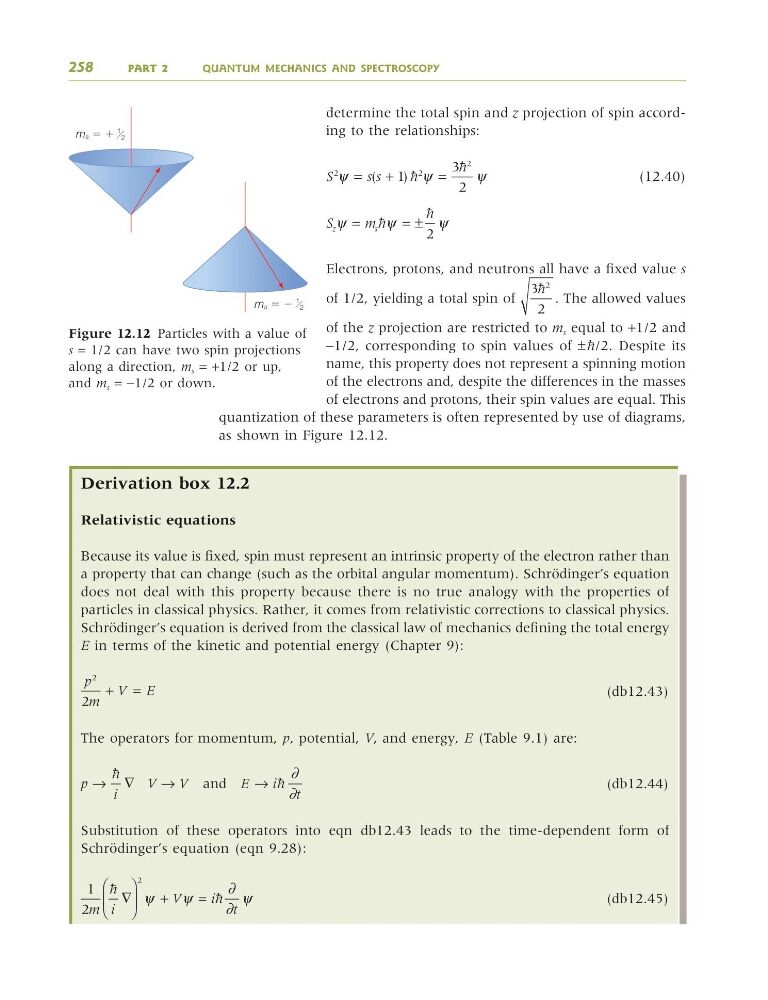
quantization of these parameters is often represented by use of diagrams,
as shown in Figure 12.12.
3
2
2
Z
S
m
z
s
ψ
ψ
ψ
=
=±
Z
Z
2
S
ss
2
2
2
1
3
2
ψ
ψ
ψ
(
)
=
+
=
Z
Z
258
PART 2
QUANTUM MECHANICS AND SPECTROSCOPY
ms ϭ ϩ
1
2
ms ϭ Ϫ
1
2
Figure 12.12 Particles with a value of
s = 1/2 can have two spin projections
along a direction, m s = +1/2 or up,
and m s = −1/2 or down.
Derivation box 12.2
Relativistic equations
Because its value is fixed, spin must represent an intrinsic property of the electron rather than
a property that can change (such as the orbital angular momentum). Schrödinger’s equation
does not deal with this property because there is no true analogy with the properties of
particles in classical physics. Rather, it comes from relativistic corrections to classical physics.
Schrödinger’s equation is derived from the classical law of mechanics defining the total energy
E in terms of the kinetic and potential energy (Chapter 9):
(db12.43)
The operators for momentum, p, potential, V, and energy, E (Table 9.1) are:
(db12.44)
Substitution of these operators into eqn db12.43 leads to the time-dependent form of
Schrödinger’s equation (eqn 9.28):
(db12.45)
1
2
2
m i
V
i
t
Z
Z
∇
⎛
⎝
⎜ ⎜
⎞
⎠
⎟ ⎟
+
=
ψ
ψ
∂
∂
ψ
p
i
V
V
E
i
t
→ ∇
→
→
Z
Z
and
∂
∂
p
m
V E
2
2
+ =
9781405124362_4_012.qxd 4/30/08 20:25 Page 258
(12.40)
Electrons, protons, and neutrons all have a fixed value s
of 1/2, yielding a total spin of
. The allowed values
of the z projection are restricted to m s equal to +1/2 and
−1/2, corresponding to spin values of ±Z/2. Despite its
name, this property does not represent a spinning motion
of the electrons and, despite the differences in the masses
of electrons and protons, their spin values are equal. This
quantization of these parameters is often represented by use of diagrams,
as shown in Figure 12.12.
3
2
2
Z
S
m
z
s
ψ
ψ
ψ
=
=±
Z
Z
2
S
ss
2
2
2
1
3
2
ψ
ψ
ψ
(
)
=
+
=
Z
Z
258
PART 2
QUANTUM MECHANICS AND SPECTROSCOPY
ms ϭ ϩ
1
2
ms ϭ Ϫ
1
2
Figure 12.12 Particles with a value of
s = 1/2 can have two spin projections
along a direction, m s = +1/2 or up,
and m s = −1/2 or down.
Derivation box 12.2
Relativistic equations
Because its value is fixed, spin must represent an intrinsic property of the electron rather than
a property that can change (such as the orbital angular momentum). Schrödinger’s equation
does not deal with this property because there is no true analogy with the properties of
particles in classical physics. Rather, it comes from relativistic corrections to classical physics.
Schrödinger’s equation is derived from the classical law of mechanics defining the total energy
E in terms of the kinetic and potential energy (Chapter 9):
(db12.43)
The operators for momentum, p, potential, V, and energy, E (Table 9.1) are:
(db12.44)
Substitution of these operators into eqn db12.43 leads to the time-dependent form of
Schrödinger’s equation (eqn 9.28):
(db12.45)
1
2
2
m i
V
i
t
Z
Z
∇
⎛
⎝
⎜ ⎜
⎞
⎠
⎟ ⎟
+
=
ψ
ψ
∂
∂
ψ
p
i
V
V
E
i
t
→ ∇
→
→
Z
Z
and
∂
∂
p
m
V E
2
2
+ =
9781405124362_4_012.qxd 4/30/08 20:25 Page 258