

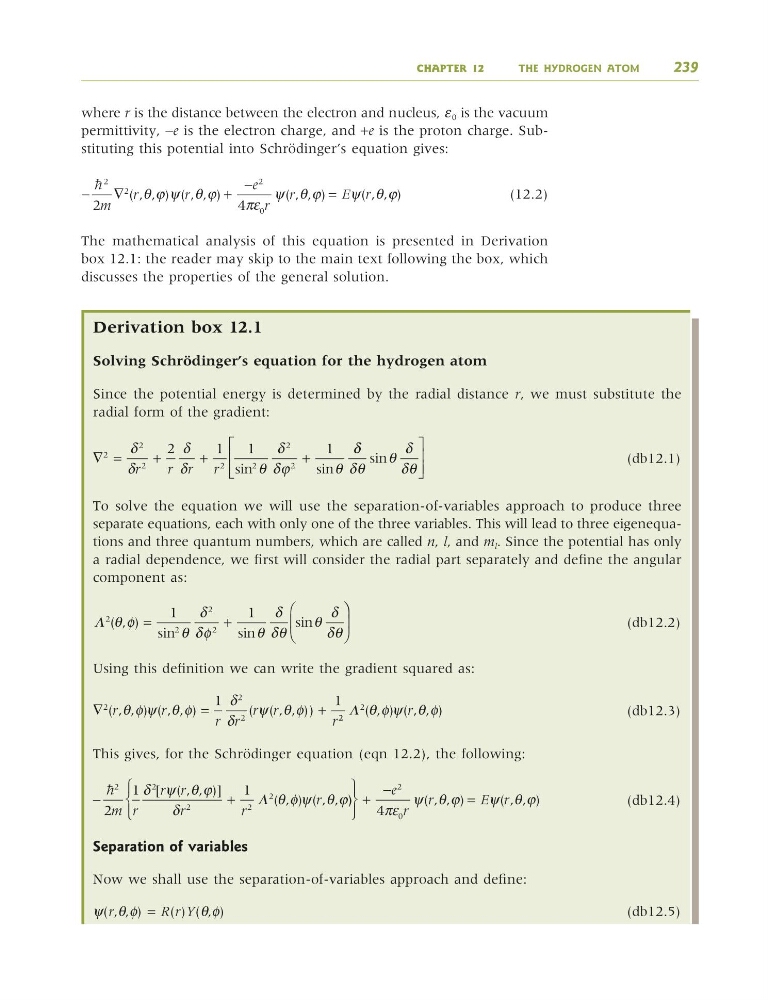
where r is the distance between the electron and nucleus, ε 0 is the vacuum
permittivity, −e is the electron charge, and +e is the proton charge. Substituting this potential into Schrödinger’s equation gives:
(12.2)
The mathematical analysis of this equation is presented in Derivation
box 12.1: the reader may skip to the main text following the box, which
discusses the properties of the general solution.
−
∇
+
−
=
Z
2
2
2
0
2
4
m
r
r
e
r
r
( , , ) ( , , )
( , , )
θ ϕ ψ θ ϕ
πε
ψ θ ϕ
( , , )
E r
ψ θ ϕ
CHAPTER 12
THE HYDROGEN ATOM
239
Derivation box 12.1
Solving Schrödinger’s equation for the hydrogen atom
Since the potential energy is determined by the radial distance r, we must substitute the
radial form of the gradient:
(db12.1)
To solve the equation we will use the separation-of-variables approach to produce three
separate equations, each with only one of the three variables. This will lead to three eigenequations and three quantum numbers, which are called n, l, and m l . Since the potential has only
a radial dependence, we first will consider the radial part separately and define the angular
component as:
(db12.2)
Using this definition we can write the gradient squared as:
(db12.3)
This gives, for the Schrödinger equation (eqn 12.2), the following:
(db12.4)
Separation of variables
Now we shall use the separation-of-variables approach and define:
ψ(r,θ,φ) = R(r)Y(θ,φ)
(db12.5)
−
+
Z
2
2
2
2
2
2
1
1
m r
r r
r
r
r
δ ψ θ ϕ
δ
θ φ ψ θ ϕ
[ ( , , )]
( , ) ( , ,
Λ
) )
( , , )
( , , )
⎧
⎨
⎪
⎩ ⎪
⎫
⎬
⎪
⎭ ⎪
+
−
=
e
r
r
E r
2
0
4πε
ψ θ ϕ
ψ θ ϕ
∇
=
+
2
2
2
1
1
( , , ) ( , , )
( ( , , ))
r
r
r r
r r
r
θ φ ψ θ φ
δ
δ
ψ θ φ
2 2
2
Λ ( , ) ( , , )
θ φ ψ θ φ
r
Λ
2
2
2
2
1
1
( , )
sin
sin
sin
θ φ
θ
δ
δφ
θ
δ
δθ
θ
δ
δθ
=
+
⎛
⎝
⎜ ⎜
⎞ ⎞
⎠
⎟ ⎟
∇ =
+
+
+
2
2
2
2
2
2
2
2
1
1
1
sin
sin
δ
δ
δ
δ
θ
δ
δϕ
θ
r
r r r
δ δ
δθ
θ
δ
δθ
sin
⎡
⎣
⎢
⎢
⎤
⎦
⎥
⎥
9781405124362_4_012.qxd 4/30/08 20:24 Page 239
permittivity, −e is the electron charge, and +e is the proton charge. Substituting this potential into Schrödinger’s equation gives:
(12.2)
The mathematical analysis of this equation is presented in Derivation
box 12.1: the reader may skip to the main text following the box, which
discusses the properties of the general solution.
−
∇
+
−
=
Z
2
2
2
0
2
4
m
r
r
e
r
r
( , , ) ( , , )
( , , )
θ ϕ ψ θ ϕ
πε
ψ θ ϕ
( , , )
E r
ψ θ ϕ
CHAPTER 12
THE HYDROGEN ATOM
239
Derivation box 12.1
Solving Schrödinger’s equation for the hydrogen atom
Since the potential energy is determined by the radial distance r, we must substitute the
radial form of the gradient:
(db12.1)
To solve the equation we will use the separation-of-variables approach to produce three
separate equations, each with only one of the three variables. This will lead to three eigenequations and three quantum numbers, which are called n, l, and m l . Since the potential has only
a radial dependence, we first will consider the radial part separately and define the angular
component as:
(db12.2)
Using this definition we can write the gradient squared as:
(db12.3)
This gives, for the Schrödinger equation (eqn 12.2), the following:
(db12.4)
Separation of variables
Now we shall use the separation-of-variables approach and define:
ψ(r,θ,φ) = R(r)Y(θ,φ)
(db12.5)
−
+
Z
2
2
2
2
2
2
1
1
m r
r r
r
r
r
δ ψ θ ϕ
δ
θ φ ψ θ ϕ
[ ( , , )]
( , ) ( , ,
Λ
) )
( , , )
( , , )
⎧
⎨
⎪
⎩ ⎪
⎫
⎬
⎪
⎭ ⎪
+
−
=
e
r
r
E r
2
0
4πε
ψ θ ϕ
ψ θ ϕ
∇
=
+
2
2
2
1
1
( , , ) ( , , )
( ( , , ))
r
r
r r
r r
r
θ φ ψ θ φ
δ
δ
ψ θ φ
2 2
2
Λ ( , ) ( , , )
θ φ ψ θ φ
r
Λ
2
2
2
2
1
1
( , )
sin
sin
sin
θ φ
θ
δ
δφ
θ
δ
δθ
θ
δ
δθ
=
+
⎛
⎝
⎜ ⎜
⎞ ⎞
⎠
⎟ ⎟
∇ =
+
+
+
2
2
2
2
2
2
2
2
1
1
1
sin
sin
δ
δ
δ
δ
θ
δ
δϕ
θ
r
r r r
δ δ
δθ
θ
δ
δθ
sin
⎡
⎣
⎢
⎢
⎤
⎦
⎥
⎥
9781405124362_4_012.qxd 4/30/08 20:24 Page 239