

temperature increases, the average motion of each air molecule increases.
The increase in speed of each molecule results in a decrease in the average time that it takes for a gas molecule to escape the balloon. Thus, the
temperature increase leads to a decrease in the average number of gas molecules at a microscopic level.
Gas mixtures
In the ideal gas model, the precise nature of the gas molecules does not
influence the properties of the gas. Thus, the properties of gases that are
mixtures of two different types of gas molecules can be predicted, as was
first realized based upon a series of experiments by John Dalton in the early
nineteenth century. The basic idea is that since the properties of the individual gas molecules do not matter and the gas molecules are considered
not to interact with each other except through collisions, the properties
of the mixture are determined by the additive contribution of each gas
molecule. Any given type of gas molecule, which we can identify as the
ith type, is considered to have a certain partial pressure P i that corresponds
to the pressure the gas would create if it were alone in the container. For
a container with a volume V, the ith type of gas has a certain number of
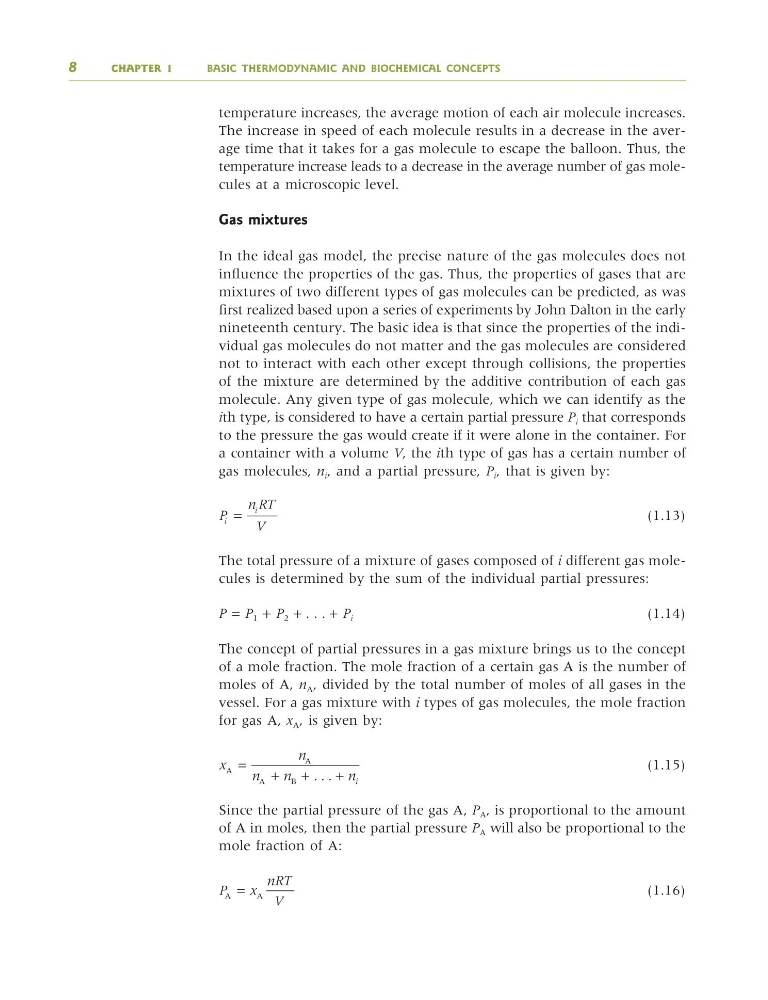
gas molecules, n i , and a partial pressure, P i , that is given by:
(1.13)
The total pressure of a mixture of gases composed of i different gas molecules is determined by the sum of the individual partial pressures:
P = P 1 + P 2 + . . . + P i
(1.14)
The concept of partial pressures in a gas mixture brings us to the concept
of a mole fraction. The mole fraction of a certain gas A is the number of
moles of A, n A , divided by the total number of moles of all gases in the
vessel. For a gas mixture with i types of gas molecules, the mole fraction
for gas A, x A , is given by:
(1.15)
Since the partial pressure of the gas A, P A , is proportional to the amount
of A in moles, then the partial pressure P A will also be proportional to the
mole fraction of A:
(1.16)
P
x
nRT
V
A
A
=
x
n
n
n
n i
A
A
A
B
. . .
=
+
+
+
P
n RT
V
i
i
=
8
CHAPTER 1
BASIC THERMODYNAMIC AND BIOCHEMICAL CONCEPTS
9781405124362_4_001.qxd 4/29/08 9:07 Page 8
The increase in speed of each molecule results in a decrease in the average time that it takes for a gas molecule to escape the balloon. Thus, the
temperature increase leads to a decrease in the average number of gas molecules at a microscopic level.
Gas mixtures
In the ideal gas model, the precise nature of the gas molecules does not
influence the properties of the gas. Thus, the properties of gases that are
mixtures of two different types of gas molecules can be predicted, as was
first realized based upon a series of experiments by John Dalton in the early
nineteenth century. The basic idea is that since the properties of the individual gas molecules do not matter and the gas molecules are considered
not to interact with each other except through collisions, the properties
of the mixture are determined by the additive contribution of each gas
molecule. Any given type of gas molecule, which we can identify as the
ith type, is considered to have a certain partial pressure P i that corresponds
to the pressure the gas would create if it were alone in the container. For
a container with a volume V, the ith type of gas has a certain number of
gas molecules, n i , and a partial pressure, P i , that is given by:
(1.13)
The total pressure of a mixture of gases composed of i different gas molecules is determined by the sum of the individual partial pressures:
P = P 1 + P 2 + . . . + P i
(1.14)
The concept of partial pressures in a gas mixture brings us to the concept
of a mole fraction. The mole fraction of a certain gas A is the number of
moles of A, n A , divided by the total number of moles of all gases in the
vessel. For a gas mixture with i types of gas molecules, the mole fraction
for gas A, x A , is given by:
(1.15)
Since the partial pressure of the gas A, P A , is proportional to the amount
of A in moles, then the partial pressure P A will also be proportional to the
mole fraction of A:
(1.16)
P
x
nRT
V
A
A
=
x
n
n
n
n i
A
A
A
B
. . .
=
+
+
+
P
n RT
V
i
i
=
8
CHAPTER 1
BASIC THERMODYNAMIC AND BIOCHEMICAL CONCEPTS
9781405124362_4_001.qxd 4/29/08 9:07 Page 8