

into Schrödinger’s equation, yielding
(11.11)
As shown above, this second-order differential equation is called the
Hermite equation and has solutions of the form:
ψ 9 (y) = N 9 H 9 e
−y 2 /2
(11.12)
where
(11.13)
N 9 is the normalization constant and is different for each term. It is equal to:
(11.14)
where 9! is the factorial term:
9! = 9(9 − 1)(9 − 2)(9 − 3) . . . (1)
(11.15)
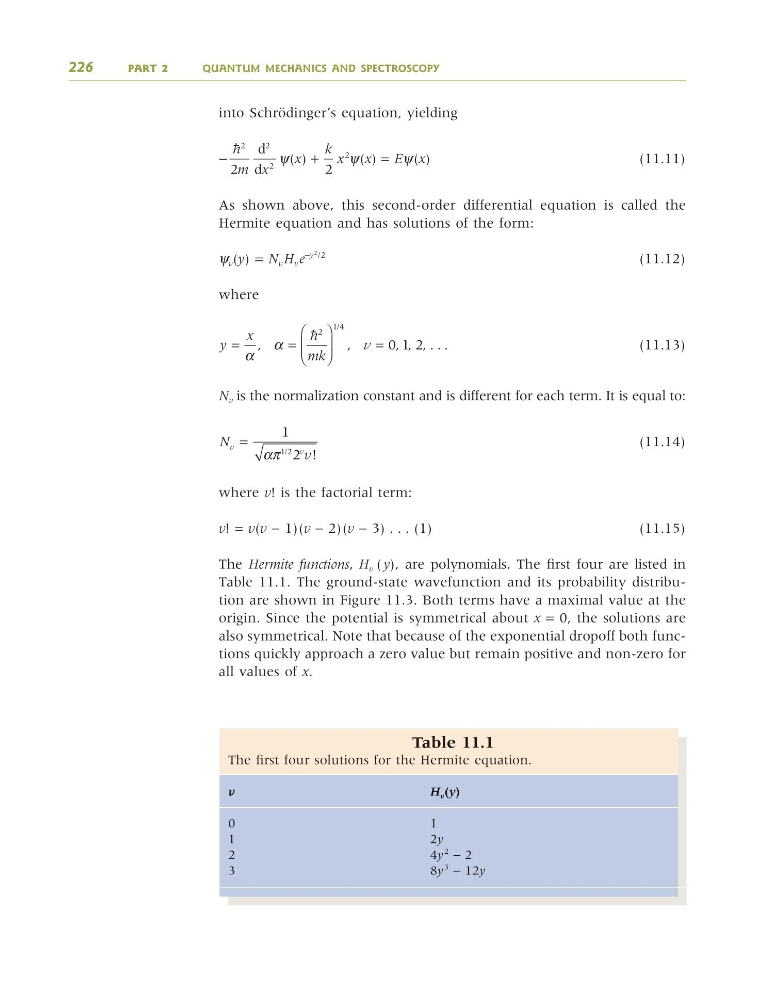
The Hermite functions, H 9 ( y), are polynomials. The first four are listed in
Table 11.1. The ground-state wavefunction and its probability distribution are shown in Figure 11.3. Both terms have a maximal value at the
origin. Since the potential is symmetrical about x = 0, the solutions are
also symmetrical. Note that because of the exponential dropoff both functions quickly approach a zero value but remain positive and non-zero for
all values of x.
N 9
9 !
/
=
1
2
1 2
απ
9
y
x
mk
,
,
, , , . .
/
=
=
⎛
⎝
⎜ ⎜
⎞
⎠
⎟ ⎟
=
α
α
Z
2
1 4
0 1 2
9
.
−
+
=
Z
2
2
2
2
2
2
m x
x
k x x
E x
d
d
ψ
ψ
ψ
( )
( )
( )
226
PART 2
QUANTUM MECHANICS AND SPECTROSCOPY
Table 11.1
The first four solutions for the Hermite equation.
0
H 0 (y)
0
1
1
2 y
2
4 y
2 − 2
3
8 y
3 − 12y
9781405124362_4_011.qxd 4/29/08 9:11 Page 226
(11.11)
As shown above, this second-order differential equation is called the
Hermite equation and has solutions of the form:
ψ 9 (y) = N 9 H 9 e
−y 2 /2
(11.12)
where
(11.13)
N 9 is the normalization constant and is different for each term. It is equal to:
(11.14)
where 9! is the factorial term:
9! = 9(9 − 1)(9 − 2)(9 − 3) . . . (1)
(11.15)
The Hermite functions, H 9 ( y), are polynomials. The first four are listed in
Table 11.1. The ground-state wavefunction and its probability distribution are shown in Figure 11.3. Both terms have a maximal value at the
origin. Since the potential is symmetrical about x = 0, the solutions are
also symmetrical. Note that because of the exponential dropoff both functions quickly approach a zero value but remain positive and non-zero for
all values of x.
N 9
9 !
/
=
1
2
1 2
απ
9
y
x
mk
,
,
, , , . .
/
=
=
⎛
⎝
⎜ ⎜
⎞
⎠
⎟ ⎟
=
α
α
Z
2
1 4
0 1 2
9
.
−
+
=
Z
2
2
2
2
2
2
m x
x
k x x
E x
d
d
ψ
ψ
ψ
( )
( )
( )
226
PART 2
QUANTUM MECHANICS AND SPECTROSCOPY
Table 11.1
The first four solutions for the Hermite equation.
0
H 0 (y)
0
1
1
2 y
2
4 y
2 − 2
3
8 y
3 − 12y
9781405124362_4_011.qxd 4/29/08 9:11 Page 226