

Note that the second derivate of x yields x multiplied by a constant.
Substituting this into eqn 11.3 yields:
(11.7)
So the mass oscillates with a frequency ω that is equal to the square root
of the spring constant divided by the mass. The frequency will be slower
for stiffer springs or for larger masses.
Potential energy for the simple harmonic oscillator
To solve Schrödinger’s equation for this problem, we must first determine
the classical expression for the potential energy, V. Classically, for a given
force, the potential energy is given by the integral of the force over the
displacement:
(11.8)
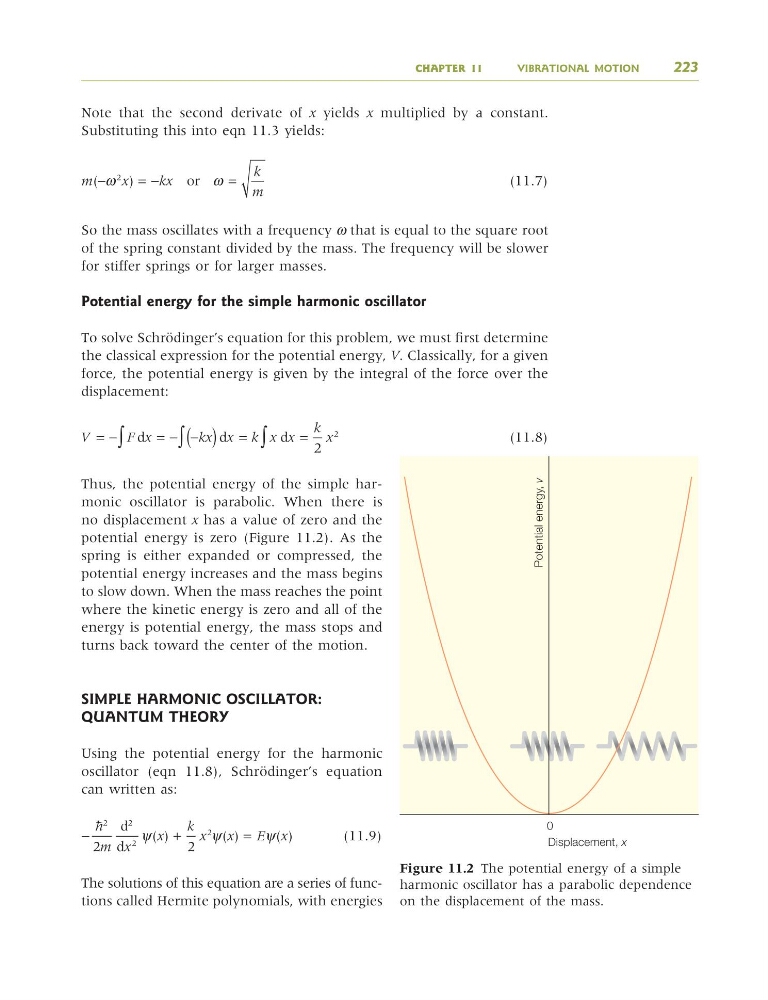
Thus, the potential energy of the simple harmonic oscillator is parabolic. When there is
no displacement x has a value of zero and the
potential energy is zero (Figure 11.2). As the
spring is either expanded or compressed, the
potential energy increases and the mass begins
to slow down. When the mass reaches the point
where the kinetic energy is zero and all of the
energy is potential energy, the mass stops and
turns back toward the center of the motion.
SIMPLE HARMONIC OSCILLATOR:
QUANTUM THEORY
Using the potential energy for the harmonic
oscillator (eqn 11.8), Schrödinger’s equation
can written as:
(11.9)
The solutions of this equation are a series of functions called Hermite polynomials, with energies
−
+
=
Z
2
2
2
2
2
2
m x
x
k x x
E x
d
d
ψ
ψ
ψ
( )
( )
( )
V
F x
kx x k x x
k x
= −
= − −
( ) =
=
∫
∫
∫
d
d
d
2
2
m
x
kx
k
m
(
)
−
= −
=
ω
ω
2
or
CHAPTER 11
VIBRATIONAL MOTION
223
0
Displacement, x
Potential energy, v
Figure 11.2 The potential energy of a simple
harmonic oscillator has a parabolic dependence
on the displacement of the mass.
9781405124362_4_011.qxd 4/29/08 9:11 Page 223
Substituting this into eqn 11.3 yields:
(11.7)
So the mass oscillates with a frequency ω that is equal to the square root
of the spring constant divided by the mass. The frequency will be slower
for stiffer springs or for larger masses.
Potential energy for the simple harmonic oscillator
To solve Schrödinger’s equation for this problem, we must first determine
the classical expression for the potential energy, V. Classically, for a given
force, the potential energy is given by the integral of the force over the
displacement:
(11.8)
Thus, the potential energy of the simple harmonic oscillator is parabolic. When there is
no displacement x has a value of zero and the
potential energy is zero (Figure 11.2). As the
spring is either expanded or compressed, the
potential energy increases and the mass begins
to slow down. When the mass reaches the point
where the kinetic energy is zero and all of the
energy is potential energy, the mass stops and
turns back toward the center of the motion.
SIMPLE HARMONIC OSCILLATOR:
QUANTUM THEORY
Using the potential energy for the harmonic
oscillator (eqn 11.8), Schrödinger’s equation
can written as:
(11.9)
The solutions of this equation are a series of functions called Hermite polynomials, with energies
−
+
=
Z
2
2
2
2
2
2
m x
x
k x x
E x
d
d
ψ
ψ
ψ
( )
( )
( )
V
F x
kx x k x x
k x
= −
= − −
( ) =
=
∫
∫
∫
d
d
d
2
2
m
x
kx
k
m
(
)
−
= −
=
ω
ω
2
or
CHAPTER 11
VIBRATIONAL MOTION
223
0
Displacement, x
Potential energy, v
Figure 11.2 The potential energy of a simple
harmonic oscillator has a parabolic dependence
on the displacement of the mass.
9781405124362_4_011.qxd 4/29/08 9:11 Page 223