

(a) Write the boundary conditions for the problem.
(b) Write Schrödinger’s equation for the problem.
(c) Write the general solution to the problem.
10.15 Write Schrödinger’s equation for a three-dimensional cubic box with a length l.
10.16 Explain the basic experimental observation of nonphotochemical quenching. How is this
process coupled to a change in carotenoids?
10.17 What is the structural difference between zeaxanthin and violaxanthin? How can this structural difference contribute to nonphotochemical quenching?
10.18 What is tunneling? How does tunneling depend upon experimental parameters?
10.19 What is STM?
10.20 What is AFM?
10.21 Give an example of how STM or AFM can be used for a biological sample.
10.22 A protein has one electron donor but two identical electron acceptors. The distance between
each acceptor and the donor is the same but significantly different electron-transfer rates
are measured between the donor and acceptor in each case. Explain this rate difference
using Marcus theory.
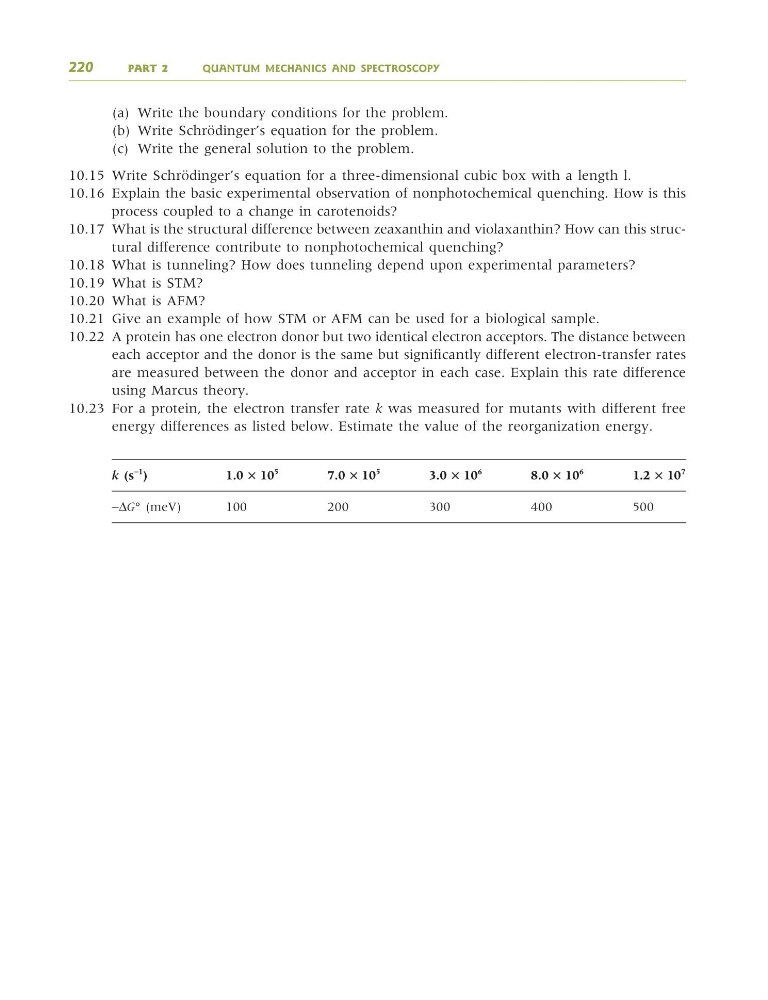
10.23 For a protein, the electron transfer rate k was measured for mutants with different free
energy differences as listed below. Estimate the value of the reorganization energy.
k (s
− −1
)
1.0 × × 10
5
7.0 × × 10
5
3.0 × × 10
6
8.0 × × 10
6
1.2 × × 10
7
−ΔG° (meV)
100
200
300
400
500
220
PART 2
QUANTUM MECHANICS AND SPECTROSCOPY
9781405124362_4_010.qxd 4/29/08 13:09 Page 220
(b) Write Schrödinger’s equation for the problem.
(c) Write the general solution to the problem.
10.15 Write Schrödinger’s equation for a three-dimensional cubic box with a length l.
10.16 Explain the basic experimental observation of nonphotochemical quenching. How is this
process coupled to a change in carotenoids?
10.17 What is the structural difference between zeaxanthin and violaxanthin? How can this structural difference contribute to nonphotochemical quenching?
10.18 What is tunneling? How does tunneling depend upon experimental parameters?
10.19 What is STM?
10.20 What is AFM?
10.21 Give an example of how STM or AFM can be used for a biological sample.
10.22 A protein has one electron donor but two identical electron acceptors. The distance between
each acceptor and the donor is the same but significantly different electron-transfer rates
are measured between the donor and acceptor in each case. Explain this rate difference
using Marcus theory.
10.23 For a protein, the electron transfer rate k was measured for mutants with different free
energy differences as listed below. Estimate the value of the reorganization energy.
k (s
− −1
)
1.0 × × 10
5
7.0 × × 10
5
3.0 × × 10
6
8.0 × × 10
6
1.2 × × 10
7
−ΔG° (meV)
100
200
300
400
500
220
PART 2
QUANTUM MECHANICS AND SPECTROSCOPY
9781405124362_4_010.qxd 4/29/08 13:09 Page 220