

In practice, this transition is not observed because it is forbidden as we have
not yet considered factors that influence the strength of the transition,
such as symmetry (Chapter 14).
Carotenoids have several essential functions in photosynthetic organisms.
This calculation is useful for understanding how the length of a carotenoid
would influence its absorption spectrum. However, to understand the role
of carotenoids in the conversion of light into chemical energy requires a
detailed analysis of the electronic structure. For example, during the afternoon on a sunny day, the amount of sunlight available is in significant excess
and plants dispose of the excess light by a process called nonphotochemical
quenching (see below). One role of carotenoids in plants is to help avoid
over-excitation of the photosynthetic system by dissipating energy when
light levels are very high (Deming-Adams 1990; Kulheim et al. 2002; Li
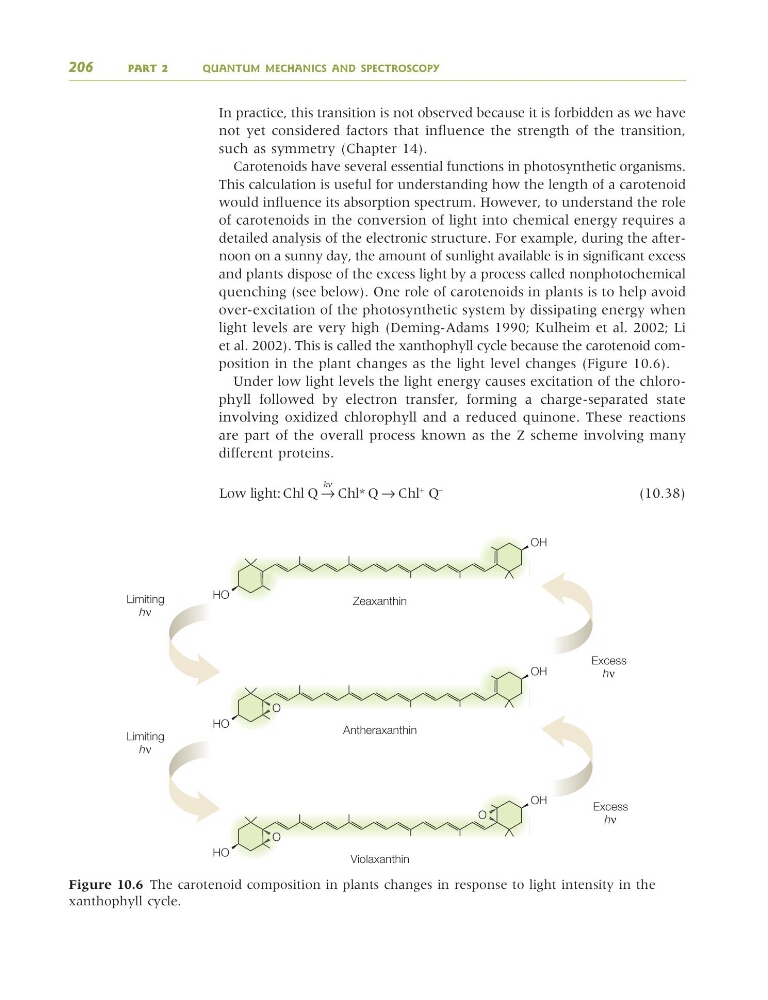
et al. 2002). This is called the xanthophyll cycle because the carotenoid composition in the plant changes as the light level changes (Figure 10.6).
Under low light levels the light energy causes excitation of the chlorophyll followed by electron transfer, forming a charge-separated state
involving oxidized chlorophyll and a reduced quinone. These reactions
are part of the overall process known as the Z scheme involving many
different proteins.
(10.38)
Low light: Chl Q Chl* Q Chl Q
→
→
+
−
hν
206
PART 2
QUANTUM MECHANICS AND SPECTROSCOPY
HO
Zeaxanthin
Limiting
hν
Limiting
hν
Excess
hν
Excess
hν
OH
HO
Antheraxanthin
O
OH
HO
Violaxanthin
O
O
OH
Figure 10.6 The carotenoid composition in plants changes in response to light intensity in the
xanthophyll cycle.
9781405124362_4_010.qxd 4/29/08 13:09 Page 206
not yet considered factors that influence the strength of the transition,
such as symmetry (Chapter 14).
Carotenoids have several essential functions in photosynthetic organisms.
This calculation is useful for understanding how the length of a carotenoid
would influence its absorption spectrum. However, to understand the role
of carotenoids in the conversion of light into chemical energy requires a
detailed analysis of the electronic structure. For example, during the afternoon on a sunny day, the amount of sunlight available is in significant excess
and plants dispose of the excess light by a process called nonphotochemical
quenching (see below). One role of carotenoids in plants is to help avoid
over-excitation of the photosynthetic system by dissipating energy when
light levels are very high (Deming-Adams 1990; Kulheim et al. 2002; Li
et al. 2002). This is called the xanthophyll cycle because the carotenoid composition in the plant changes as the light level changes (Figure 10.6).
Under low light levels the light energy causes excitation of the chlorophyll followed by electron transfer, forming a charge-separated state
involving oxidized chlorophyll and a reduced quinone. These reactions
are part of the overall process known as the Z scheme involving many
different proteins.
(10.38)
Low light: Chl Q Chl* Q Chl Q
→
→
+
−
hν
206
PART 2
QUANTUM MECHANICS AND SPECTROSCOPY
HO
Zeaxanthin
Limiting
hν
Limiting
hν
Excess
hν
Excess
hν
OH
HO
Antheraxanthin
O
OH
HO
Violaxanthin
O
O
OH
Figure 10.6 The carotenoid composition in plants changes in response to light intensity in the
xanthophyll cycle.
9781405124362_4_010.qxd 4/29/08 13:09 Page 206