

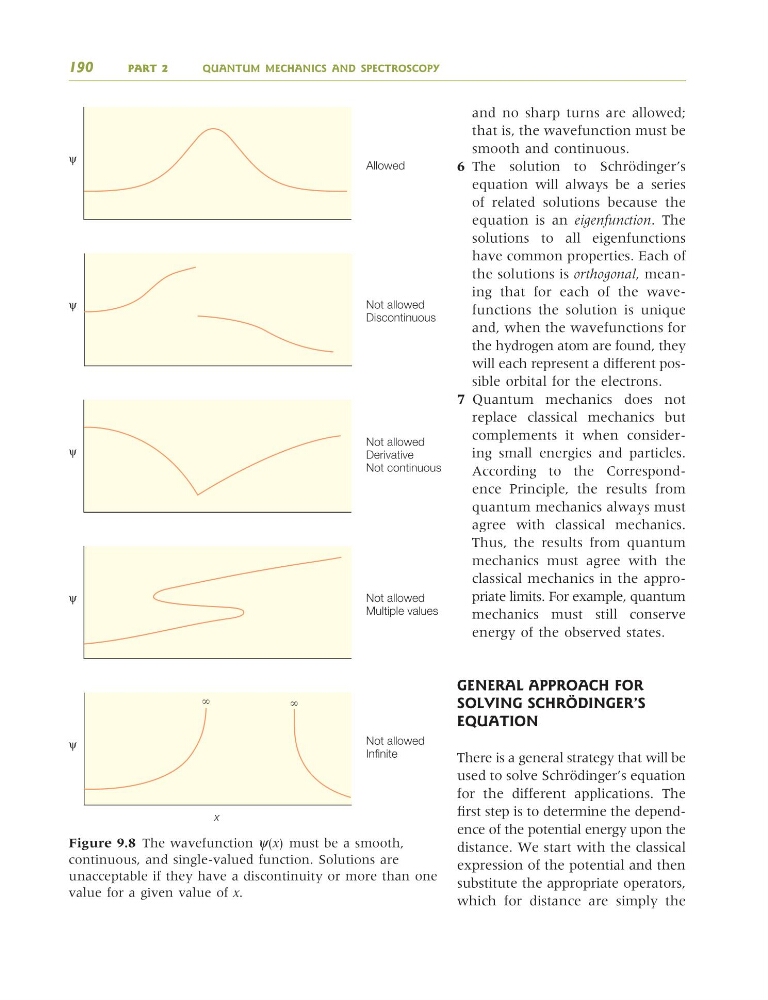
and no sharp turns are allowed;
that is, the wavefunction must be
smooth and continuous.
6 The solution to Schrödinger’s
equation will always be a series
of related solutions because the
equation is an eigenfunction. The
solutions to all eigenfunctions
have common properties. Each of
the solutions is orthogonal, meaning that for each of the wavefunctions the solution is unique
and, when the wavefunctions for
the hydrogen atom are found, they
will each represent a different possible orbital for the electrons.
7 Quantum mechanics does not
replace classical mechanics but
complements it when considering small energies and particles.
According to the Correspondence Principle, the results from
quantum mechanics always must
agree with classical mechanics.
Thus, the results from quantum
mechanics must agree with the
classical mechanics in the appropriate limits. For example, quantum
mechanics must still conserve
energy of the observed states.
GENERAL APPROACH FOR
SOLVING SCHRÖDINGER’S
EQUATION
There is a general strategy that will be
used to solve Schrödinger’s equation
for the different applications. The
first step is to determine the dependence of the potential energy upon the
distance. We start with the classical
expression of the potential and then
substitute the appropriate operators,
which for distance are simply the
190
PART 2
QUANTUM MECHANICS AND SPECTROSCOPY
Not allowed
Discontinuous
Not allowed
Derivative
Not continuous
Not allowed
Multiple values
Not allowed
Infinite
x
ϱ
ϱ
ψ
Allowed
ψ
ψ
ψ
ψ
Figure 9.8 The wavefunction ψ(x) must be a smooth,
continuous, and single-valued function. Solutions are
unacceptable if they have a discontinuity or more than one
value for a given value of x.
9781405124362_4_009.qxd 4/29/08 10:42 Page 190
that is, the wavefunction must be
smooth and continuous.
6 The solution to Schrödinger’s
equation will always be a series
of related solutions because the
equation is an eigenfunction. The
solutions to all eigenfunctions
have common properties. Each of
the solutions is orthogonal, meaning that for each of the wavefunctions the solution is unique
and, when the wavefunctions for
the hydrogen atom are found, they
will each represent a different possible orbital for the electrons.
7 Quantum mechanics does not
replace classical mechanics but
complements it when considering small energies and particles.
According to the Correspondence Principle, the results from
quantum mechanics always must
agree with classical mechanics.
Thus, the results from quantum
mechanics must agree with the
classical mechanics in the appropriate limits. For example, quantum
mechanics must still conserve
energy of the observed states.
GENERAL APPROACH FOR
SOLVING SCHRÖDINGER’S
EQUATION
There is a general strategy that will be
used to solve Schrödinger’s equation
for the different applications. The
first step is to determine the dependence of the potential energy upon the
distance. We start with the classical
expression of the potential and then
substitute the appropriate operators,
which for distance are simply the
190
PART 2
QUANTUM MECHANICS AND SPECTROSCOPY
Not allowed
Discontinuous
Not allowed
Derivative
Not continuous
Not allowed
Multiple values
Not allowed
Infinite
x
ϱ
ϱ
ψ
Allowed
ψ
ψ
ψ
ψ
Figure 9.8 The wavefunction ψ(x) must be a smooth,
continuous, and single-valued function. Solutions are
unacceptable if they have a discontinuity or more than one
value for a given value of x.
9781405124362_4_009.qxd 4/29/08 10:42 Page 190