

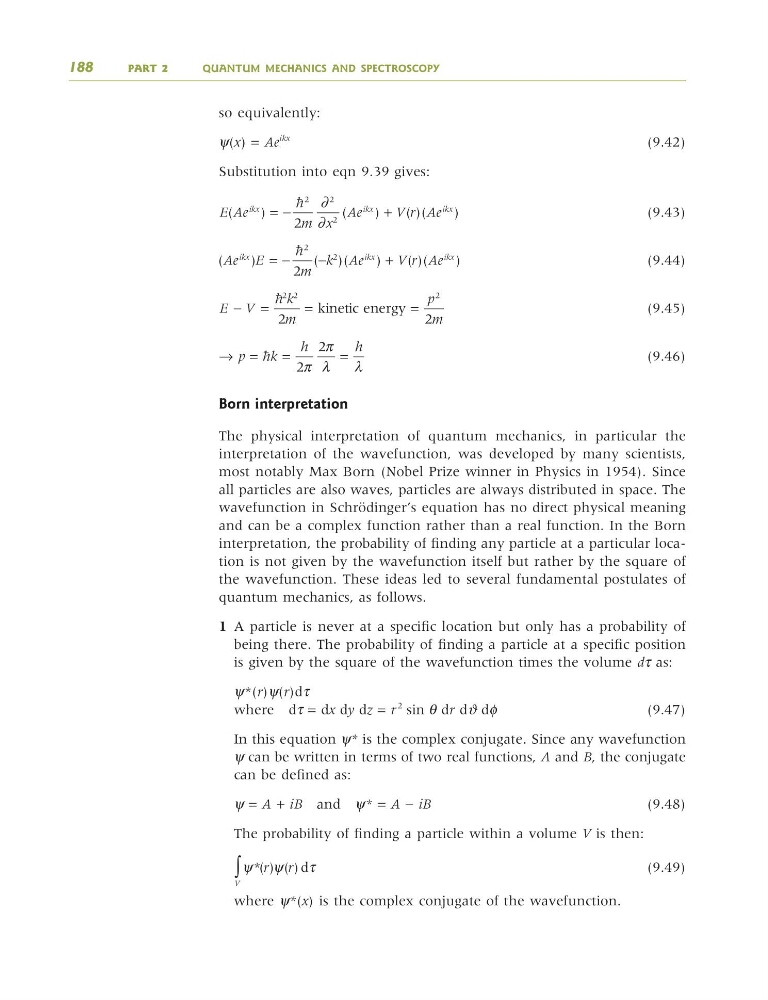
so equivalently:
ψ(x) = Ae
ikx
(9.42)
Substitution into eqn 9.39 gives:
(9.43)
(9.44)
(9.45)
(9.46)
Born interpretation
The physical interpretation of quantum mechanics, in particular the
interpretation of the wavefunction, was developed by many scientists,
most notably Max Born (Nobel Prize winner in Physics in 1954). Since
all particles are also waves, particles are always distributed in space. The
wavefunction in Schrödinger’s equation has no direct physical meaning
and can be a complex function rather than a real function. In the Born
interpretation, the probability of finding any particle at a particular location is not given by the wavefunction itself but rather by the square of
the wavefunction. These ideas led to several fundamental postulates of
quantum mechanics, as follows.
1 A particle is never at a specific location but only has a probability of
being there. The probability of finding a particle at a specific position
is given by the square of the wavefunction times the volume dτ as:
ψ*(r)ψ(r)dτ
where dτ = dx dy dz = r
2 sin θ dr dϑ dφ
(9.47)
In this equation ψ* is the complex conjugate. Since any wavefunction
ψ can be written in terms of two real functions, A and B, the conjugate
can be defined as:
ψ = A + iB and ψ* = A − iB
(9.48)
The probability of finding a particle within a volume V is then:
(9.49)
where ψ*(x) is the complex conjugate of the wavefunction.
ψ ψ
τ
*
d
( ) ( )
r r
V
∫
→ =
=
=
p
k
h
h
Z
2
2
π
π
λ
λ
E V
k
m
p
m
− =
=
=
Z
2 2
2
2
2
kinetic energy
(
)
( )(
)
( )(
)
Ae E
m
k Ae
V r Ae
ikx
ikx
ikx
= −
−
+
Z
2
2
2
E Ae
m x
Ae
V r Ae
ikx
ikx
ikx
(
)
(
)
( )(
)
= −
+
Z
2
2
2
2
∂
∂
188
PART 2
QUANTUM MECHANICS AND SPECTROSCOPY
9781405124362_4_009.qxd 4/29/08 10:42 Page 188
ψ(x) = Ae
ikx
(9.42)
Substitution into eqn 9.39 gives:
(9.43)
(9.44)
(9.45)
(9.46)
Born interpretation
The physical interpretation of quantum mechanics, in particular the
interpretation of the wavefunction, was developed by many scientists,
most notably Max Born (Nobel Prize winner in Physics in 1954). Since
all particles are also waves, particles are always distributed in space. The
wavefunction in Schrödinger’s equation has no direct physical meaning
and can be a complex function rather than a real function. In the Born
interpretation, the probability of finding any particle at a particular location is not given by the wavefunction itself but rather by the square of
the wavefunction. These ideas led to several fundamental postulates of
quantum mechanics, as follows.
1 A particle is never at a specific location but only has a probability of
being there. The probability of finding a particle at a specific position
is given by the square of the wavefunction times the volume dτ as:
ψ*(r)ψ(r)dτ
where dτ = dx dy dz = r
2 sin θ dr dϑ dφ
(9.47)
In this equation ψ* is the complex conjugate. Since any wavefunction
ψ can be written in terms of two real functions, A and B, the conjugate
can be defined as:
ψ = A + iB and ψ* = A − iB
(9.48)
The probability of finding a particle within a volume V is then:
(9.49)
where ψ*(x) is the complex conjugate of the wavefunction.
ψ ψ
τ
*
d
( ) ( )
r r
V
∫
→ =
=
=
p
k
h
h
Z
2
2
π
π
λ
λ
E V
k
m
p
m
− =
=
=
Z
2 2
2
2
2
kinetic energy
(
)
( )(
)
( )(
)
Ae E
m
k Ae
V r Ae
ikx
ikx
ikx
= −
−
+
Z
2
2
2
E Ae
m x
Ae
V r Ae
ikx
ikx
ikx
(
)
(
)
( )(
)
= −
+
Z
2
2
2
2
∂
∂
188
PART 2
QUANTUM MECHANICS AND SPECTROSCOPY
9781405124362_4_009.qxd 4/29/08 10:42 Page 188