

with a factor of iZ. Since the wavefunctions usually involve more than
one dimension, for example, x, y, and z for a three-dimensional problem,
the derivatives are written as partial derivatives rather than full derivatives.
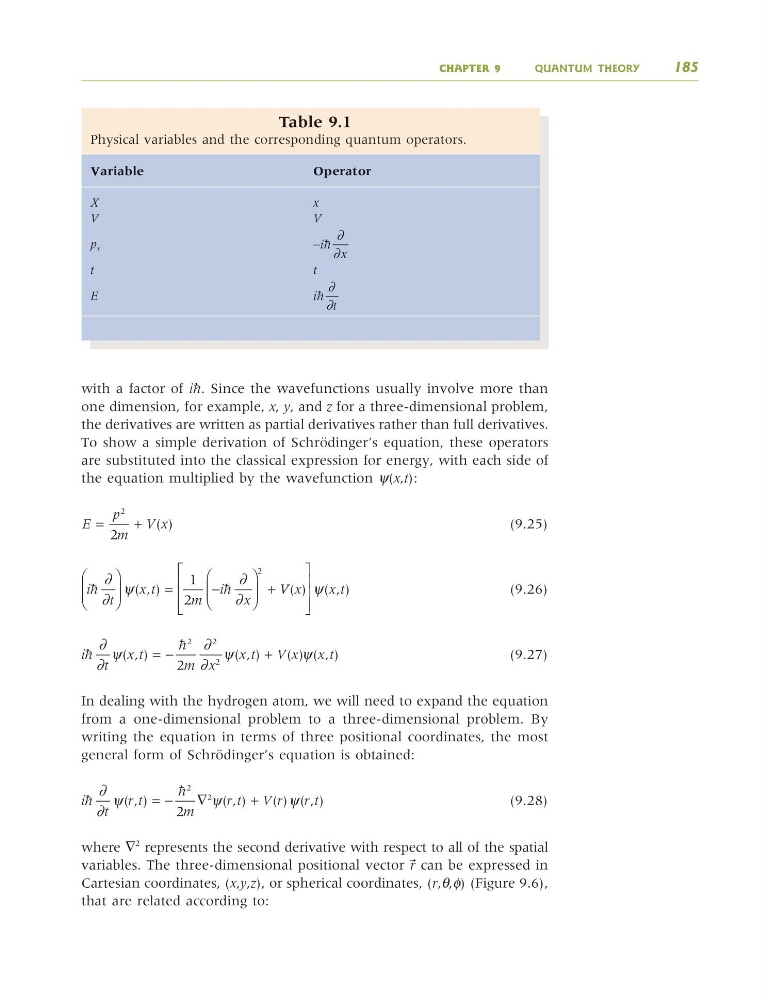
To show a simple derivation of Schrödinger’s equation, these operators
are substituted into the classical expression for energy, with each side of
the equation multiplied by the wavefunction ψ(x,t):
(9.25)
(9.26)
(9.27)
In dealing with the hydrogen atom, we will need to expand the equation
from a one-dimensional problem to a three-dimensional problem. By
writing the equation in terms of three positional coordinates, the most
general form of Schrödinger’s equation is obtained:
(9.28)
where ∇
2 represents the second derivative with respect to all of the spatial
variables. The three-dimensional positional vector J can be expressed in
Cartesian coordinates, (x,y,z), or spherical coordinates, (r,θ,φ) (Figure 9.6),
that are related according to:
i
t
r t
m
r t
V r
r t
Z
Z
∂
∂
ψ
ψ
ψ
( , )
( , )
( ) ( , )
= −
∇
+
2
2
2
i
t
x t
m x
x t
V x x t
Z
Z
∂
∂
ψ
∂
∂
ψ
ψ
( , )
( , )
( ) ( , )
= −
+
2
2
2
2
i
t
x t
m
i
x
Z
Z
∂
∂
ψ
∂
∂
⎛
⎝
⎜ ⎜
⎞
⎠
⎟ ⎟
=
−
⎛
⎝
⎜ ⎜
⎞
⎠
⎟ ⎟ +
( , )
1
2
2
V V x
x t
( ) ( , )
⎡
⎣
⎢
⎢
⎢
⎤
⎦
⎥
⎥
⎥
ψ
E
p
m
V x
( )
=
+
2
2
CHAPTER 9
QUANTUM THEORY
185
Table 9.1
Physical variables and the corresponding quantum operators.
Variable
Operator
X
x
V
V
p x
t
t
E
i
t
Z
∂
∂
−i
x
Z
∂
∂
9781405124362_4_009.qxd 4/30/08 19:31 Page 185
one dimension, for example, x, y, and z for a three-dimensional problem,
the derivatives are written as partial derivatives rather than full derivatives.
To show a simple derivation of Schrödinger’s equation, these operators
are substituted into the classical expression for energy, with each side of
the equation multiplied by the wavefunction ψ(x,t):
(9.25)
(9.26)
(9.27)
In dealing with the hydrogen atom, we will need to expand the equation
from a one-dimensional problem to a three-dimensional problem. By
writing the equation in terms of three positional coordinates, the most
general form of Schrödinger’s equation is obtained:
(9.28)
where ∇
2 represents the second derivative with respect to all of the spatial
variables. The three-dimensional positional vector J can be expressed in
Cartesian coordinates, (x,y,z), or spherical coordinates, (r,θ,φ) (Figure 9.6),
that are related according to:
i
t
r t
m
r t
V r
r t
Z
Z
∂
∂
ψ
ψ
ψ
( , )
( , )
( ) ( , )
= −
∇
+
2
2
2
i
t
x t
m x
x t
V x x t
Z
Z
∂
∂
ψ
∂
∂
ψ
ψ
( , )
( , )
( ) ( , )
= −
+
2
2
2
2
i
t
x t
m
i
x
Z
Z
∂
∂
ψ
∂
∂
⎛
⎝
⎜ ⎜
⎞
⎠
⎟ ⎟
=
−
⎛
⎝
⎜ ⎜
⎞
⎠
⎟ ⎟ +
( , )
1
2
2
V V x
x t
( ) ( , )
⎡
⎣
⎢
⎢
⎢
⎤
⎦
⎥
⎥
⎥
ψ
E
p
m
V x
( )
=
+
2
2
CHAPTER 9
QUANTUM THEORY
185
Table 9.1
Physical variables and the corresponding quantum operators.
Variable
Operator
X
x
V
V
p x
t
t
E
i
t
Z
∂
∂
−i
x
Z
∂
∂
9781405124362_4_009.qxd 4/30/08 19:31 Page 185