

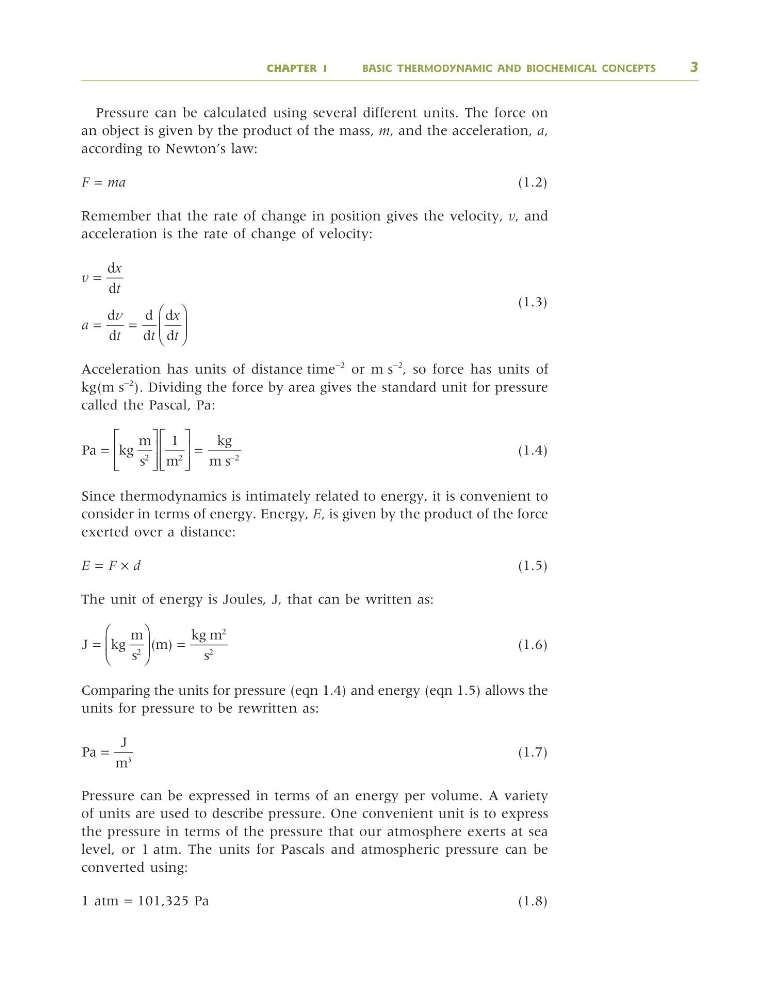
Pressure can be calculated using several different units. The force on
an object is given by the product of the mass, m, and the acceleration, a,
according to Newton’s law:
F = ma
(1.2)
Remember that the rate of change in position gives the velocity, 9, and
acceleration is the rate of change of velocity:
(1.3)
Acceleration has units of distance time
−2 or m s
−2
, so force has units of
kg(m s
−2
). Dividing the force by area gives the standard unit for pressure
called the Pascal, Pa:
(1.4)
Since thermodynamics is intimately related to energy, it is convenient to
consider in terms of energy. Energy, E, is given by the product of the force
exerted over a distance:
E = F × d
(1.5)
The unit of energy is Joules, J, that can be written as:
(1.6)
Comparing the units for pressure (eqn 1.4) and energy (eqn 1.5) allows the
units for pressure to be rewritten as:
(1.7)
Pressure can be expressed in terms of an energy per volume. A variety
of units are used to describe pressure. One convenient unit is to express
the pressure in terms of the pressure that our atmosphere exerts at sea
level, or 1 atm. The units for Pascals and atmospheric pressure can be
converted using:
1 atm = 101,325 Pa
(1.8)
Pa
J
m
= 3
J
kg
m
s
m
kg m
s
( )
=
⎛
⎝
⎜ ⎜
⎞
⎠
⎟ ⎟
=
2
2
2
Pa
kg
m
s m
kg
m s
=
⎡
⎣
⎢
⎢
⎤
⎦
⎥
⎥
⎡
⎣
⎢
⎢
⎤
⎦
⎥
⎥
=
−
2
2
2
1
a
t
t
x
t
=
=
⎛
⎝
⎜ ⎜
⎞
⎠
⎟ ⎟
d
d
d
d
d
d
9
9 =
d
d
x
t
CHAPTER 1
BASIC THERMODYNAMIC AND BIOCHEMICAL CONCEPTS
3
9781405124362_4_001.qxd 4/29/08 9:07 Page 3
an object is given by the product of the mass, m, and the acceleration, a,
according to Newton’s law:
F = ma
(1.2)
Remember that the rate of change in position gives the velocity, 9, and
acceleration is the rate of change of velocity:
(1.3)
Acceleration has units of distance time
−2 or m s
−2
, so force has units of
kg(m s
−2
). Dividing the force by area gives the standard unit for pressure
called the Pascal, Pa:
(1.4)
Since thermodynamics is intimately related to energy, it is convenient to
consider in terms of energy. Energy, E, is given by the product of the force
exerted over a distance:
E = F × d
(1.5)
The unit of energy is Joules, J, that can be written as:
(1.6)
Comparing the units for pressure (eqn 1.4) and energy (eqn 1.5) allows the
units for pressure to be rewritten as:
(1.7)
Pressure can be expressed in terms of an energy per volume. A variety
of units are used to describe pressure. One convenient unit is to express
the pressure in terms of the pressure that our atmosphere exerts at sea
level, or 1 atm. The units for Pascals and atmospheric pressure can be
converted using:
1 atm = 101,325 Pa
(1.8)
Pa
J
m
= 3
J
kg
m
s
m
kg m
s
( )
=
⎛
⎝
⎜ ⎜
⎞
⎠
⎟ ⎟
=
2
2
2
Pa
kg
m
s m
kg
m s
=
⎡
⎣
⎢
⎢
⎤
⎦
⎥
⎥
⎡
⎣
⎢
⎢
⎤
⎦
⎥
⎥
=
−
2
2
2
1
a
t
t
x
t
=
=
⎛
⎝
⎜ ⎜
⎞
⎠
⎟ ⎟
d
d
d
d
d
d
9
9 =
d
d
x
t
CHAPTER 1
BASIC THERMODYNAMIC AND BIOCHEMICAL CONCEPTS
3
9781405124362_4_001.qxd 4/29/08 9:07 Page 3