

But this expression can be rewritten using factorials by dividing out the
remaining contributions:
(8.7)
BOLTZMANN DISTRIBUTION
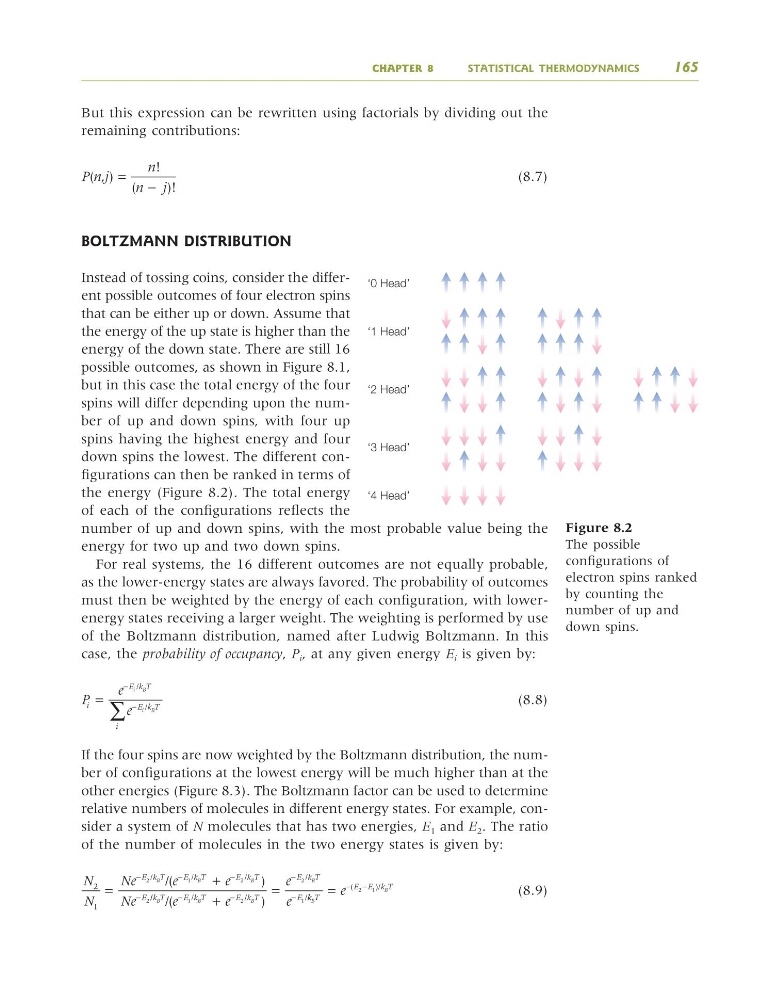
Instead of tossing coins, consider the different possible outcomes of four electron spins
that can be either up or down. Assume that
the energy of the up state is higher than the
energy of the down state. There are still 16
possible outcomes, as shown in Figure 8.1,
but in this case the total energy of the four
spins will differ depending upon the number of up and down spins, with four up
spins having the highest energy and four
down spins the lowest. The different configurations can then be ranked in terms of
the energy (Figure 8.2). The total energy
of each of the configurations reflects the
number of up and down spins, with the most probable value being the
energy for two up and two down spins.
For real systems, the 16 different outcomes are not equally probable,
as the lower-energy states are always favored. The probability of outcomes
must then be weighted by the energy of each configuration, with lowerenergy states receiving a larger weight. The weighting is performed by use
of the Boltzmann distribution, named after Ludwig Boltzmann. In this
case, the probability of occupancy, P i , at any given energy E i is given by:
(8.8)
If the four spins are now weighted by the Boltzmann distribution, the number of configurations at the lowest energy will be much higher than at the
other energies (Figure 8.3). The Boltzmann factor can be used to determine
relative numbers of molecules in different energy states. For example, consider a system of N molecules that has two energies, E 1 and E 2 . The ratio
of the number of molecules in the two energy states is given by:
(8.9)
N
N
Ne
e
e
Ne
E k T
E k T
E k T
E
B
B
B
2
1
2
1
2
2
(
)
/
/
/
=
+
−
−
−
−
/
/ /
/
/
/
/
(
)
k T
E k T
E k T
E k T
E
B
B
B
B
e
e
e
e
/
−
−
−
−
+
=
1
2
2
1 k k T
E E k T
B
B
e
(
) /
=
− −
2
1
P
e
e
i
E k T
E k T
i
i B
i B
/
/
=
−
−
∑
P n j
n
n j
( )
!
(
)!
, =
−
CHAPTER 8
STATISTICAL THERMODYNAMICS
165
‘0 Head’
‘1 Head’
‘2 Head’
‘3 Head’
‘4 Head’
Figure 8.2
The possible
configurations of
electron spins ranked
by counting the
number of up and
down spins.
9781405124362_4_008.qxd 4/29/08 9:09 Page 165
remaining contributions:
(8.7)
BOLTZMANN DISTRIBUTION
Instead of tossing coins, consider the different possible outcomes of four electron spins
that can be either up or down. Assume that
the energy of the up state is higher than the
energy of the down state. There are still 16
possible outcomes, as shown in Figure 8.1,
but in this case the total energy of the four
spins will differ depending upon the number of up and down spins, with four up
spins having the highest energy and four
down spins the lowest. The different configurations can then be ranked in terms of
the energy (Figure 8.2). The total energy
of each of the configurations reflects the
number of up and down spins, with the most probable value being the
energy for two up and two down spins.
For real systems, the 16 different outcomes are not equally probable,
as the lower-energy states are always favored. The probability of outcomes
must then be weighted by the energy of each configuration, with lowerenergy states receiving a larger weight. The weighting is performed by use
of the Boltzmann distribution, named after Ludwig Boltzmann. In this
case, the probability of occupancy, P i , at any given energy E i is given by:
(8.8)
If the four spins are now weighted by the Boltzmann distribution, the number of configurations at the lowest energy will be much higher than at the
other energies (Figure 8.3). The Boltzmann factor can be used to determine
relative numbers of molecules in different energy states. For example, consider a system of N molecules that has two energies, E 1 and E 2 . The ratio
of the number of molecules in the two energy states is given by:
(8.9)
N
N
Ne
e
e
Ne
E k T
E k T
E k T
E
B
B
B
2
1
2
1
2
2
(
)
/
/
/
=
+
−
−
−
−
/
/ /
/
/
/
/
(
)
k T
E k T
E k T
E k T
E
B
B
B
B
e
e
e
e
/
−
−
−
−
+
=
1
2
2
1 k k T
E E k T
B
B
e
(
) /
=
− −
2
1
P
e
e
i
E k T
E k T
i
i B
i B
/
/
=
−
−
∑
P n j
n
n j
( )
!
(
)!
, =
−
CHAPTER 8
STATISTICAL THERMODYNAMICS
165
‘0 Head’
‘1 Head’
‘2 Head’
‘3 Head’
‘4 Head’
Figure 8.2
The possible
configurations of
electron spins ranked
by counting the
number of up and
down spins.
9781405124362_4_008.qxd 4/29/08 9:09 Page 165