

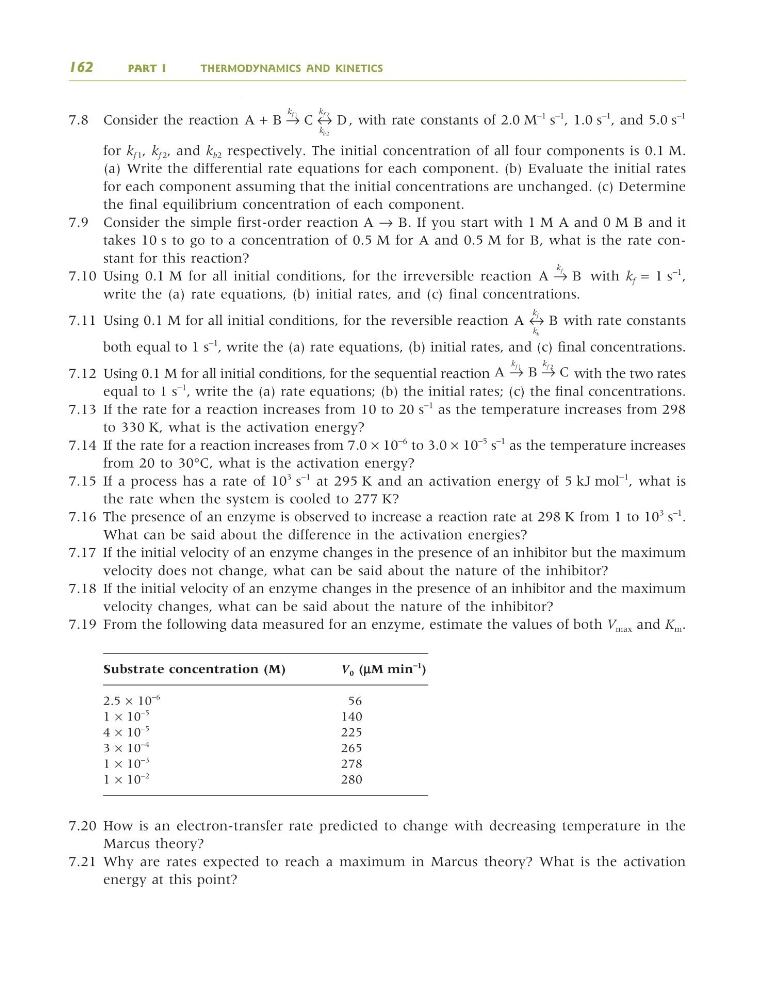
7.8 Consider the reaction
, with rate constants of 2.0 M
−1 s
−1
, 1.0 s
−1
, and 5.0 s
−1
for k f 1 , k f 2 , and k b2 respectively. The initial concentration of all four components is 0.1 M.
(a) Write the differential rate equations for each component. (b) Evaluate the initial rates
for each component assuming that the initial concentrations are unchanged. (c) Determine
the final equilibrium concentration of each component.
7.9 Consider the simple first-order reaction A → B. If you start with 1 M A and 0 M B and it
takes 10 s to go to a concentration of 0.5 M for A and 0.5 M for B, what is the rate constant for this reaction?
7.10 Using 0.1 M for all initial conditions, for the irreversible reaction
with k f = 1 s
−1
,
write the (a) rate equations, (b) initial rates, and (c) final concentrations.
7.11 Using 0.1 M for all initial conditions, for the reversible reaction
with rate constants
both equal to 1 s
−1
, write the (a) rate equations, (b) initial rates, and (c) final concentrations.
7.12 Using 0.1 M for all initial conditions, for the sequential reaction
with the two rates
equal to 1 s
−1
, write the (a) rate equations; (b) the initial rates; (c) the final concentrations.
7.13 If the rate for a reaction increases from 10 to 20 s
−1 as the temperature increases from 298
to 330 K, what is the activation energy?
7.14 If the rate for a reaction increases from 7.0 × 10
−6 to 3.0 × 10
−5 s
−1 as the temperature increases
from 20 to 30°C, what is the activation energy?
7.15 If a process has a rate of 10
3 s
−1 at 295 K and an activation energy of 5 kJ mol
−1
, what is
the rate when the system is cooled to 277 K?
7.16 The presence of an enzyme is observed to increase a reaction rate at 298 K from 1 to 10
3 s
−1
.
What can be said about the difference in the activation energies?
7.17 If the initial velocity of an enzyme changes in the presence of an inhibitor but the maximum
velocity does not change, what can be said about the nature of the inhibitor?
7.18 If the initial velocity of an enzyme changes in the presence of an inhibitor and the maximum
velocity changes, what can be said about the nature of the inhibitor?
7.19 From the following data measured for an enzyme, estimate the values of both V max and K m .
Substrate concentration (M)
V 0 (μ μM min
− −1
)
2.5 × 10
−6
56
1 × 10
−5
140
4 × 10
−5
225
3 × 10
−4
265
1 × 10
−3
278
1 × 10
−2
280
7.20 How is an electron-transfer rate predicted to change with decreasing temperature in the
Marcus theory?
7.21 Why are rates expected to reach a maximum in Marcus theory? What is the activation
energy at this point?
A
B
C
→ →
k
k
f
f
1
2
A
B
↔
k
k
b
f
A
B
→
k f
A B
C
D
+ → ↔
k
k
k
f
b
f
1
2
2
162
PART I
THERMODYNAMICS AND KINETICS
9781405124362_4_007.qxd 4/29/08 10:41 Page 162
, with rate constants of 2.0 M
−1 s
−1
, 1.0 s
−1
, and 5.0 s
−1
for k f 1 , k f 2 , and k b2 respectively. The initial concentration of all four components is 0.1 M.
(a) Write the differential rate equations for each component. (b) Evaluate the initial rates
for each component assuming that the initial concentrations are unchanged. (c) Determine
the final equilibrium concentration of each component.
7.9 Consider the simple first-order reaction A → B. If you start with 1 M A and 0 M B and it
takes 10 s to go to a concentration of 0.5 M for A and 0.5 M for B, what is the rate constant for this reaction?
7.10 Using 0.1 M for all initial conditions, for the irreversible reaction
with k f = 1 s
−1
,
write the (a) rate equations, (b) initial rates, and (c) final concentrations.
7.11 Using 0.1 M for all initial conditions, for the reversible reaction
with rate constants
both equal to 1 s
−1
, write the (a) rate equations, (b) initial rates, and (c) final concentrations.
7.12 Using 0.1 M for all initial conditions, for the sequential reaction
with the two rates
equal to 1 s
−1
, write the (a) rate equations; (b) the initial rates; (c) the final concentrations.
7.13 If the rate for a reaction increases from 10 to 20 s
−1 as the temperature increases from 298
to 330 K, what is the activation energy?
7.14 If the rate for a reaction increases from 7.0 × 10
−6 to 3.0 × 10
−5 s
−1 as the temperature increases
from 20 to 30°C, what is the activation energy?
7.15 If a process has a rate of 10
3 s
−1 at 295 K and an activation energy of 5 kJ mol
−1
, what is
the rate when the system is cooled to 277 K?
7.16 The presence of an enzyme is observed to increase a reaction rate at 298 K from 1 to 10
3 s
−1
.
What can be said about the difference in the activation energies?
7.17 If the initial velocity of an enzyme changes in the presence of an inhibitor but the maximum
velocity does not change, what can be said about the nature of the inhibitor?
7.18 If the initial velocity of an enzyme changes in the presence of an inhibitor and the maximum
velocity changes, what can be said about the nature of the inhibitor?
7.19 From the following data measured for an enzyme, estimate the values of both V max and K m .
Substrate concentration (M)
V 0 (μ μM min
− −1
)
2.5 × 10
−6
56
1 × 10
−5
140
4 × 10
−5
225
3 × 10
−4
265
1 × 10
−3
278
1 × 10
−2
280
7.20 How is an electron-transfer rate predicted to change with decreasing temperature in the
Marcus theory?
7.21 Why are rates expected to reach a maximum in Marcus theory? What is the activation
energy at this point?
A
B
C
→ →
k
k
f
f
1
2
A
B
↔
k
k
b
f
A
B
→
k f
A B
C
D
+ → ↔
k
k
k
f
b
f
1
2
2
162
PART I
THERMODYNAMICS AND KINETICS
9781405124362_4_007.qxd 4/29/08 10:41 Page 162