

CHAPTER 7
KINETICS AND ENZYMES
155
Thus, the value of the maximum velocity can be found by an extrapolation
of the curve, and the value of K M is equal to the substrate concentration
at half-maximum velocity.
LINEWEAVER–BURK EQUATION
The Michaelis–Menten equation can be transformed into a linear relationship by making use of parameters other than the initial velocity and
substrate concentration for the graph. One common relationship is derived
by taking the reciprocal of the Michaelis–Menten equation (eqn 7.45):
(7.49)
y = mx + b where y = 1/V 0 , m = K M /V max , and b = 1/V max
This form of the relationship is known as the Linewea9er–Burk equation.
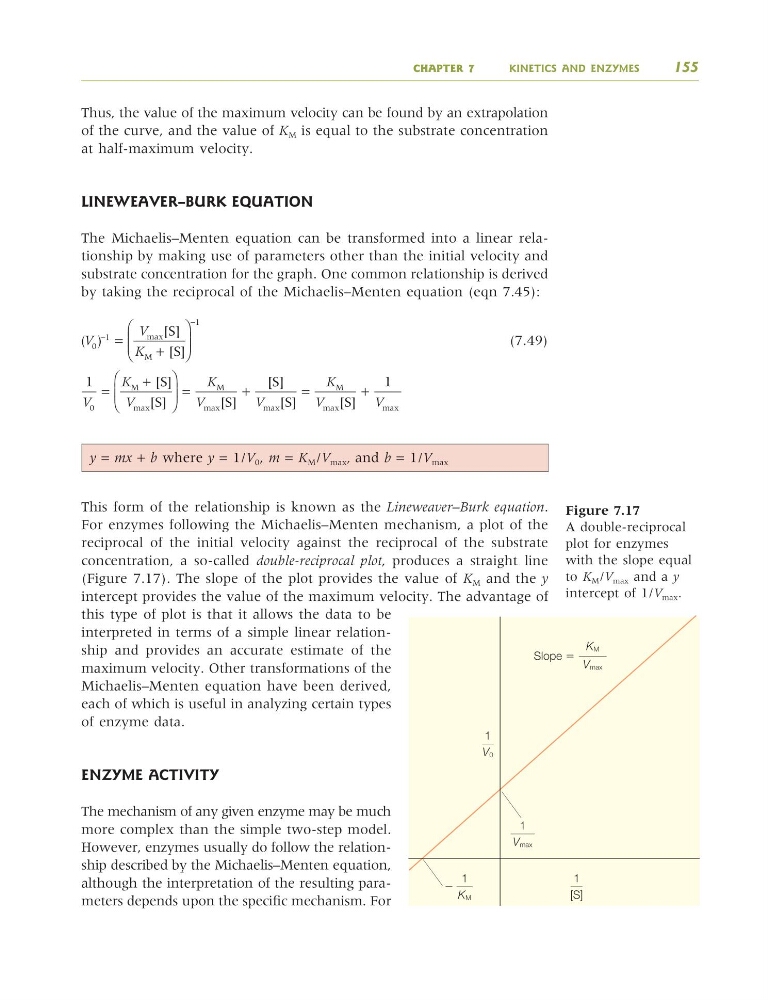
For enzymes following the Michaelis–Menten mechanism, a plot of the
reciprocal of the initial velocity against the reciprocal of the substrate
concentration, a so-called double-reciprocal plot, produces a straight line
(Figure 7.17). The slope of the plot provides the value of K M and the y
intercept provides the value of the maximum velocity. The advantage of
this type of plot is that it allows the data to be
interpreted in terms of a simple linear relationship and provides an accurate estimate of the
maximum velocity. Other transformations of the
Michaelis–Menten equation have been derived,
each of which is useful in analyzing certain types
of enzyme data.
ENZYME ACTIVITY
The mechanism of any given enzyme may be much
more complex than the simple two-step model.
However, enzymes usually do follow the relationship described by the Michaelis–Menten equation,
although the interpretation of the resulting parameters depends upon the specific mechanism. For
1
0
V
K
V
K
V
[ ]
[ ]
[ ]
max
max
=
+
⎛
⎝
⎜ ⎜
⎞
⎠
⎟ ⎟ =
+
M
M
S
S
S
[ [ ]
[ ]
[ ]
max
max
max
S
S
S
M
V
K
V
V
=
+
1
( )
[ ]
[ ]
max
V
V
K
0
1
1
−
−
=
+
⎛
⎝
⎜ ⎜
⎞
⎠
⎟ ⎟
S
S
M
KM
Slope ϭ
V max
Vmax
KM
1
V0
1
1
Ϫ
[S]
1
Figure 7.17
A double-reciprocal
plot for enzymes
with the slope equal
to K M /V max and a y
intercept of 1/V max .
9781405124362_4_007.qxd 4/29/08 10:41 Page 155
KINETICS AND ENZYMES
155
Thus, the value of the maximum velocity can be found by an extrapolation
of the curve, and the value of K M is equal to the substrate concentration
at half-maximum velocity.
LINEWEAVER–BURK EQUATION
The Michaelis–Menten equation can be transformed into a linear relationship by making use of parameters other than the initial velocity and
substrate concentration for the graph. One common relationship is derived
by taking the reciprocal of the Michaelis–Menten equation (eqn 7.45):
(7.49)
y = mx + b where y = 1/V 0 , m = K M /V max , and b = 1/V max
This form of the relationship is known as the Linewea9er–Burk equation.
For enzymes following the Michaelis–Menten mechanism, a plot of the
reciprocal of the initial velocity against the reciprocal of the substrate
concentration, a so-called double-reciprocal plot, produces a straight line
(Figure 7.17). The slope of the plot provides the value of K M and the y
intercept provides the value of the maximum velocity. The advantage of
this type of plot is that it allows the data to be
interpreted in terms of a simple linear relationship and provides an accurate estimate of the
maximum velocity. Other transformations of the
Michaelis–Menten equation have been derived,
each of which is useful in analyzing certain types
of enzyme data.
ENZYME ACTIVITY
The mechanism of any given enzyme may be much
more complex than the simple two-step model.
However, enzymes usually do follow the relationship described by the Michaelis–Menten equation,
although the interpretation of the resulting parameters depends upon the specific mechanism. For
1
0
V
K
V
K
V
[ ]
[ ]
[ ]
max
max
=
+
⎛
⎝
⎜ ⎜
⎞
⎠
⎟ ⎟ =
+
M
M
S
S
S
[ [ ]
[ ]
[ ]
max
max
max
S
S
S
M
V
K
V
V
=
+
1
( )
[ ]
[ ]
max
V
V
K
0
1
1
−
−
=
+
⎛
⎝
⎜ ⎜
⎞
⎠
⎟ ⎟
S
S
M
KM
Slope ϭ
V max
Vmax
KM
1
V0
1
1
Ϫ
[S]
1
Figure 7.17
A double-reciprocal
plot for enzymes
with the slope equal
to K M /V max and a y
intercept of 1/V max .
9781405124362_4_007.qxd 4/29/08 10:41 Page 155