

144
PART I
THERMODYNAMICS AND KINETICS
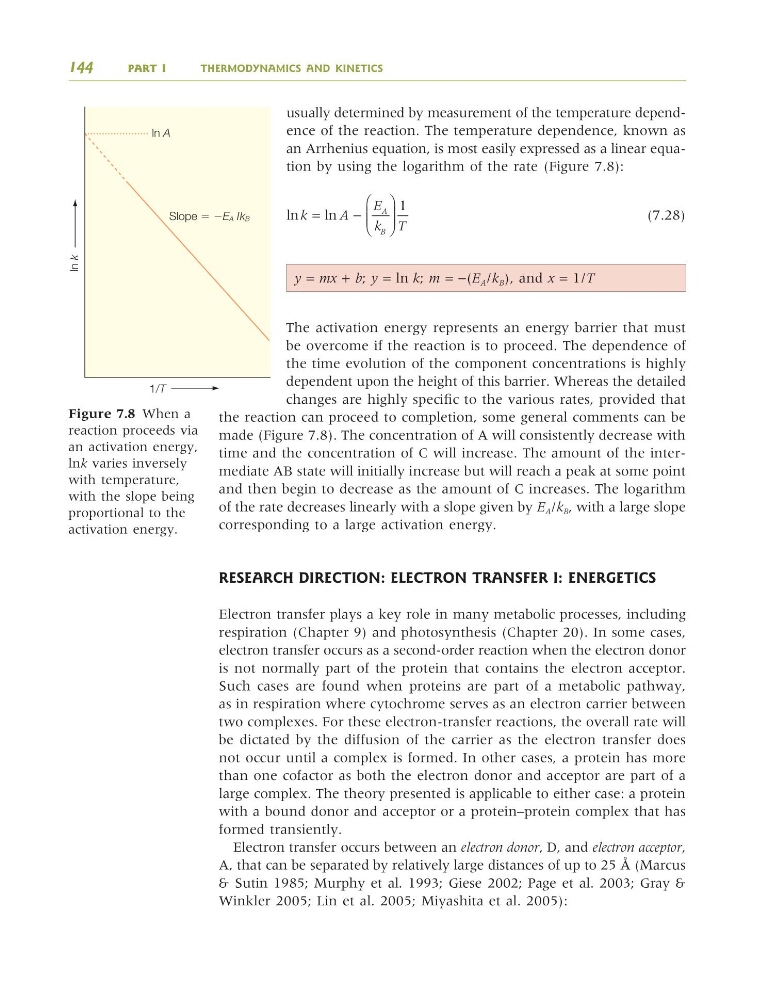
usually determined by measurement of the temperature dependence of the reaction. The temperature dependence, known as
an Arrhenius equation, is most easily expressed as a linear equation by using the logarithm of the rate (Figure 7.8):
(7.28)
y = mx + b; y = ln k; m = −(E A /k B ), and x = 1/T
The activation energy represents an energy barrier that must
be overcome if the reaction is to proceed. The dependence of
the time evolution of the component concentrations is highly
dependent upon the height of this barrier. Whereas the detailed
changes are highly specific to the various rates, provided that
the reaction can proceed to completion, some general comments can be
made (Figure 7.8). The concentration of A will consistently decrease with
time and the concentration of C will increase. The amount of the intermediate AB state will initially increase but will reach a peak at some point
and then begin to decrease as the amount of C increases. The logarithm
of the rate decreases linearly with a slope given by E A /k B , with a large slope
corresponding to a large activation energy.
RESEARCH DIRECTION: ELECTRON TRANSFER I: ENERGETICS
Electron transfer plays a key role in many metabolic processes, including
respiration (Chapter 9) and photosynthesis (Chapter 20). In some cases,
electron transfer occurs as a second-order reaction when the electron donor
is not normally part of the protein that contains the electron acceptor.
Such cases are found when proteins are part of a metabolic pathway,
as in respiration where cytochrome serves as an electron carrier between
two complexes. For these electron-transfer reactions, the overall rate will
be dictated by the diffusion of the carrier as the electron transfer does
not occur until a complex is formed. In other cases, a protein has more
than one cofactor as both the electron donor and acceptor are part of a
large complex. The theory presented is applicable to either case: a protein
with a bound donor and acceptor or a protein–protein complex that has
formed transiently.
Electron transfer occurs between an electron donor, D, and electron acceptor,
A, that can be separated by relatively large distances of up to 25 Å (Marcus
& Sutin 1985; Murphy et al. 1993; Giese 2002; Page et al. 2003; Gray &
Winkler 2005; Lin et al. 2005; Miyashita et al. 2005):
ln
ln
k
A
E
k T
A
B
=
−
⎛
⎝
⎜ ⎜
⎞
⎠
⎟ ⎟
1
ln k
1/T
Slope ϭ ϪEA IkB
ln A
Figure 7.8 When a
reaction proceeds via
an activation energy,
lnk varies inversely
with temperature,
with the slope being
proportional to the
activation energy.
9781405124362_4_007.qxd 4/29/08 10:41 Page 144
PART I
THERMODYNAMICS AND KINETICS
usually determined by measurement of the temperature dependence of the reaction. The temperature dependence, known as
an Arrhenius equation, is most easily expressed as a linear equation by using the logarithm of the rate (Figure 7.8):
(7.28)
y = mx + b; y = ln k; m = −(E A /k B ), and x = 1/T
The activation energy represents an energy barrier that must
be overcome if the reaction is to proceed. The dependence of
the time evolution of the component concentrations is highly
dependent upon the height of this barrier. Whereas the detailed
changes are highly specific to the various rates, provided that
the reaction can proceed to completion, some general comments can be
made (Figure 7.8). The concentration of A will consistently decrease with
time and the concentration of C will increase. The amount of the intermediate AB state will initially increase but will reach a peak at some point
and then begin to decrease as the amount of C increases. The logarithm
of the rate decreases linearly with a slope given by E A /k B , with a large slope
corresponding to a large activation energy.
RESEARCH DIRECTION: ELECTRON TRANSFER I: ENERGETICS
Electron transfer plays a key role in many metabolic processes, including
respiration (Chapter 9) and photosynthesis (Chapter 20). In some cases,
electron transfer occurs as a second-order reaction when the electron donor
is not normally part of the protein that contains the electron acceptor.
Such cases are found when proteins are part of a metabolic pathway,
as in respiration where cytochrome serves as an electron carrier between
two complexes. For these electron-transfer reactions, the overall rate will
be dictated by the diffusion of the carrier as the electron transfer does
not occur until a complex is formed. In other cases, a protein has more
than one cofactor as both the electron donor and acceptor are part of a
large complex. The theory presented is applicable to either case: a protein
with a bound donor and acceptor or a protein–protein complex that has
formed transiently.
Electron transfer occurs between an electron donor, D, and electron acceptor,
A, that can be separated by relatively large distances of up to 25 Å (Marcus
& Sutin 1985; Murphy et al. 1993; Giese 2002; Page et al. 2003; Gray &
Winkler 2005; Lin et al. 2005; Miyashita et al. 2005):
ln
ln
k
A
E
k T
A
B
=
−
⎛
⎝
⎜ ⎜
⎞
⎠
⎟ ⎟
1
ln k
1/T
Slope ϭ ϪEA IkB
ln A
Figure 7.8 When a
reaction proceeds via
an activation energy,
lnk varies inversely
with temperature,
with the slope being
proportional to the
activation energy.
9781405124362_4_007.qxd 4/29/08 10:41 Page 144