

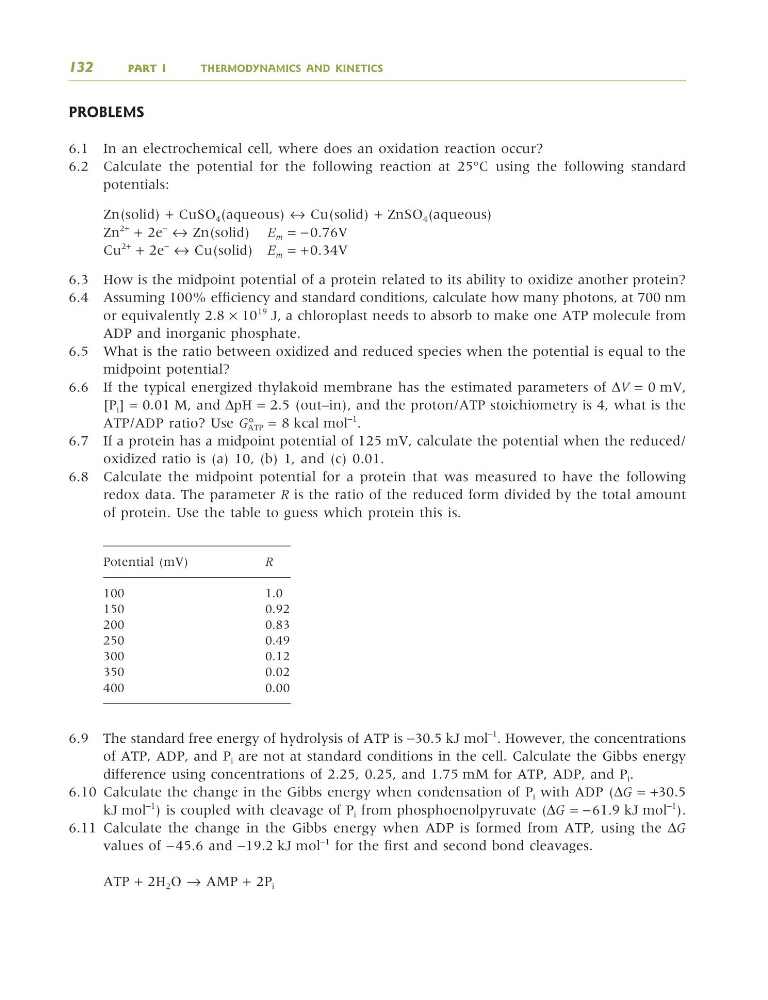
PROBLEMS
6.1 In an electrochemical cell, where does an oxidation reaction occur?
6.2 Calculate the potential for the following reaction at 25°C using the following standard
potentials:
Zn(solid) + CuSO 4 (aqueous) ↔ Cu(solid) + ZnSO 4 (aqueous)
Zn
2+
+ 2e
−
↔ Zn(solid) E m = −0.76V
Cu
2+
+ 2e
−
↔ Cu(solid) E m = +0.34V
6.3 How is the midpoint potential of a protein related to its ability to oxidize another protein?
6.4 Assuming 100% efficiency and standard conditions, calculate how many photons, at 700 nm
or equivalently 2.8 × 10
19 J, a chloroplast needs to absorb to make one ATP molecule from
ADP and inorganic phosphate.
6.5 What is the ratio between oxidized and reduced species when the potential is equal to the
midpoint potential?
6.6 If the typical energized thylakoid membrane has the estimated parameters of ΔV = 0 mV,
[P i ] = 0.01 M, and ΔpH = 2.5 (out–in), and the proton/ATP stoichiometry is 4, what is the
ATP/ADP ratio? Use G° ATP = 8 kcal mol
−1
.
6.7 If a protein has a midpoint potential of 125 mV, calculate the potential when the reduced/
oxidized ratio is (a) 10, (b) 1, and (c) 0.01.
6.8 Calculate the midpoint potential for a protein that was measured to have the following
redox data. The parameter R is the ratio of the reduced form divided by the total amount
of protein. Use the table to guess which protein this is.
Potential (mV)
R
100
1.0
150
0.92
200
0.83
250
0.49
300
0.12
350
0.02
400
0.00
6.9 The standard free energy of hydrolysis of ATP is −30.5 kJ mol
−1
. However, the concentrations
of ATP, ADP, and P i are not at standard conditions in the cell. Calculate the Gibbs energy
difference using concentrations of 2.25, 0.25, and 1.75 mM for ATP, ADP, and P i .
6.10 Calculate the change in the Gibbs energy when condensation of P i with ADP (ΔG = +30.5
kJ mol
−1
) is coupled with cleavage of P i from phosphoenolpyruvate (ΔG = −61.9 kJ mol
−1
).
6.11 Calculate the change in the Gibbs energy when ADP is formed from ATP, using the ΔG
values of −45.6 and −19.2 kJ mol
−1 for the first and second bond cleavages.
ATP + 2H 2 O → AMP + 2P i
132
PART I
THERMODYNAMICS AND KINETICS
9781405124362_4_006.qxd 4/29/08 14:07 Page 132
6.1 In an electrochemical cell, where does an oxidation reaction occur?
6.2 Calculate the potential for the following reaction at 25°C using the following standard
potentials:
Zn(solid) + CuSO 4 (aqueous) ↔ Cu(solid) + ZnSO 4 (aqueous)
Zn
2+
+ 2e
−
↔ Zn(solid) E m = −0.76V
Cu
2+
+ 2e
−
↔ Cu(solid) E m = +0.34V
6.3 How is the midpoint potential of a protein related to its ability to oxidize another protein?
6.4 Assuming 100% efficiency and standard conditions, calculate how many photons, at 700 nm
or equivalently 2.8 × 10
19 J, a chloroplast needs to absorb to make one ATP molecule from
ADP and inorganic phosphate.
6.5 What is the ratio between oxidized and reduced species when the potential is equal to the
midpoint potential?
6.6 If the typical energized thylakoid membrane has the estimated parameters of ΔV = 0 mV,
[P i ] = 0.01 M, and ΔpH = 2.5 (out–in), and the proton/ATP stoichiometry is 4, what is the
ATP/ADP ratio? Use G° ATP = 8 kcal mol
−1
.
6.7 If a protein has a midpoint potential of 125 mV, calculate the potential when the reduced/
oxidized ratio is (a) 10, (b) 1, and (c) 0.01.
6.8 Calculate the midpoint potential for a protein that was measured to have the following
redox data. The parameter R is the ratio of the reduced form divided by the total amount
of protein. Use the table to guess which protein this is.
Potential (mV)
R
100
1.0
150
0.92
200
0.83
250
0.49
300
0.12
350
0.02
400
0.00
6.9 The standard free energy of hydrolysis of ATP is −30.5 kJ mol
−1
. However, the concentrations
of ATP, ADP, and P i are not at standard conditions in the cell. Calculate the Gibbs energy
difference using concentrations of 2.25, 0.25, and 1.75 mM for ATP, ADP, and P i .
6.10 Calculate the change in the Gibbs energy when condensation of P i with ADP (ΔG = +30.5
kJ mol
−1
) is coupled with cleavage of P i from phosphoenolpyruvate (ΔG = −61.9 kJ mol
−1
).
6.11 Calculate the change in the Gibbs energy when ADP is formed from ATP, using the ΔG
values of −45.6 and −19.2 kJ mol
−1 for the first and second bond cleavages.
ATP + 2H 2 O → AMP + 2P i
132
PART I
THERMODYNAMICS AND KINETICS
9781405124362_4_006.qxd 4/29/08 14:07 Page 132