

The second contribution arises from the difference in charge for the two
sides of the membrane. The difference in the Gibbs energy for that contribution is given by the voltage difference ΔV across the cell membrane
(eqn 6.5) using n = 1 for a proton charge:
(ΔG) rec = −nFΔV = −FΔV
(6.21)
Together, the total Gibbs energy available due to the difference in the
concentration of protons on the two sides of the cell membrane is termed
the protonmoti9e force, Δp, and can be written as:
Δp = −FV − 2.3RT(ΔpH)
(6.22)
Experiments have established that only the total value of Δp is critical for
the synthesis of ATP, as different relative fractions of the two components
result in the same outcome. In thylakoids, the membrane potential is small
and so Δp is due primarily to the pH difference across the membrane,
although in intact plants the membrane potential may be larger.
RESEARCH DIRECTION: RESPIRATORY CHAIN
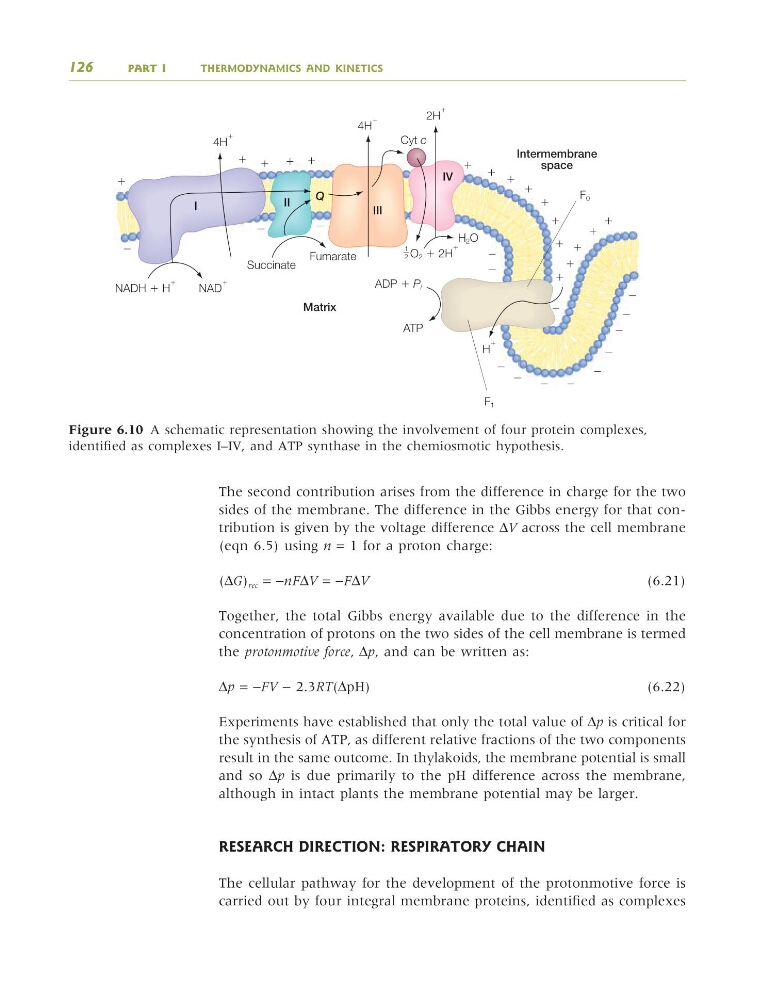
The cellular pathway for the development of the protonmotive force is
carried out by four integral membrane proteins, identified as complexes
126
PART I
THERMODYNAMICS AND KINETICS
ϩ
4H
ϩ
4H
ϩ
H
ϩ
Intermembrane
space
Q
I
II
III
IV
Cyt c
H 2 O
F 0
F 1
O 2 ϩ 2H
ϩ
2H
ϩ
ADP ϩ P i
NADH ϩ H
ϩ
NAD
ϩ
Fumarate
Succinate
Matrix
ATP
ϩ ϩ ϩ ϩ
ϩ ϩ ϩ ϩ
ϩ
ϩ
ϩ
ϩ
ϩ
ϩ
ϩ
ϩ
ϩ
Ϫ
Ϫ
Ϫ
Ϫ
Ϫ
Ϫ
Ϫ Ϫ Ϫ
Ϫ
Ϫ
Ϫ
Ϫ
Ϫ
1
2
Figure 6.10 A schematic representation showing the involvement of four protein complexes,
identified as complexes I–IV, and ATP synthase in the chemiosmotic hypothesis.
9781405124362_4_006.qxd 4/29/08 14:07 Page 126
sides of the membrane. The difference in the Gibbs energy for that contribution is given by the voltage difference ΔV across the cell membrane
(eqn 6.5) using n = 1 for a proton charge:
(ΔG) rec = −nFΔV = −FΔV
(6.21)
Together, the total Gibbs energy available due to the difference in the
concentration of protons on the two sides of the cell membrane is termed
the protonmoti9e force, Δp, and can be written as:
Δp = −FV − 2.3RT(ΔpH)
(6.22)
Experiments have established that only the total value of Δp is critical for
the synthesis of ATP, as different relative fractions of the two components
result in the same outcome. In thylakoids, the membrane potential is small
and so Δp is due primarily to the pH difference across the membrane,
although in intact plants the membrane potential may be larger.
RESEARCH DIRECTION: RESPIRATORY CHAIN
The cellular pathway for the development of the protonmotive force is
carried out by four integral membrane proteins, identified as complexes
126
PART I
THERMODYNAMICS AND KINETICS
ϩ
4H
ϩ
4H
ϩ
H
ϩ
Intermembrane
space
Q
I
II
III
IV
Cyt c
H 2 O
F 0
F 1
O 2 ϩ 2H
ϩ
2H
ϩ
ADP ϩ P i
NADH ϩ H
ϩ
NAD
ϩ
Fumarate
Succinate
Matrix
ATP
ϩ ϩ ϩ ϩ
ϩ ϩ ϩ ϩ
ϩ
ϩ
ϩ
ϩ
ϩ
ϩ
ϩ
ϩ
ϩ
Ϫ
Ϫ
Ϫ
Ϫ
Ϫ
Ϫ
Ϫ Ϫ Ϫ
Ϫ
Ϫ
Ϫ
Ϫ
Ϫ
1
2
Figure 6.10 A schematic representation showing the involvement of four protein complexes,
identified as complexes I–IV, and ATP synthase in the chemiosmotic hypothesis.
9781405124362_4_006.qxd 4/29/08 14:07 Page 126