

The value of −30.5 kJ mol
−1 for ATP hydrolysis represents the standard-state
Gibbs energy change when all reactants are at a concentration of 1 M
and pH 7. In a cell, the concentrations and pH are not at the standardstate values and therefore the actual energy change will differ from that
calculated using the standard-state conditions. The actual Gibbs energy
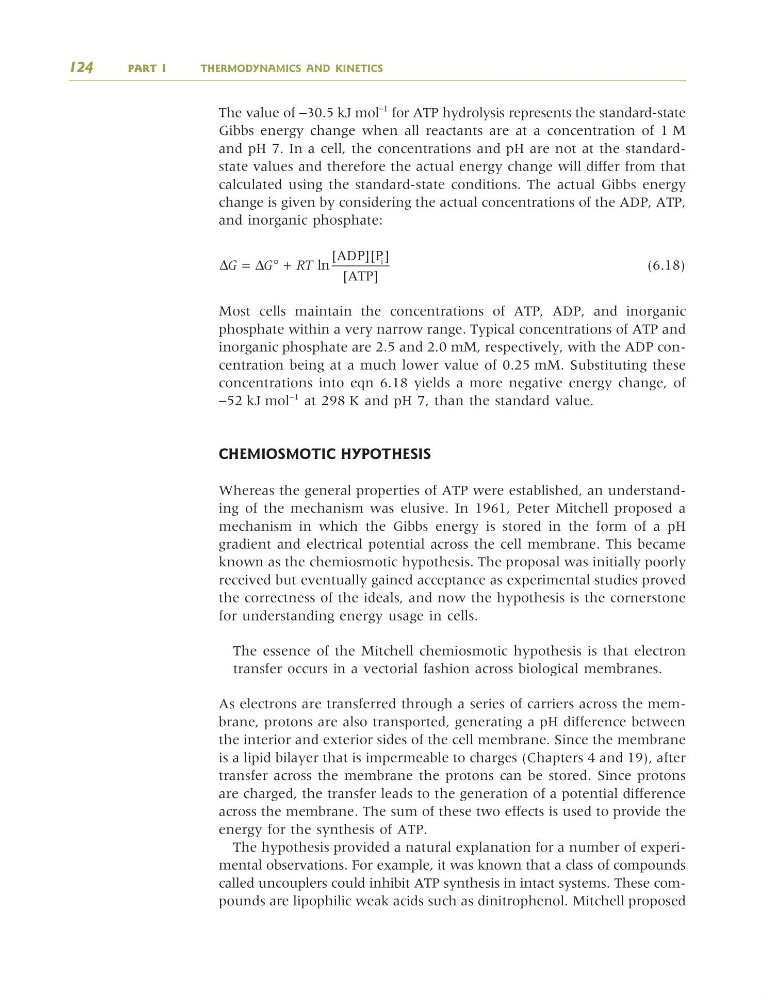
change is given by considering the actual concentrations of the ADP, ATP,
and inorganic phosphate:
(6.18)
Most cells maintain the concentrations of ATP, ADP, and inorganic
phosphate within a very narrow range. Typical concentrations of ATP and
inorganic phosphate are 2.5 and 2.0 mM, respectively, with the ADP concentration being at a much lower value of 0.25 mM. Substituting these
concentrations into eqn 6.18 yields a more negative energy change, of
−52 kJ mol
−1 at 298 K and pH 7, than the standard value.
CHEMIOSMOTIC HYPOTHESIS
Whereas the general properties of ATP were established, an understanding of the mechanism was elusive. In 1961, Peter Mitchell proposed a
mechanism in which the Gibbs energy is stored in the form of a pH
gradient and electrical potential across the cell membrane. This became
known as the chemiosmotic hypothesis. The proposal was initially poorly
received but eventually gained acceptance as experimental studies proved
the correctness of the ideals, and now the hypothesis is the cornerstone
for understanding energy usage in cells.
The essence of the Mitchell chemiosmotic hypothesis is that electron
transfer occurs in a vectorial fashion across biological membranes.
As electrons are transferred through a series of carriers across the membrane, protons are also transported, generating a pH difference between
the interior and exterior sides of the cell membrane. Since the membrane
is a lipid bilayer that is impermeable to charges (Chapters 4 and 19), after
transfer across the membrane the protons can be stored. Since protons
are charged, the transfer leads to the generation of a potential difference
across the membrane. The sum of these two effects is used to provide the
energy for the synthesis of ATP.
The hypothesis provided a natural explanation for a number of experimental observations. For example, it was known that a class of compounds
called uncouplers could inhibit ATP synthesis in intact systems. These compounds are lipophilic weak acids such as dinitrophenol. Mitchell proposed
Δ
Δ
G
G
RT ln
=
° +
[ADP][P]
[ATP]
i
124
PART I
THERMODYNAMICS AND KINETICS
9781405124362_4_006.qxd 4/29/08 14:07 Page 124
−1 for ATP hydrolysis represents the standard-state
Gibbs energy change when all reactants are at a concentration of 1 M
and pH 7. In a cell, the concentrations and pH are not at the standardstate values and therefore the actual energy change will differ from that
calculated using the standard-state conditions. The actual Gibbs energy
change is given by considering the actual concentrations of the ADP, ATP,
and inorganic phosphate:
(6.18)
Most cells maintain the concentrations of ATP, ADP, and inorganic
phosphate within a very narrow range. Typical concentrations of ATP and
inorganic phosphate are 2.5 and 2.0 mM, respectively, with the ADP concentration being at a much lower value of 0.25 mM. Substituting these
concentrations into eqn 6.18 yields a more negative energy change, of
−52 kJ mol
−1 at 298 K and pH 7, than the standard value.
CHEMIOSMOTIC HYPOTHESIS
Whereas the general properties of ATP were established, an understanding of the mechanism was elusive. In 1961, Peter Mitchell proposed a
mechanism in which the Gibbs energy is stored in the form of a pH
gradient and electrical potential across the cell membrane. This became
known as the chemiosmotic hypothesis. The proposal was initially poorly
received but eventually gained acceptance as experimental studies proved
the correctness of the ideals, and now the hypothesis is the cornerstone
for understanding energy usage in cells.
The essence of the Mitchell chemiosmotic hypothesis is that electron
transfer occurs in a vectorial fashion across biological membranes.
As electrons are transferred through a series of carriers across the membrane, protons are also transported, generating a pH difference between
the interior and exterior sides of the cell membrane. Since the membrane
is a lipid bilayer that is impermeable to charges (Chapters 4 and 19), after
transfer across the membrane the protons can be stored. Since protons
are charged, the transfer leads to the generation of a potential difference
across the membrane. The sum of these two effects is used to provide the
energy for the synthesis of ATP.
The hypothesis provided a natural explanation for a number of experimental observations. For example, it was known that a class of compounds
called uncouplers could inhibit ATP synthesis in intact systems. These compounds are lipophilic weak acids such as dinitrophenol. Mitchell proposed
Δ
Δ
G
G
RT ln
=
° +
[ADP][P]
[ATP]
i
124
PART I
THERMODYNAMICS AND KINETICS
9781405124362_4_006.qxd 4/29/08 14:07 Page 124