

CHAPTER 5
EQUILIBRIA AND REACTIONS INVOLVING PROTONS
103
(5.23)
pK = −log K
(eqn 5.14)
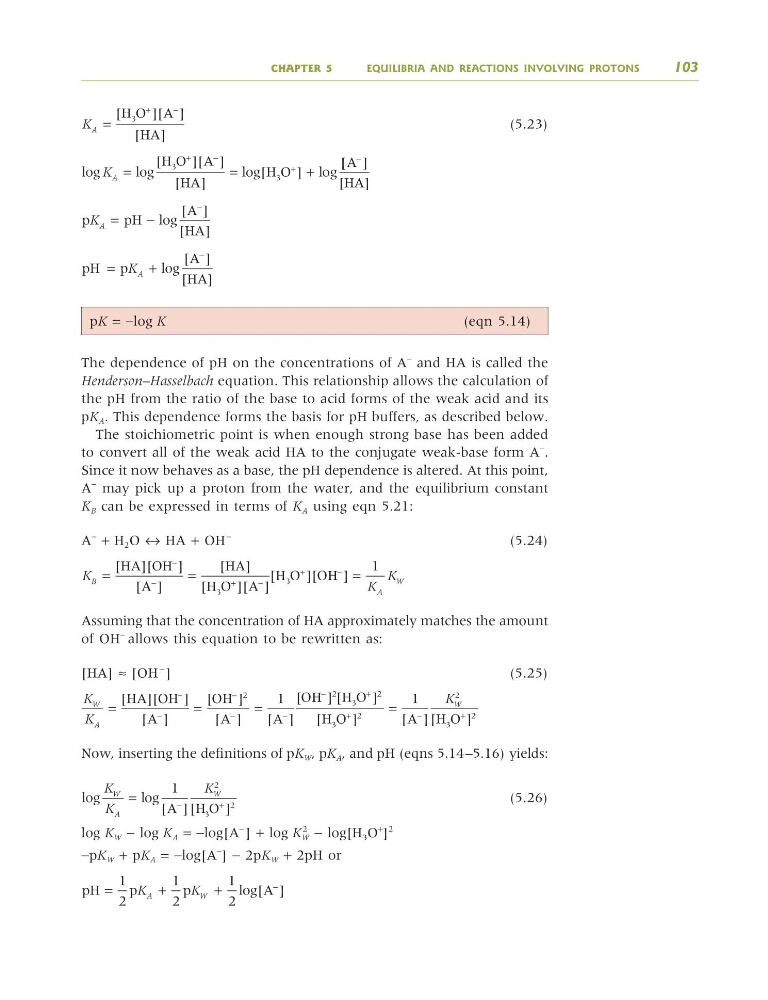
The dependence of pH on the concentrations of A
− and HA is called the
Henderson–Hasselbach equation. This relationship allows the calculation of
the pH from the ratio of the base to acid forms of the weak acid and its
pK A . This dependence forms the basis for pH buffers, as described below.
The stoichiometric point is when enough strong base has been added
to convert all of the weak acid HA to the conjugate weak-base form A
−
.
Since it now behaves as a base, the pH dependence is altered. At this point,
A
− may pick up a proton from the water, and the equilibrium constant
K B can be expressed in terms of K A using eqn 5.21:
A
−
+ H 2 O ↔ HA + OH
−
(5.24)
Assuming that the concentration of HA approximately matches the amount
of OH
− allows this equation to be rewritten as:
[HA] ≈ [OH
− ]
(5.25)
Now, inserting the definitions of pK W , pK A , and pH (eqns 5.14–5.16) yields:
(5.26)
log K W − log K A = −log[A
− ] + log K
2
W − log[H 3 O
+
]
2
−pK W + pK A = −log[A
−
] − 2pK W + 2pH or
pH
p
p
A
log[ ]
=
+
+
−
1
2
1
2
1
2
K
K
A
W
log
log
[ ][
]
K
K
K
W
A
W
=
−
+
1
2
2
A HO 3
K
K
W
A
[ ][
]
[ ]
[
]
[ ]
[ ]
[
=
=
=
−
−
−
−
−
HA OH
A
OH
A
A
O
2
1
H H H O
H O
A H O
3
3
2
3
−
+
+
−
+
=
] [
]
[
]
[ ][
]
2
2
2
2
1
K W
K B
[ ][
]
[ ]
[ ]
[
][ ]
[
][
=
=
−
−
+
−
+
HA OH
A
HA
H O A
H O O
3
3
H H
−
=
]
1
K
K
A
W
pH p
A
HA
=
+
−
log
[ ]
[ ]
K A
p
pH
A
HA
K A
log
[ ]
[ ]
=
−
−
log
log
[
][ ]
[ ]
log[
] log
K A =
=
+
+
−
+
H O A
HA
H O
3
3
[ [ ]
A
[HA]
−
K A
[
][ ]
[ ]
=
+
−
H O A
HA
3
9781405124362_4_005.qxd 4/29/08 9:08 Page 103
EQUILIBRIA AND REACTIONS INVOLVING PROTONS
103
(5.23)
pK = −log K
(eqn 5.14)
The dependence of pH on the concentrations of A
− and HA is called the
Henderson–Hasselbach equation. This relationship allows the calculation of
the pH from the ratio of the base to acid forms of the weak acid and its
pK A . This dependence forms the basis for pH buffers, as described below.
The stoichiometric point is when enough strong base has been added
to convert all of the weak acid HA to the conjugate weak-base form A
−
.
Since it now behaves as a base, the pH dependence is altered. At this point,
A
− may pick up a proton from the water, and the equilibrium constant
K B can be expressed in terms of K A using eqn 5.21:
A
−
+ H 2 O ↔ HA + OH
−
(5.24)
Assuming that the concentration of HA approximately matches the amount
of OH
− allows this equation to be rewritten as:
[HA] ≈ [OH
− ]
(5.25)
Now, inserting the definitions of pK W , pK A , and pH (eqns 5.14–5.16) yields:
(5.26)
log K W − log K A = −log[A
− ] + log K
2
W − log[H 3 O
+
]
2
−pK W + pK A = −log[A
−
] − 2pK W + 2pH or
pH
p
p
A
log[ ]
=
+
+
−
1
2
1
2
1
2
K
K
A
W
log
log
[ ][
]
K
K
K
W
A
W
=
−
+
1
2
2
A HO 3
K
K
W
A
[ ][
]
[ ]
[
]
[ ]
[ ]
[
=
=
=
−
−
−
−
−
HA OH
A
OH
A
A
O
2
1
H H H O
H O
A H O
3
3
2
3
−
+
+
−
+
=
] [
]
[
]
[ ][
]
2
2
2
2
1
K W
K B
[ ][
]
[ ]
[ ]
[
][ ]
[
][
=
=
−
−
+
−
+
HA OH
A
HA
H O A
H O O
3
3
H H
−
=
]
1
K
K
A
W
pH p
A
HA
=
+
−
log
[ ]
[ ]
K A
p
pH
A
HA
K A
log
[ ]
[ ]
=
−
−
log
log
[
][ ]
[ ]
log[
] log
K A =
=
+
+
−
+
H O A
HA
H O
3
3
[ [ ]
A
[HA]
−
K A
[
][ ]
[ ]
=
+
−
H O A
HA
3
9781405124362_4_005.qxd 4/29/08 9:08 Page 103