

100
PART I
THERMODYNAMICS AND KINETICS
equilibrium reaction is often written without explicitly including the
involvement of the water molecule:
HA ↔ H
+
+ A
−
(5.8)
Water can also serve directly as an acid by donating a proton to a base, B.
Once the water molecule donates the proton, the OH
− can serve as a proton
acceptor for the conjugate acid, BH
+
, according to the following reaction:
B + H 2 O ↔ BH
+
+ OH
−
(5.9)
Since water is capable of serving as both an acid and a base, two water
molecules can exchange a proton:
H 2 O + H 2 O ↔ H 3 O
+
+ OH
−
(5.10)
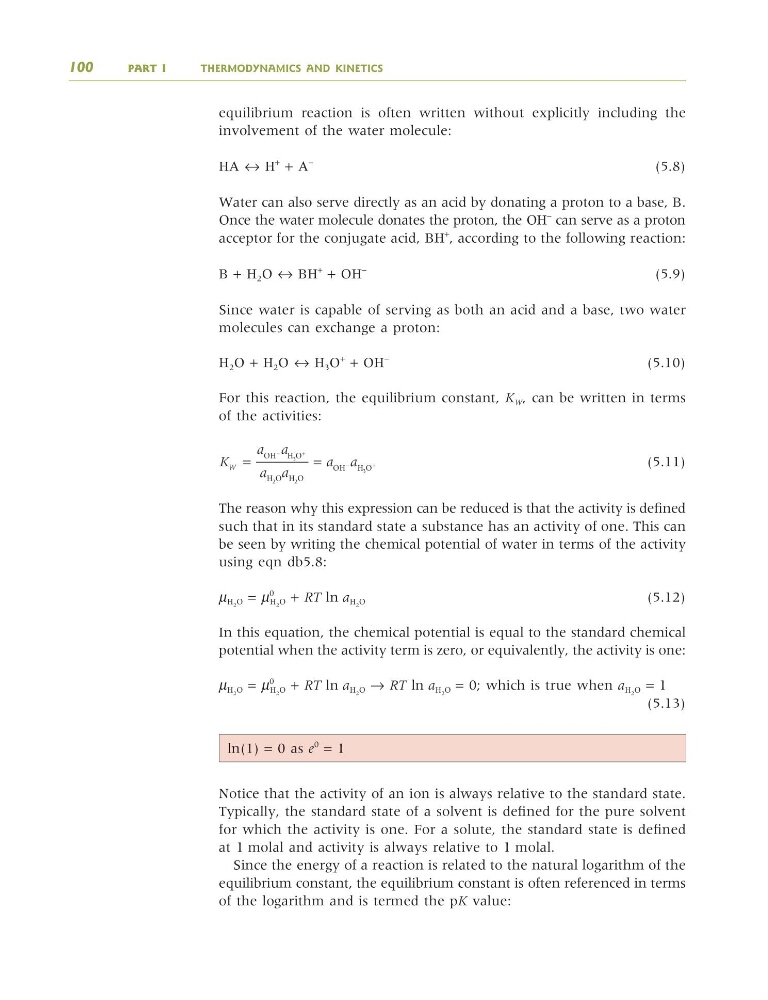
For this reaction, the equilibrium constant, K W , can be written in terms
of the activities:
(5.11)
The reason why this expression can be reduced is that the activity is defined
such that in its standard state a substance has an activity of one. This can
be seen by writing the chemical potential of water in terms of the activity
using eqn db5.8:
μ H 2 O = μ
0
H 2 O + RT ln a H 2 O
(5.12)
In this equation, the chemical potential is equal to the standard chemical
potential when the activity term is zero, or equivalently, the activity is one:
μ H 2 O = μ
0
H 2 O + RT ln a H 2 O → RT ln a H 2 O = 0; which is true when a H 2 O = 1
(5.13)
ln(1) = 0 as e
0
= 1
Notice that the activity of an ion is always relative to the standard state.
Typically, the standard state of a solvent is defined for the pure solvent
for which the activity is one. For a solute, the standard state is defined
at 1 molal and activity is always relative to 1 molal.
Since the energy of a reaction is related to the natural logarithm of the
equilibrium constant, the equilibrium constant is often referenced in terms
of the logarithm and is termed the pK value:
K
a a
a a
a a
W =
=
−
+
−
+
OH H O
H O H O
OH H O
3
2
2
3
9781405124362_4_005.qxd 4/29/08 9:08 Page 100
PART I
THERMODYNAMICS AND KINETICS
equilibrium reaction is often written without explicitly including the
involvement of the water molecule:
HA ↔ H
+
+ A
−
(5.8)
Water can also serve directly as an acid by donating a proton to a base, B.
Once the water molecule donates the proton, the OH
− can serve as a proton
acceptor for the conjugate acid, BH
+
, according to the following reaction:
B + H 2 O ↔ BH
+
+ OH
−
(5.9)
Since water is capable of serving as both an acid and a base, two water
molecules can exchange a proton:
H 2 O + H 2 O ↔ H 3 O
+
+ OH
−
(5.10)
For this reaction, the equilibrium constant, K W , can be written in terms
of the activities:
(5.11)
The reason why this expression can be reduced is that the activity is defined
such that in its standard state a substance has an activity of one. This can
be seen by writing the chemical potential of water in terms of the activity
using eqn db5.8:
μ H 2 O = μ
0
H 2 O + RT ln a H 2 O
(5.12)
In this equation, the chemical potential is equal to the standard chemical
potential when the activity term is zero, or equivalently, the activity is one:
μ H 2 O = μ
0
H 2 O + RT ln a H 2 O → RT ln a H 2 O = 0; which is true when a H 2 O = 1
(5.13)
ln(1) = 0 as e
0
= 1
Notice that the activity of an ion is always relative to the standard state.
Typically, the standard state of a solvent is defined for the pure solvent
for which the activity is one. For a solute, the standard state is defined
at 1 molal and activity is always relative to 1 molal.
Since the energy of a reaction is related to the natural logarithm of the
equilibrium constant, the equilibrium constant is often referenced in terms
of the logarithm and is termed the pK value:
K
a a
a a
a a
W =
=
−
+
−
+
OH H O
H O H O
OH H O
3
2
2
3
9781405124362_4_005.qxd 4/29/08 9:08 Page 100