

96
PART I
THERMODYNAMICS AND KINETICS
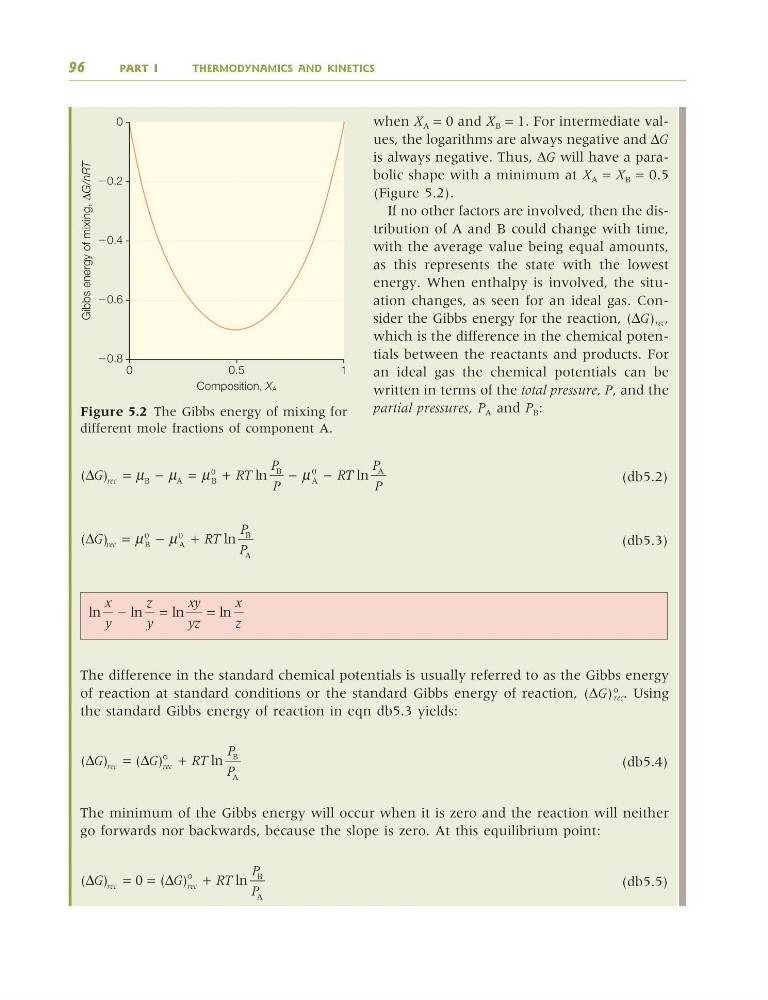
when X A = 0 and X B = 1. For intermediate values, the logarithms are always negative and ΔG
is always negative. Thus, ΔG will have a parabolic shape with a minimum at X A = X B = 0.5
(Figure 5.2).
If no other factors are involved, then the distribution of A and B could change with time,
with the average value being equal amounts,
as this represents the state with the lowest
energy. When enthalpy is involved, the situation changes, as seen for an ideal gas. Consider the Gibbs energy for the reaction, (ΔG) rec ,
which is the difference in the chemical potentials between the reactants and products. For
an ideal gas the chemical potentials can be
written in terms of the total pressure, P, and the
partial pressures, P A and P B :
(db5.2)
(db5.3)
The difference in the standard chemical potentials is usually referred to as the Gibbs energy
of reaction at standard conditions or the standard Gibbs energy of reaction, (ΔG)° rec . Using
the standard Gibbs energy of reaction in eqn db5.3 yields:
(db5.4)
The minimum of the Gibbs energy will occur when it is zero and the reaction will neither
go forwards nor backwards, because the slope is zero. At this equilibrium point:
(db5.5)
( )
( )
ln
Δ
Δ
G
G
R T
P
P
rec
rec
= =
° +
0
B
A
( )
( )
ln
Δ
Δ
G
G
R T
P
P
rec
rec
=
° +
B
A
ln
ln
ln
ln
x
y
z
y
xy
yz
x
z
−
=
=
0
Ϫ0.4
Ϫ0.2
Ϫ0.6
Ϫ0.8
0
0.5
1
Gibbs energy of mixing,
ΔG/nRT
Composition, XA
Figure 5.2 The Gibbs energy of mixing for
different mole fractions of component A.
( )
ln
ΔG
R T
P
P
rec =
−
+
μ
μ
B
A
B
A
0
0
( )
ln
B
ΔG
R T
P
P
R
rec =
−
=
+
−
−
μ
μ
μ
μ
A
B
B
A
0
T T
P
P
ln
A
0
9781405124362_4_005.qxd 4/30/08 19:06 Page 96
PART I
THERMODYNAMICS AND KINETICS
when X A = 0 and X B = 1. For intermediate values, the logarithms are always negative and ΔG
is always negative. Thus, ΔG will have a parabolic shape with a minimum at X A = X B = 0.5
(Figure 5.2).
If no other factors are involved, then the distribution of A and B could change with time,
with the average value being equal amounts,
as this represents the state with the lowest
energy. When enthalpy is involved, the situation changes, as seen for an ideal gas. Consider the Gibbs energy for the reaction, (ΔG) rec ,
which is the difference in the chemical potentials between the reactants and products. For
an ideal gas the chemical potentials can be
written in terms of the total pressure, P, and the
partial pressures, P A and P B :
(db5.2)
(db5.3)
The difference in the standard chemical potentials is usually referred to as the Gibbs energy
of reaction at standard conditions or the standard Gibbs energy of reaction, (ΔG)° rec . Using
the standard Gibbs energy of reaction in eqn db5.3 yields:
(db5.4)
The minimum of the Gibbs energy will occur when it is zero and the reaction will neither
go forwards nor backwards, because the slope is zero. At this equilibrium point:
(db5.5)
( )
( )
ln
Δ
Δ
G
G
R T
P
P
rec
rec
= =
° +
0
B
A
( )
( )
ln
Δ
Δ
G
G
R T
P
P
rec
rec
=
° +
B
A
ln
ln
ln
ln
x
y
z
y
xy
yz
x
z
−
=
=
0
Ϫ0.4
Ϫ0.2
Ϫ0.6
Ϫ0.8
0
0.5
1
Gibbs energy of mixing,
ΔG/nRT
Composition, XA
Figure 5.2 The Gibbs energy of mixing for
different mole fractions of component A.
( )
ln
ΔG
R T
P
P
rec =
−
+
μ
μ
B
A
B
A
0
0
( )
ln
B
ΔG
R T
P
P
R
rec =
−
=
+
−
−
μ
μ
μ
μ
A
B
B
A
0
T T
P
P
ln
A
0
9781405124362_4_005.qxd 4/30/08 19:06 Page 96