

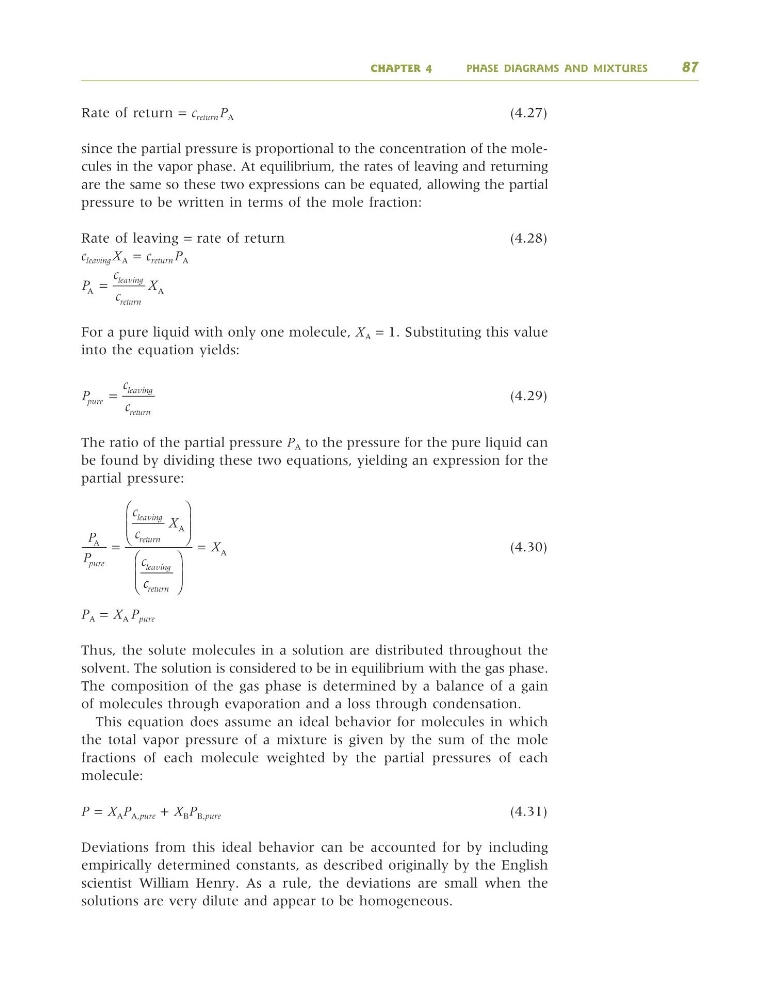
Rate of return = c return P A
(4.27)
since the partial pressure is proportional to the concentration of the molecules in the vapor phase. At equilibrium, the rates of leaving and returning
are the same so these two expressions can be equated, allowing the partial
pressure to be written in terms of the mole fraction:
Rate of leaving = rate of return
(4.28)
c lea9ing X A = c return P A
For a pure liquid with only one molecule, X A = 1. Substituting this value
into the equation yields:
(4.29)
The ratio of the partial pressure P A to the pressure for the pure liquid can
be found by dividing these two equations, yielding an expression for the
partial pressure:
(4.30)
P A = X A P pure
Thus, the solute molecules in a solution are distributed throughout the
solvent. The solution is considered to be in equilibrium with the gas phase.
The composition of the gas phase is determined by a balance of a gain
of molecules through evaporation and a loss through condensation.
This equation does assume an ideal behavior for molecules in which
the total vapor pressure of a mixture is given by the sum of the mole
fractions of each molecule weighted by the partial pressures of each
molecule:
P = X A P A,pure + X B P B,pure
(4.31)
Deviations from this ideal behavior can be accounted for by including
empirically determined constants, as described originally by the English
scientist William Henry. As a rule, the deviations are small when the
solutions are very dilute and appear to be homogeneous.
P
P
c
c
X
c
pure
lea ing
return
lea ing
A
A
=
⎛
⎝
⎜
⎜
⎞
⎠
⎟
⎟
9
9
c c
X
return
⎛
⎝
⎜
⎜
⎞
⎠
⎟
⎟
= A
P
c
c
pure
lea ing
return
=
9
P
c
c
X
lea ing
return
A
A
=
9
CHAPTER 4
PHASE DIAGRAMS AND MIXTURES
87
9781405124362_4_004.qxd 4/29/08 9:08 Page 87
(4.27)
since the partial pressure is proportional to the concentration of the molecules in the vapor phase. At equilibrium, the rates of leaving and returning
are the same so these two expressions can be equated, allowing the partial
pressure to be written in terms of the mole fraction:
Rate of leaving = rate of return
(4.28)
c lea9ing X A = c return P A
For a pure liquid with only one molecule, X A = 1. Substituting this value
into the equation yields:
(4.29)
The ratio of the partial pressure P A to the pressure for the pure liquid can
be found by dividing these two equations, yielding an expression for the
partial pressure:
(4.30)
P A = X A P pure
Thus, the solute molecules in a solution are distributed throughout the
solvent. The solution is considered to be in equilibrium with the gas phase.
The composition of the gas phase is determined by a balance of a gain
of molecules through evaporation and a loss through condensation.
This equation does assume an ideal behavior for molecules in which
the total vapor pressure of a mixture is given by the sum of the mole
fractions of each molecule weighted by the partial pressures of each
molecule:
P = X A P A,pure + X B P B,pure
(4.31)
Deviations from this ideal behavior can be accounted for by including
empirically determined constants, as described originally by the English
scientist William Henry. As a rule, the deviations are small when the
solutions are very dilute and appear to be homogeneous.
P
P
c
c
X
c
pure
lea ing
return
lea ing
A
A
=
⎛
⎝
⎜
⎜
⎞
⎠
⎟
⎟
9
9
c c
X
return
⎛
⎝
⎜
⎜
⎞
⎠
⎟
⎟
= A
P
c
c
pure
lea ing
return
=
9
P
c
c
X
lea ing
return
A
A
=
9
CHAPTER 4
PHASE DIAGRAMS AND MIXTURES
87
9781405124362_4_004.qxd 4/29/08 9:08 Page 87