

Anguillidae Anguilla japomca
et:
26
Japanese
freshwater eel
UNAGl
-.….
…………………
…..-…-…-…\
N.olf.
N‘°'f‘
-—
_
bulb.olf.
lob.olf.
lob.olf.
sac_…_
ch.opt.
infund.
lob.inf.
lob.mf.
_
cbl
c.cbi.
————3
NS.
'
'
vent.q.
N.9.+10.
.
_
med.ob.
‘
N.9.+1
med.s
med-sp.
5"…
lateral
'ventrai
dorsal
___—___—_——————————————
Descriptive notes :
“âîîiâ”âËlîËîä L,“Cäg U
.
Adults attain about 60 cm in body length.
%ËLÎL\5_
Body extremely elongated and
eel-like shape.
3Ër‘Ëœqmz
t/l\gä(à/]\È { 5E%5Ëfææ_
Anterior part of body not compressed but posterior part well
$Ël:läêjîëäîü) 1 @ (5ÊËËË) (g;< %iËL'CL‘6.
compressed.
Scales slender and small and burried under
skin.
Eyes especially small; nostrils large; lower jaw somewhat
longer than upper.
Body color dark-brown or leaden blue; ventral surface,
silver-white with scattered irregular spots.
Fish of this kind ascend rivers entering seas influenced by
Japan Current (Black Stream), and grow to maturity there.
After attaining maturity they descend rivers to seas.
ln the daytime hide in the fresh and muddy waters, in mud
and among stones.
Search for food at night by means of
olfactory sense.
'
»
.
Extent of migration wide.
Swimming movement slow.
Caught by sniggling, pole and lines, long lines and eel-pots.
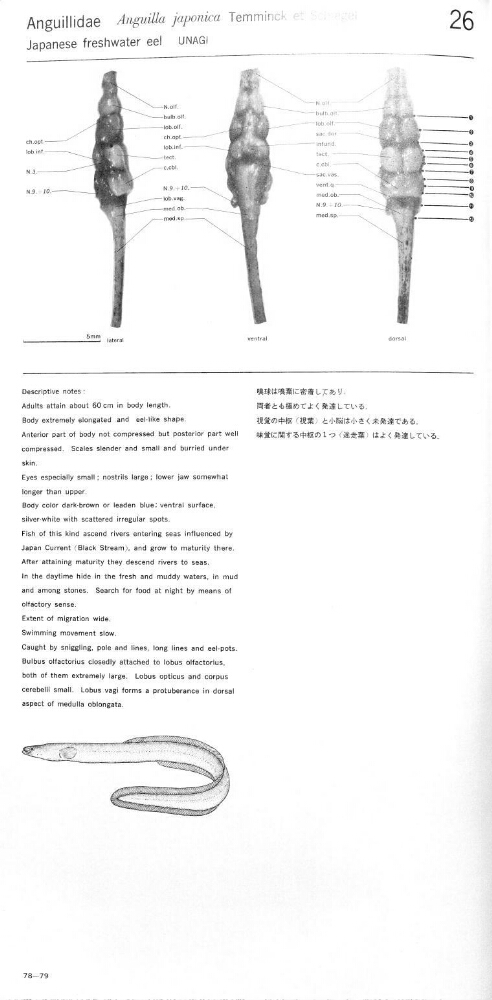
Bulbus olfactorius closedly attached to lobus olfactorius,
both of them extremely large.
Lobus opticus and corpus
cerebelli small.
Lobus vagi forms a protuberance in dorsal
aspect of medulla oblongata.
'
,
_
f
78—79
-
et:
26
Japanese
freshwater eel
UNAGl
-.….
…………………
…..-…-…-…\
N.olf.
N‘°'f‘
-—
_
bulb.olf.
lob.olf.
lob.olf.
sac_…_
ch.opt.
infund.
lob.inf.
lob.mf.
_
cbl
c.cbi.
————3
NS.
'
'
vent.q.
N.9.+10.
.
_
med.ob.
‘
N.9.+1
med.s
med-sp.
5"…
lateral
'ventrai
dorsal
___—___—_——————————————
Descriptive notes :
“âîîiâ”âËlîËîä L,“Cäg U
.
Adults attain about 60 cm in body length.
%ËLÎL\5_
Body extremely elongated and
eel-like shape.
3Ër‘Ëœqmz
t/l\gä(à/]\È { 5E%5Ëfææ_
Anterior part of body not compressed but posterior part well
$Ël:läêjîëäîü) 1 @ (5ÊËËË) (g;< %iËL'CL‘6.
compressed.
Scales slender and small and burried under
skin.
Eyes especially small; nostrils large; lower jaw somewhat
longer than upper.
Body color dark-brown or leaden blue; ventral surface,
silver-white with scattered irregular spots.
Fish of this kind ascend rivers entering seas influenced by
Japan Current (Black Stream), and grow to maturity there.
After attaining maturity they descend rivers to seas.
ln the daytime hide in the fresh and muddy waters, in mud
and among stones.
Search for food at night by means of
olfactory sense.
'
»
.
Extent of migration wide.
Swimming movement slow.
Caught by sniggling, pole and lines, long lines and eel-pots.
Bulbus olfactorius closedly attached to lobus olfactorius,
both of them extremely large.
Lobus opticus and corpus
cerebelli small.
Lobus vagi forms a protuberance in dorsal
aspect of medulla oblongata.
'
,
_
f
78—79
-