

Salmon ldâ€
Salma gazrdneru
mdeu3
….
Rainbow trout
NIJIMASU
'
.
î
N.…f.
_
N-°”.
,
_
.
.
sac.d0r—
sac.d0f—
'
lob.olf.
‘°b'°'f'
.
sul.yp.
‘
_
,
t
Î:'
_—.
ch.opt.
_
î:h.0P
-
tech
tect.
…
.
,
_
infund.
emin.grânhypos.
lob.înf.
:
_
.
|0b'mf
N 9 +10
.
sac.vas.
-"
,
%
N.3.
ccbl
med.ob
'
'
,
'
sac.
med.sp.
med'0b'
=f
,
ccbl
med.sp
.
N.9.+10.
'
'
,
;
lateral
ventral
dorsal
'
,
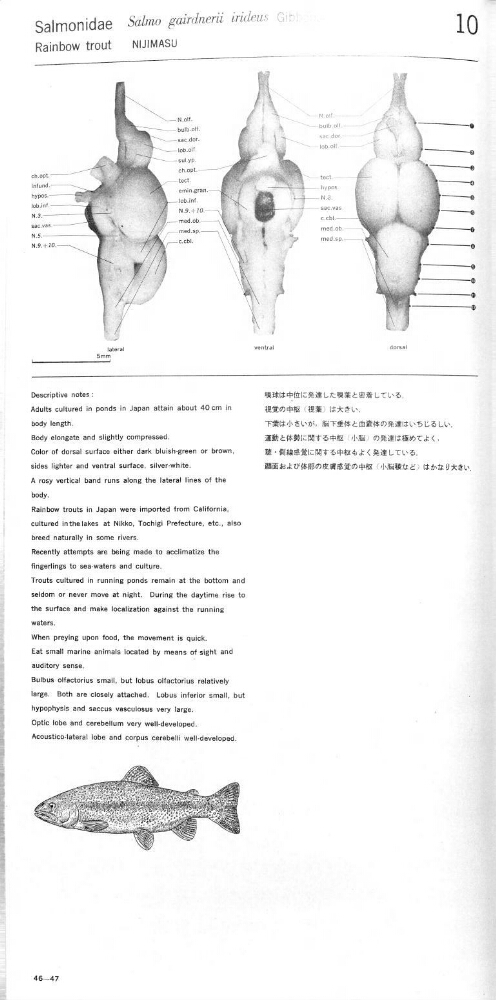
Descriptive notes:
DîïâälätFll:%âäLfdätÊ—ËLtbæ_
_
_
_
Adults cultured in ponds in Japan attain about 40 cm in
lËË®$ËX
lËÎÊL\.
body length.
“FËli/l\ët\ûî, HêiTâl$ànäl$œ%iäläbätæLtx
-
'
Î
Body elongate and slightly compressed.
.
(ll\Hiä) ®%Ëlîäbîà <,
Color of dorsal surface either dark bluish—green or brown,
gg .
( %ËL'CL‘ZD.
_
'
sides lighter and ventre] surface, silver-white.
{xixëÿü,£)
.
A rosy vertical band runs along the lateral lines of the
body.
_
»
Rainbow trouts in Japan were imported from California,
’
cultured-inthelakes at Nikko, Tochigi Prefecture, etc., also
-
‘
breed naturally in some rivers.
,
-.
â
Recently attempts are being made to acclimatize the '
'
‘
%
fingerlings to sea-waters and culture.
ä
Trouts cultured
in running ponds remain at the bottom and
-
'
,
[
î
seldom or never move at night.
During the daytime rise to
î
the surface and make localization against the running
%
waters.
-
—
'
T‘
.
_
When preying upon food, the movement is quick.
,
î
Eat small marine animals locatedbÿ means of sight and
â
auditory sense.
_
f
.
.
Ë
Bulbus
small, bÏut
relatively
'
‘
.
Ë
‘
large.
a&aChe_d}
inferior small, but
.
%
hjypophy‘sl;
,
,
-
…
_.
'
“
.
;
«
_
,
, _.
;“
% .
_
Optic
.‘Cefïêb‘ellUÙΑy-erÿ
.
_
-
__
g
i]
'
_
-‘
*
f
.
Îâ
.
'
-
'
-_
,
,
;
,_
,
…
â
46—47
'
-
'
_
‘
Salma gazrdneru
mdeu3
….
Rainbow trout
NIJIMASU
'
.
î
N.…f.
_
N-°”.
,
_
.
.
sac.d0r—
sac.d0f—
'
lob.olf.
‘°b'°'f'
.
sul.yp.
‘
_
,
t
Î:'
_—.
ch.opt.
_
î:h.0P
-
tech
tect.
…
.
,
_
infund.
emin.grânhypos.
lob.înf.
:
_
.
|0b'mf
N 9 +10
.
sac.vas.
-"
,
%
N.3.
ccbl
med.ob
'
'
,
'
sac.
med.sp.
med'0b'
=f
,
ccbl
med.sp
.
N.9.+10.
'
'
,
;
lateral
ventral
dorsal
'
,
Descriptive notes:
DîïâälätFll:%âäLfdätÊ—ËLtbæ_
_
_
_
Adults cultured in ponds in Japan attain about 40 cm in
lËË®$ËX
lËÎÊL\.
body length.
“FËli/l\ët\ûî, HêiTâl$ànäl$œ%iäläbätæLtx
-
'
Î
Body elongate and slightly compressed.
.
(ll\Hiä) ®%Ëlîäbîà <,
Color of dorsal surface either dark bluish—green or brown,
gg .
( %ËL'CL‘ZD.
_
'
sides lighter and ventre] surface, silver-white.
{xixëÿü,£)
.
A rosy vertical band runs along the lateral lines of the
body.
_
»
Rainbow trouts in Japan were imported from California,
’
cultured-inthelakes at Nikko, Tochigi Prefecture, etc., also
-
‘
breed naturally in some rivers.
,
-.
â
Recently attempts are being made to acclimatize the '
'
‘
%
fingerlings to sea-waters and culture.
ä
Trouts cultured
in running ponds remain at the bottom and
-
'
,
[
î
seldom or never move at night.
During the daytime rise to
î
the surface and make localization against the running
%
waters.
-
—
'
T‘
.
_
When preying upon food, the movement is quick.
,
î
Eat small marine animals locatedbÿ means of sight and
â
auditory sense.
_
f
.
.
Ë
Bulbus
small, bÏut
relatively
'
‘
.
Ë
‘
large.
a&aChe_d}
inferior small, but
.
%
hjypophy‘sl;
,
,
-
…
_.
'
“
.
;
«
_
,
, _.
;“
% .
_
Optic
.‘Cefïêb‘ellUÙΑy-erÿ
.
_
-
__
g
i]
'
_
-‘
*
f
.
Îâ
.
'
-
'
-_
,
,
;
,_
,
…
â
46—47
'
-
'
_
‘