

'
°
=
.…Ë:
"
Serran|dae Doderlemza
r
_
AKAMUTS_U
___…_…_____
"
N olf.
N.olf.
.
bulb.olf.
lob.olf.
_
‘°b'OH
ch opt.
sac.Vâ$
“__“_“——0
ch.opt.
h
lob.inf.
———————9
lob.inf.
teyft
'
teCt_
___—9
-—————0
N.3.
N—3—
c.cbl.
@
_
C.CbL
.
___—©
_
emin.gran.
emm.gran.
————————0
.
acu_lat.a.
'°b'fac'
___—@
cri5t.cbl.
meb'°b‘
___—â
med,_ob.
_____œ
.
»
'
med.sp.
.
d.sp.
me
@
L___-îŒn lateral
ventral
dorsal
Descriptive notes :
Adults attain about 30 cm in body length.
“âËlä/l\ëb\
Body more or less slender and compressed.
?ËÊtEË - {ËUÆÊËlËJC<
Il\HEälâ£/l\ëb.
Mouth wide and cleft obliquely; teeth irregular with
numerous canines.
Eyes extremely large.
'
Body color somewhat greyish-red,- ventral surface lighter.
of mouth, black.
—
.
Live at the san-dy and muddy bottoms of comparativelÿ deep
waters of the continental shelf.
.
Eat small marine
animals located by means of gustatory
and“ olfactory senses.
Extent of migration narrow.
.
‘
Swimming mwement slow.
_
.
’
Found in the waters of Hokkaido and districts to the south,
as well as south Korea.
Known as warm current fish.
.
Caught mainly by bottom set nets, trawls and trawlers.
'
.
,
'
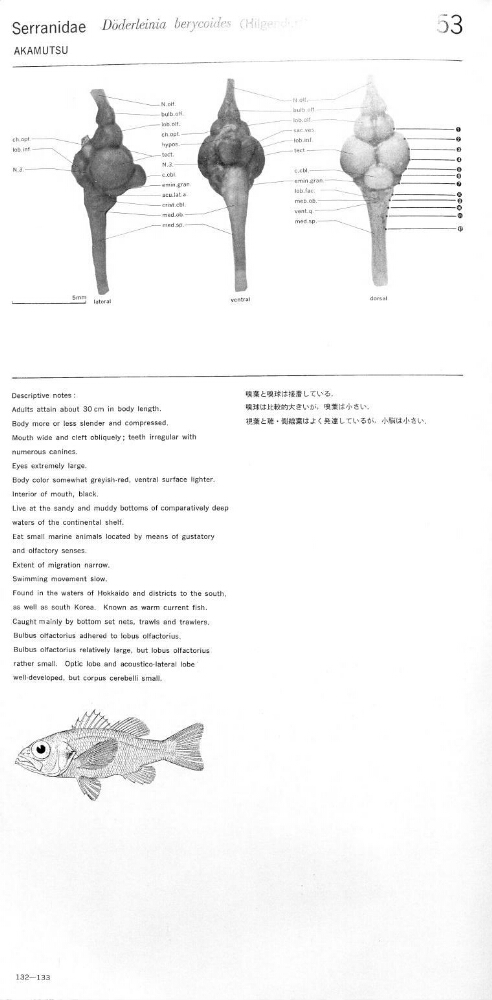
Bulbus olfactorius adhered tolobus olfactdrius.
Bulbus olfactorius relatively large, but lobus olfactorius
'
'
.
:
rather small.
Optic lobe and ac‘oustiCo-laterallobe'
'
.
,
.
well—developed, but corpus cerebelli small.
‘
°
=
.…Ë:
"
Serran|dae Doderlemza
r
_
AKAMUTS_U
___…_…_____
"
N olf.
N.olf.
.
bulb.olf.
lob.olf.
_
‘°b'OH
ch opt.
sac.Vâ$
“__“_“——0
ch.opt.
h
lob.inf.
———————9
lob.inf.
teyft
'
teCt_
___—9
-—————0
N.3.
N—3—
c.cbl.
@
_
C.CbL
.
___—©
_
emin.gran.
emm.gran.
————————0
.
acu_lat.a.
'°b'fac'
___—@
cri5t.cbl.
meb'°b‘
___—â
med,_ob.
_____œ
.
»
'
med.sp.
.
d.sp.
me
@
L___-îŒn lateral
ventral
dorsal
Descriptive notes :
Adults attain about 30 cm in body length.
“âËlä/l\ëb\
Body more or less slender and compressed.
?ËÊtEË - {ËUÆÊËlËJC<
Il\HEälâ£/l\ëb.
Mouth wide and cleft obliquely; teeth irregular with
numerous canines.
Eyes extremely large.
'
Body color somewhat greyish-red,- ventral surface lighter.
of mouth, black.
—
.
Live at the san-dy and muddy bottoms of comparativelÿ deep
waters of the continental shelf.
.
Eat small marine
animals located by means of gustatory
and“ olfactory senses.
Extent of migration narrow.
.
‘
Swimming mwement slow.
_
.
’
Found in the waters of Hokkaido and districts to the south,
as well as south Korea.
Known as warm current fish.
.
Caught mainly by bottom set nets, trawls and trawlers.
'
.
,
'
Bulbus olfactorius adhered tolobus olfactdrius.
Bulbus olfactorius relatively large, but lobus olfactorius
'
'
.
:
rather small.
Optic lobe and ac‘oustiCo-laterallobe'
'
.
,
.
well—developed, but corpus cerebelli small.
‘