

4—10.
EINSTEIN’S PHOTOELECTRIC EQUATION
81
the light by Richardson'and Compton and also by Hughes in 1912.
.
However, it remained for Millikan and his aSsociates, in 1916, to
_
make the experimental proof of Einstein’s equation entirely
convincing by the great care which they used to eliminate all
sources of error.
The
was a veritable
“
machine
shop in a vacuum.”3
Fresh surfaces of lithium, sodium and
potassium were prepared in a vacuum by means of a knife and
rotating mechanism. Contact potential differences were measured
by the Kelvin method wherein an auxiliary battery is used to
balance this potential; the two potentials were known to be equal
—
when a movement of one of the electrodes no longer set up a current
in their external circuit.
Now, from equations 4—6 and 4—10,
Vae = %mv2max = hv — (75.
(4—11)
.
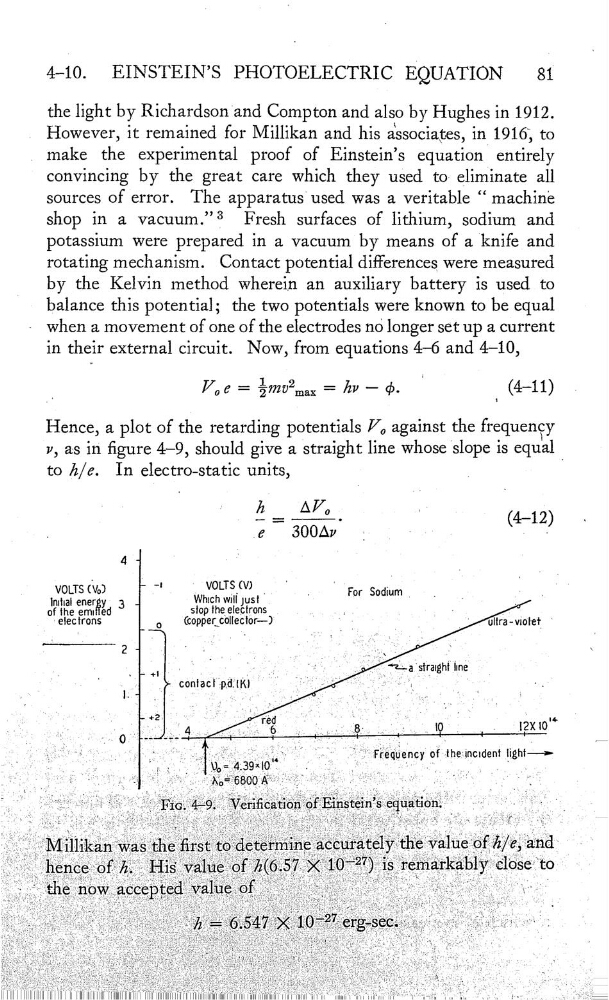
Hence, a plot of the retarding potentials 170 against the frequency
v, as in gure 4—9, should give a straight line whose slope is equal
to h/e. In electro-static units,
,
'
];
AV
,
-
_
:
——-°—.
(4—12)
.
.4
‘
'
vous(va
."
\ VOLT_5.“‘”
.
.
For Sodium
_
—
lmhal enerÊy
3
Whtch w:ll,usî _
‘
‘
_
ofîhe em: ed
sî0plhe…elecfrons
.
.
:
,
-
.
electrons
°
(copper_colleclor—)
'
‘
ultra—violet ‘
_
_
+:
:
lmè
_
‘
‘
_:
‘
coniaclb.“lKl
‘
‘
—.
…
M
‘
…
‘4
_
…
_
““El
1………;s
…»
…:o
…
.
:2x:0'*
:=--. M‘?…o=Ï4-39*Ç'9‘
Ü
…
=
«
Ï
7Ào=6800A
:
:”
‘
‘
‘
—
”
-
‘
_
,
mm :
…:
EINSTEIN’S PHOTOELECTRIC EQUATION
81
the light by Richardson'and Compton and also by Hughes in 1912.
.
However, it remained for Millikan and his aSsociates, in 1916, to
_
make the experimental proof of Einstein’s equation entirely
convincing by the great care which they used to eliminate all
sources of error.
The
was a veritable
“
machine
shop in a vacuum.”3
Fresh surfaces of lithium, sodium and
potassium were prepared in a vacuum by means of a knife and
rotating mechanism. Contact potential differences were measured
by the Kelvin method wherein an auxiliary battery is used to
balance this potential; the two potentials were known to be equal
—
when a movement of one of the electrodes no longer set up a current
in their external circuit.
Now, from equations 4—6 and 4—10,
Vae = %mv2max = hv — (75.
(4—11)
.
Hence, a plot of the retarding potentials 170 against the frequency
v, as in gure 4—9, should give a straight line whose slope is equal
to h/e. In electro-static units,
,
'
];
AV
,
-
_
:
——-°—.
(4—12)
.
.4
‘
'
vous(va
."
\ VOLT_5.“‘”
.
.
For Sodium
_
—
lmhal enerÊy
3
Whtch w:ll,usî _
‘
‘
_
ofîhe em: ed
sî0plhe…elecfrons
.
.
:
,
-
.
electrons
°
(copper_colleclor—)
'
‘
ultra—violet ‘
_
_
+:
:
lmè
_
‘
‘
_:
‘
coniaclb.“lKl
‘
‘
—.
…
M
‘
…
‘4
_
…
_
““El
1………;s
…»
…:o
…
.
:2x:0'*
:=--. M‘?…o=Ï4-39*Ç'9‘
Ü
…
=
«
Ï
7Ào=6800A
:
:”
‘
‘
‘
—
”
-
‘
_
,
mm :
…: