

,
.
4—8.
DUALISTÏC NATURE OF RADIANT ENERGY
77
-
theory of metallic conductors, the number of electrons With veloci—
ties near the maximum velocity does not suddenly reduce to zero
except when the emitting surface is at zero degrees absolute.
At room temperatures, the distribution curve, instead of plunging
into the velocity axis, approaches it at an angle. However, the
slope of the curve is so great that, at least for rough work, it is
easily possible to identify the maximum value. Thus, in gure 4—7,
the lower left end of the curve would cut sharply into the voltage
.’
axis at zero degrees absolute and does approach the axis fairly
rapidly at room temperatures.
_
Films of silver of increasing thicknesses have been used as the
eritting surface. A critical thickness about one-hundred atoms
deep has been found. For thicker surfaces the electrons have a
wide distribution of velocities, as pointed out above, but for lms
of lesser thickness, the electrons all “have much morenearly the
same velocity. It is known that these thin metallic lms are quite
.
transparent to the ultra—violet light used.
.
Hence, it appears that
in* the case of silver most of the
_
photo—electrons originate in a sur—
"
face
layer one-hundred atoms
2400A
i
-thick.
_
2540A
.
‘
'
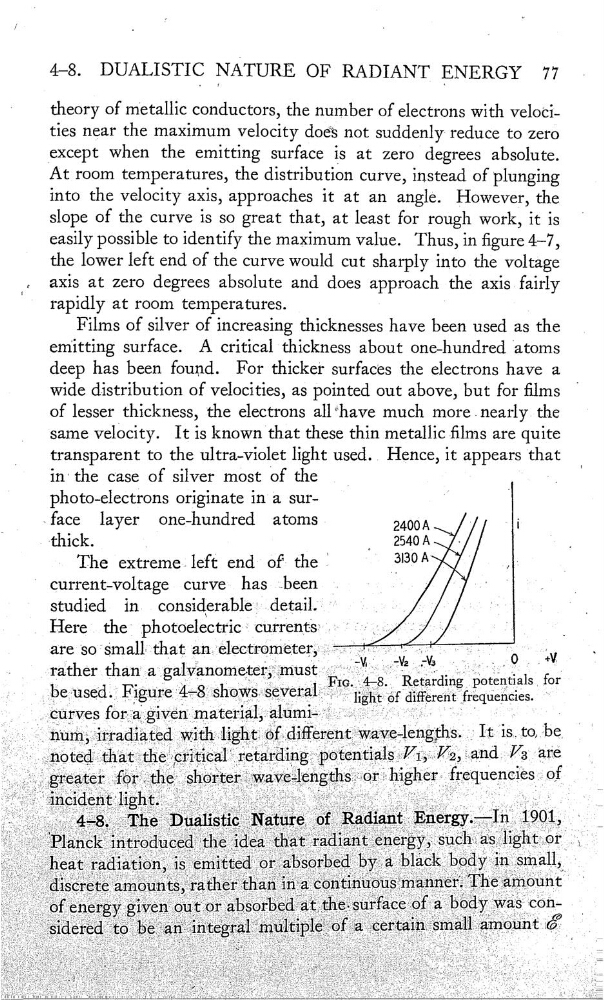
The extremeleft end of the
__3'30A .
,=
_
‘
current-voltage curve has been
.
.'
'
,
_
studied
in
considerable'qÎdetail.f
-
_
«
,
.
‘
_
_
Here. the photoelectr’ic» currentSî
"
«
"
_
are ‘so Small«that an
…
‘0
N
.
.
_
rather
“
‘;. '
’
.
-
.
.
.,
.
…
Retardmg_potentrs_ for
‘
be used F1gure 4—83howssevelallight of
‘“
numnrad1atedw1thhght@fdlerentwavelengths 1î‘îS=
madenthght
SlderedtobeanmœgralmultWïe®fa°‘3ftamenall""mOunt
.
-
.
4—8.
DUALISTÏC NATURE OF RADIANT ENERGY
77
-
theory of metallic conductors, the number of electrons With veloci—
ties near the maximum velocity does not suddenly reduce to zero
except when the emitting surface is at zero degrees absolute.
At room temperatures, the distribution curve, instead of plunging
into the velocity axis, approaches it at an angle. However, the
slope of the curve is so great that, at least for rough work, it is
easily possible to identify the maximum value. Thus, in gure 4—7,
the lower left end of the curve would cut sharply into the voltage
.’
axis at zero degrees absolute and does approach the axis fairly
rapidly at room temperatures.
_
Films of silver of increasing thicknesses have been used as the
eritting surface. A critical thickness about one-hundred atoms
deep has been found. For thicker surfaces the electrons have a
wide distribution of velocities, as pointed out above, but for lms
of lesser thickness, the electrons all “have much morenearly the
same velocity. It is known that these thin metallic lms are quite
.
transparent to the ultra—violet light used.
.
Hence, it appears that
in* the case of silver most of the
_
photo—electrons originate in a sur—
"
face
layer one-hundred atoms
2400A
i
-thick.
_
2540A
.
‘
'
The extremeleft end of the
__3'30A .
,=
_
‘
current-voltage curve has been
.
.'
'
,
_
studied
in
considerable'qÎdetail.f
-
_
«
,
.
‘
_
_
Here. the photoelectr’ic» currentSî
"
«
"
_
are ‘so Small«that an
…
‘0
N
.
.
_
rather
“
‘;. '
’
.
-
.
.
.,
.
…
Retardmg_potentrs_ for
‘
be used F1gure 4—83howssevelallight of
‘“
numnrad1atedw1thhght@fdlerentwavelengths 1î‘îS=
madenthght
SlderedtobeanmœgralmultWïe®fa°‘3ftamenall""mOunt
.
-