

74
4.
PHOTOELECTRIC EMISSION
*
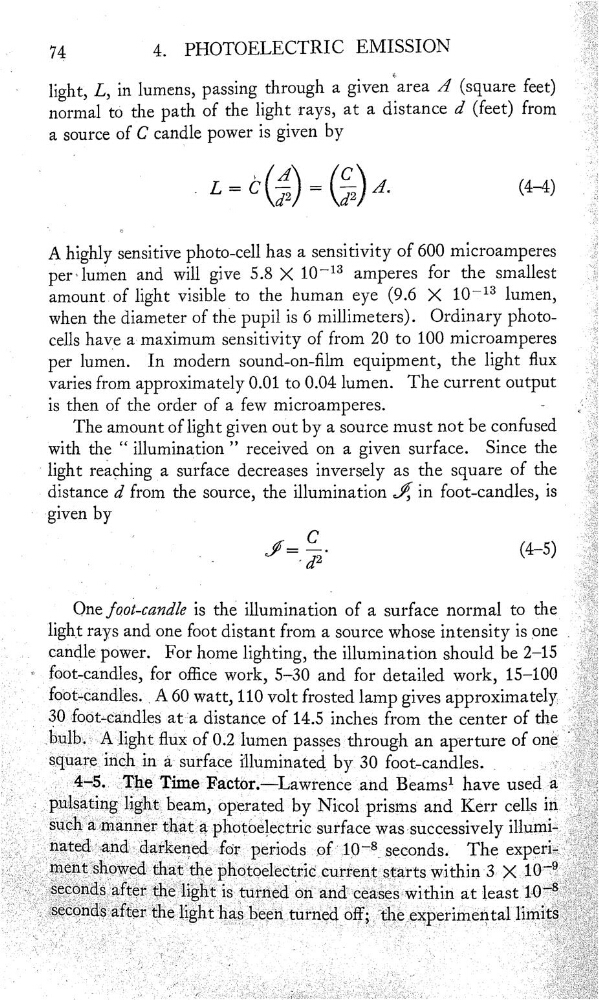
light, L, in lumens, passing through a
 (square feet)
normal to the path of the light rays,
at a distance d (feet) from
3. source of C candle power
is given by
‘
\
Â
C
.
-
L =
C<ÎZ)
=
(252)
Â
A highly sensitive photo-cell has a sensitivity of 600 microamperes
and Will give 5.8 X 10"13 amperes
for the smallest
amountof light visible to the human eye (9.6 X 10”13 lumen,
when the diameter of the pupil is 6 millimeters). Ordinary photocells have a maximum sensitivity of from 20 to 100 microamperes
per lumen.
In modern sound-on—lm equipment, the light ux
varies from approximately 0.01 to 0.04 lumen. The current output
is then of the order of a few microamperes.
—
The amount of light given out by a source must not be confused
with the
“
illumination
”
received on a given surface. Since the
‘
light reaching a surface decreases inversely as the square
of the
distance 41 from the source, the illumination .f, in foot-candles, is
given by
‘
"
C
,
'
'
j='
(4—5)
One faot—candle is the illumination of a surface normal to the
light rays and one foot distant from a source whose intensity is one
_
cahdle‘ power. For home lighting, the illumination should be 2—15
for ofce work, 5—30 and for detailed work, 15—100
_
A 60 watt, 110 volt frosted lamp gives approximately
-
at ’a distance of 14.5 inches from the center of the
uX of 0.2 lumen passes through an ap‘erture
of
Squaremch in a surface illuminated by 30 foot—candles.
,
;
and Beams1 have useda
operated by Nicol prisms and Kerr cells in
'_ 1 '
surface Was successively
of ; 10“8w seconds.
The expen—
mentShÛWGdthattheph0t0€lecü’lcCurfe,ntï,,sta‘rts Within & ><
secondsafœrthehghtlsturned on andœasesw1thm at least 10-8
4.
PHOTOELECTRIC EMISSION
*
light, L, in lumens, passing through a
 (square feet)
normal to the path of the light rays,
at a distance d (feet) from
3. source of C candle power
is given by
‘
\
Â
C
.
-
L =
C<ÎZ)
=
(252)
Â
A highly sensitive photo-cell has a sensitivity of 600 microamperes
and Will give 5.8 X 10"13 amperes
for the smallest
amountof light visible to the human eye (9.6 X 10”13 lumen,
when the diameter of the pupil is 6 millimeters). Ordinary photocells have a maximum sensitivity of from 20 to 100 microamperes
per lumen.
In modern sound-on—lm equipment, the light ux
varies from approximately 0.01 to 0.04 lumen. The current output
is then of the order of a few microamperes.
—
The amount of light given out by a source must not be confused
with the
“
illumination
”
received on a given surface. Since the
‘
light reaching a surface decreases inversely as the square
of the
distance 41 from the source, the illumination .f, in foot-candles, is
given by
‘
"
C
,
'
'
j='
(4—5)
One faot—candle is the illumination of a surface normal to the
light rays and one foot distant from a source whose intensity is one
_
cahdle‘ power. For home lighting, the illumination should be 2—15
for ofce work, 5—30 and for detailed work, 15—100
_
A 60 watt, 110 volt frosted lamp gives approximately
-
at ’a distance of 14.5 inches from the center of the
uX of 0.2 lumen passes through an ap‘erture
of
Squaremch in a surface illuminated by 30 foot—candles.
,
;
and Beams1 have useda
operated by Nicol prisms and Kerr cells in
'_ 1 '
surface Was successively
of ; 10“8w seconds.
The expen—
mentShÛWGdthattheph0t0€lecü’lcCurfe,ntï,,sta‘rts Within & ><
secondsafœrthehghtlsturned on andœasesw1thm at least 10-8