

'
56
-
3.
WAVE—LENGTH OF THE ELECTRON
electrons from the surface atoms of the crystal has shown that the
relation )\ : ]z/mv may be used with accuracy in the calculation of
the electron wave-length, equation 3—9 may
be used to obtain
'
values of ,a.
In this manner the index of refraction of a nickel
crystal has been found to range from 1.00 to 1.12 for electrons
accelerated by potentials from 460 to 67 volts.
3—7.
Surface Energy—As is known from other studies, the
nature of conductors is such that electrons do not y off readily
into the Surrounding space.
There is some form of attraction for
electrons at the surface of metals.
Thus, when an electron approaches sufciently close to a metal, surface forces act upon
it to
draw it inside and increase its energy by an amount
called the
_
surface energy.
Similarly, when leaving the metal, an electron
'
must have an
sufcient to overcome this potential barrier
â,.*
the value of this energy is used as the potential energy
.
in Schrôdinger’s wave-equation (3—1), the wave-length of the
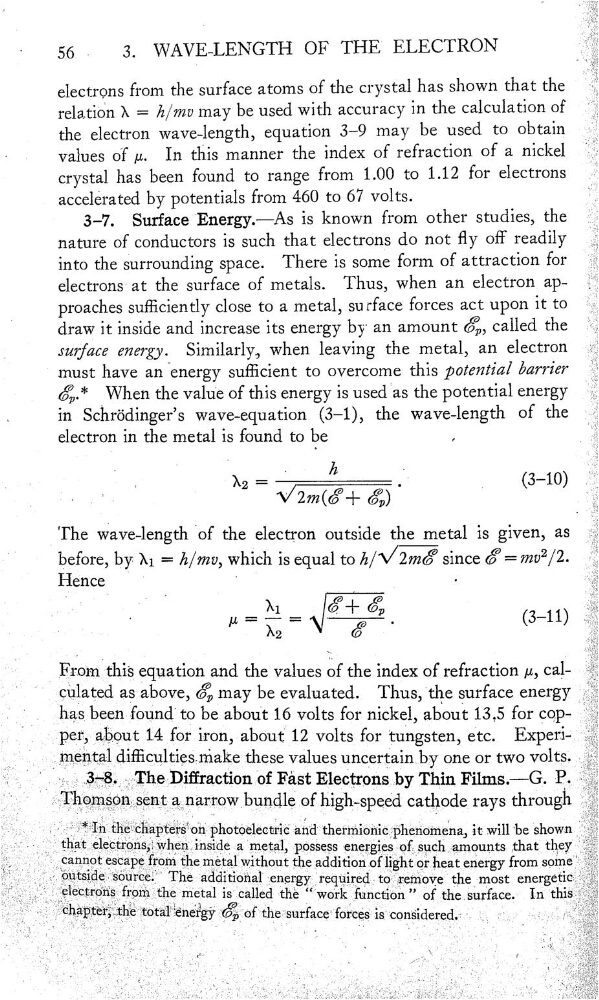
electron in the metal is found to be
,
,
-
x
=
.
3—10
,
2
V2m((o@+é‘ä)
(
)
The wave-length
the electron outside the metal is given, as
'
before, by >\1 = h/ mv, which is equal to h/V2m(Ë since @@ = m02/2.
Hence
‘
.
(311)
'
,
'
M
a
'
'
From this equation and the values of the index of refraction la, cal—
as above, éÎ, may be evaluated. Thus, ”the surface energy
_
_
-
has been found to be about 16 volts for nickel, about 13.5 for cop—
_
about 14 for iron, about 12 volts for tuhgsten, etc. Experi—_
'
- _
these values une_ertain by one or two volts.
"à
f. ;:r:- ;ëräë-ggçæflîheDiffraction
of Fast
by Thin Films.——G. P,.
'
of high—speed cathode rays thrOugh
î” - j ;
i
photOelec—tri_ë and“themiioic;pheomàææ, it will “be shown
that…
‘a metal,
such amounts that they -Ÿ
p… them:eialwithw
from m
1ttdf…h“î…
>°“9îgï.ÿ
the.m°st gt
_
-
_,
_
,
a
is called the
work-function ” of
In
chaPt€r,thët0talenergy ôÎ,of thaï—surface“forces= is"‘conëidered.v z
,
.f_
56
-
3.
WAVE—LENGTH OF THE ELECTRON
electrons from the surface atoms of the crystal has shown that the
relation )\ : ]z/mv may be used with accuracy in the calculation of
the electron wave-length, equation 3—9 may
be used to obtain
'
values of ,a.
In this manner the index of refraction of a nickel
crystal has been found to range from 1.00 to 1.12 for electrons
accelerated by potentials from 460 to 67 volts.
3—7.
Surface Energy—As is known from other studies, the
nature of conductors is such that electrons do not y off readily
into the Surrounding space.
There is some form of attraction for
electrons at the surface of metals.
Thus, when an electron approaches sufciently close to a metal, surface forces act upon
it to
draw it inside and increase its energy by an amount
called the
_
surface energy.
Similarly, when leaving the metal, an electron
'
must have an
sufcient to overcome this potential barrier
â,.*
the value of this energy is used as the potential energy
.
in Schrôdinger’s wave-equation (3—1), the wave-length of the
electron in the metal is found to be
,
,
-
x
=
.
3—10
,
2
V2m((o@+é‘ä)
(
)
The wave-length
the electron outside the metal is given, as
'
before, by >\1 = h/ mv, which is equal to h/V2m(Ë since @@ = m02/2.
Hence
‘
.
(311)
'
,
'
M
a
'
'
From this equation and the values of the index of refraction la, cal—
as above, éÎ, may be evaluated. Thus, ”the surface energy
_
_
-
has been found to be about 16 volts for nickel, about 13.5 for cop—
_
about 14 for iron, about 12 volts for tuhgsten, etc. Experi—_
'
- _
these values une_ertain by one or two volts.
"à
f. ;:r:- ;ëräë-ggçæflîheDiffraction
of Fast
by Thin Films.——G. P,.
'
of high—speed cathode rays thrOugh
î” - j ;
i
photOelec—tri_ë and“themiioic;pheomàææ, it will “be shown
that…
‘a metal,
such amounts that they -Ÿ
p… them:eialwithw
from m
1ttdf…h“î…
>°“9îgï.ÿ
the.m°st gt
_
-
_,
_
,
a
is called the
work-function ” of
In
chaPt€r,thët0talenergy ôÎ,of thaï—surface“forces= is"‘conëidered.v z
,
.f_