

3—4.
DIFFRACTION__OF LIGHT AND X-RAYS
53
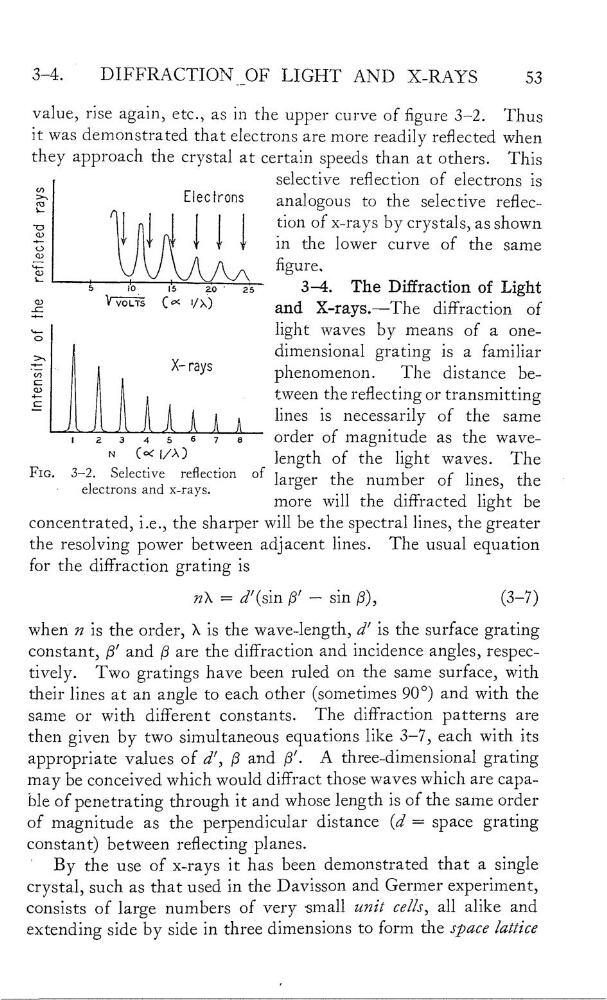
value, rise again, etc., as in the upper curve of gure 3—2. Thus
it was demonstrated that electrons are more readily reected when
they approach the crystal at certain speeds than at others. This
selective reection of electrons is
%
Electrons
analogous to the selective reflecb
l l
1 1 l
tion of X—rays by crystals, as shown
%
in the lower curve of the same
%
gure.
5
15
go '
25
3—4.
The Diffraction Of Light
%
VW‘Fs
(“ '/>\)
and
X—rays.—The diffraction of
…5
light waves by means of a one—
>
dimensional grating is a familiar
'Ë
,
,
rays
phenomenon.
The distance be—
%
_
tween the reecting or transmitting
_
lines is necessarily of the same
.
2
3
4
5
s
7
&
order of magnitude as the wave”
C°< VÀ)
_
length of the light waves. The
FIG'_
Of
larger the number of lines, the
'
_
more
Will the diffracted light be
concentrated, i.e., the sharper will be the spectral lines, the greater
the resolving power between adjacent lines. The usual equation
for the diffraction grating is
n)\ = d'(sin 5' — sin ,8),
(3—7)
When 71 is the order, >\ is the wave—length, a” is the surface grating
constant, ,8' and B are the diffraction and incidence angles, respectively. Two gratings have been ruled on the same surface, with
their lines at an angle to each other (sometimes 90°) and with the
same
or
with different constants.
The diffraction patterns are
then given by two simultaneous equations like 3—7, each With its
appropriate values of d', [? and 5’. A three—dimensional grating
may be conceived which would diffract those waves which are capable of penetrating through it and whose length is of the same order
of magnitude as the perpendicular distance (527 = space grating
constant) between reecting planes.
'
By the use of X-ray3
it has been demonstrated that a single
crystal, such as that used in the Davisson and Germer experiment,
consists of large numbers of very small unit cel/5, all alike and
extending side by side in three dimensions to form the space lattice
DIFFRACTION__OF LIGHT AND X-RAYS
53
value, rise again, etc., as in the upper curve of gure 3—2. Thus
it was demonstrated that electrons are more readily reected when
they approach the crystal at certain speeds than at others. This
selective reection of electrons is
%
Electrons
analogous to the selective reflecb
l l
1 1 l
tion of X—rays by crystals, as shown
%
in the lower curve of the same
%
gure.
5
15
go '
25
3—4.
The Diffraction Of Light
%
VW‘Fs
(“ '/>\)
and
X—rays.—The diffraction of
…5
light waves by means of a one—
>
dimensional grating is a familiar
'Ë
,
,
rays
phenomenon.
The distance be—
%
_
tween the reecting or transmitting
_
lines is necessarily of the same
.
2
3
4
5
s
7
&
order of magnitude as the wave”
C°< VÀ)
_
length of the light waves. The
FIG'_
Of
larger the number of lines, the
'
_
more
Will the diffracted light be
concentrated, i.e., the sharper will be the spectral lines, the greater
the resolving power between adjacent lines. The usual equation
for the diffraction grating is
n)\ = d'(sin 5' — sin ,8),
(3—7)
When 71 is the order, >\ is the wave—length, a” is the surface grating
constant, ,8' and B are the diffraction and incidence angles, respectively. Two gratings have been ruled on the same surface, with
their lines at an angle to each other (sometimes 90°) and with the
same
or
with different constants.
The diffraction patterns are
then given by two simultaneous equations like 3—7, each With its
appropriate values of d', [? and 5’. A three—dimensional grating
may be conceived which would diffract those waves which are capable of penetrating through it and whose length is of the same order
of magnitude as the perpendicular distance (527 = space grating
constant) between reecting planes.
'
By the use of X-ray3
it has been demonstrated that a single
crystal, such as that used in the Davisson and Germer experiment,
consists of large numbers of very small unit cel/5, all alike and
extending side by side in three dimensions to form the space lattice