

PROBLEMS
455
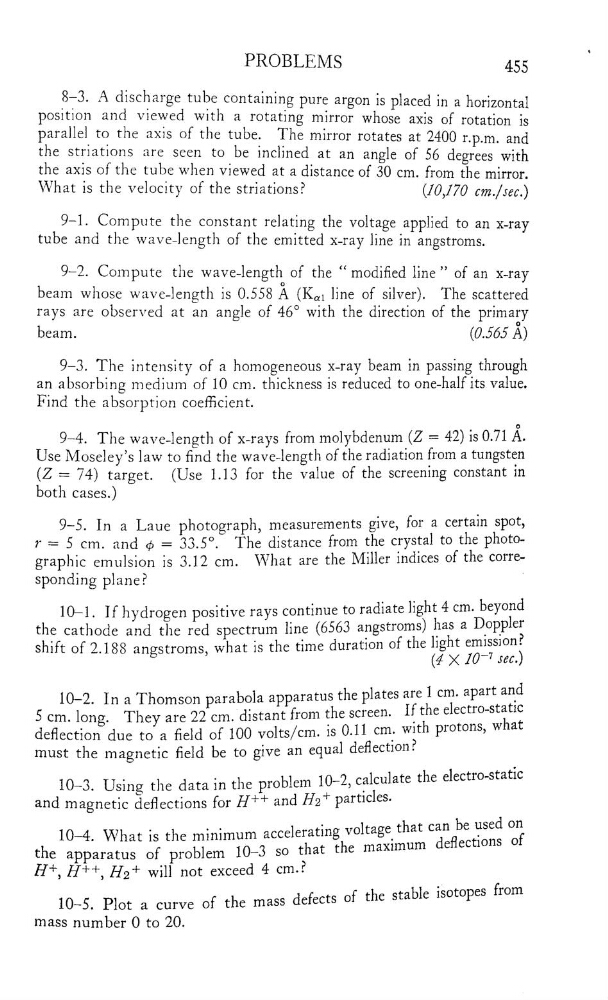
8—3. A discharge
tube containing pure argon is placed in a horizontal
position and Viewed with a rotating mirror whose axis of rotation is
parallel to the axis of the tube. The mirror rotates at 2400 rpm. and
the striations are seen to be inclined at an angle of 56 degrees with
the axis of the tube when viewed at a distance of 30 cm. from the mirror.
What is the velocity of the striations?
(10,170 cm./sec.)
9—1. Compute the constant relating the voltage applied to an X-ray
tube and the wave-length of the emitted X-ray line in angstroms.
9—2. Compute the wave-length of the “
modied line” of an x-ray
beam whose wave-length is 0.558 A (K… line of silver). The scattered
rays are observed at an angle of 46° with the direction of the primary
beam.
(0.565 A)
9—3. The intensity of a homogeneous X-ray beam in passing through
an absorbing medium of 10 cm. thickness is reduced to one—half 1ts value.
Find the absorption coefcient.
9—4. The wave—length of x-rays from molybdenum(Z
=
42) is 0.71 A.
Use Moseley’s law to find the wave-length of the radiation _from a tungsten
(Z = 74) target.
(Use 1.13 for the value of the screening
constant in
both cases.)
9—5. In a Laue photograph,
measurements give, for a certain spot,
7' =
5 cm. and d) = 33.5°.
The distance from the crystal
to the photographie emulsion is 3.12 cm. What are the Miller indices of the corresponding plane?
10—1. If hydrogen positive rays
continue to radiate light 4 cm. beyopd
the cathode and the red spectrum line (6563 angstromsl Ï _13} 51
a
shift of 2.188 angstroms,
what is the time duration of the
ÊËiS78lec.)
10—2. In a Thomson parabola apparatus
the plates are 1 cm. apart and
5 cm. long. They are 22 cm. distant from the
screen.
If:
the
deection due to a eld of 100 volts/cm. 13 0.11
W;th
PTOt0nS, W
must the magnetic eld be to give an equal d€€Ctïon10—3. Using the data in the problem 10—2> CÊl1CUIaŒ
the eleCtr0'sœt1C
and magnetic deections for H++ and H2+ particles.
10—4. What is the minimum accelerating VO1tge_
that CËîîîtïîî
the aPParatus of problem
10—3 so that the max1mum
H+, H++, H2+ will not exceed 4 cm.?
10_5_ Plot a curve of the mass defects of the stable isotopes
from
mass number 0 to 20.
455
8—3. A discharge
tube containing pure argon is placed in a horizontal
position and Viewed with a rotating mirror whose axis of rotation is
parallel to the axis of the tube. The mirror rotates at 2400 rpm. and
the striations are seen to be inclined at an angle of 56 degrees with
the axis of the tube when viewed at a distance of 30 cm. from the mirror.
What is the velocity of the striations?
(10,170 cm./sec.)
9—1. Compute the constant relating the voltage applied to an X-ray
tube and the wave-length of the emitted X-ray line in angstroms.
9—2. Compute the wave-length of the “
modied line” of an x-ray
beam whose wave-length is 0.558 A (K… line of silver). The scattered
rays are observed at an angle of 46° with the direction of the primary
beam.
(0.565 A)
9—3. The intensity of a homogeneous X-ray beam in passing through
an absorbing medium of 10 cm. thickness is reduced to one—half 1ts value.
Find the absorption coefcient.
9—4. The wave—length of x-rays from molybdenum(Z
=
42) is 0.71 A.
Use Moseley’s law to find the wave-length of the radiation _from a tungsten
(Z = 74) target.
(Use 1.13 for the value of the screening
constant in
both cases.)
9—5. In a Laue photograph,
measurements give, for a certain spot,
7' =
5 cm. and d) = 33.5°.
The distance from the crystal
to the photographie emulsion is 3.12 cm. What are the Miller indices of the corresponding plane?
10—1. If hydrogen positive rays
continue to radiate light 4 cm. beyopd
the cathode and the red spectrum line (6563 angstromsl Ï _13} 51
a
shift of 2.188 angstroms,
what is the time duration of the
ÊËiS78lec.)
10—2. In a Thomson parabola apparatus
the plates are 1 cm. apart and
5 cm. long. They are 22 cm. distant from the
screen.
If:
the
deection due to a eld of 100 volts/cm. 13 0.11
W;th
PTOt0nS, W
must the magnetic eld be to give an equal d€€Ctïon10—3. Using the data in the problem 10—2> CÊl1CUIaŒ
the eleCtr0'sœt1C
and magnetic deections for H++ and H2+ particles.
10—4. What is the minimum accelerating VO1tge_
that CËîîîtïîî
the aPParatus of problem
10—3 so that the max1mum
H+, H++, H2+ will not exceed 4 cm.?
10_5_ Plot a curve of the mass defects of the stable isotopes
from
mass number 0 to 20.