

18—16.
DESIGN OF EXPANSION CHAMBERS
435
"
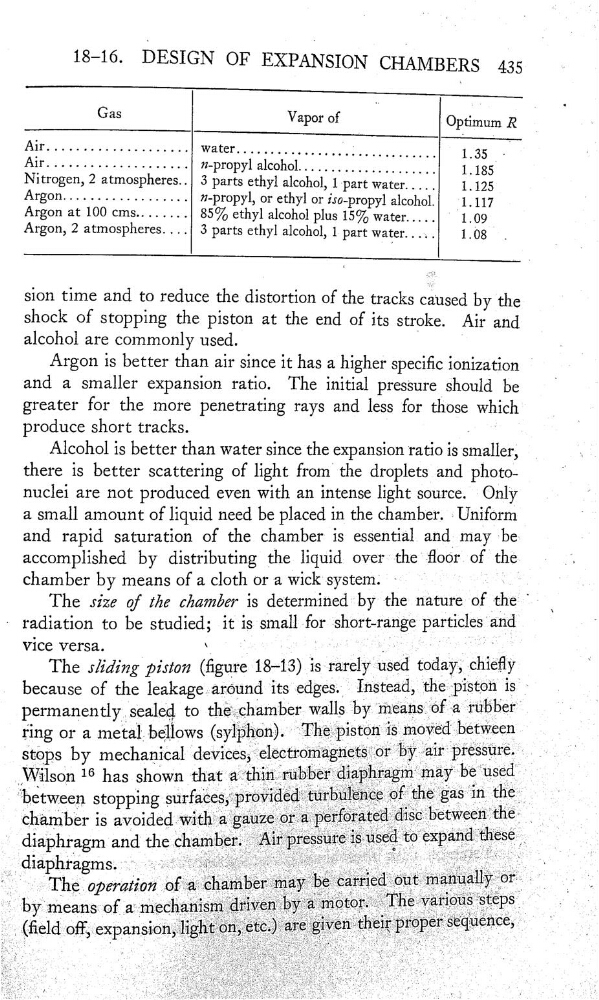
Gas
vaPor of
Optimum R
.
A1r
n-propylalcohol...........…........
Nitrogen, 2 atmospheres… 3 parts ethyl alcohol, 1-part water.
.
.
.
.
1.125
Argon. . . . . . . . . . . . . . . . . . n-propyl, or ethyl or iro-propyl alcohol.
1.117
_
Argon at 100 cms…
..
.
..
.
85% ethyl alcohol plus 15% water.
.
.
.
.
'
l.09
Argon, 2 atmospheres. . . . 3 parts ethyl alcohol, 1 part water.
.
..
.
1.08
.
.
sion time and to reduce the distortion of the tracks caused by the
shock of stopping the piston at the end of its stroke. Air and
alcohol are commonly used.
Argon is better than air since it has a higher specic ionization '
and a smaller expansion ratio. The initial pressure should be
greater for the more penetrating rays and less for those Which
_
produce short tracks.
’
Alcohol is better than water since the expansion ratio is smaller,
.
there is better scattering of light from the droplets and photo"
nuclei are not produced even With an intense light source. Only
_
“
a small amount of liquid need be placed in the chamber.
‘
and rapid saturation of the chamber is essential and may be
accomplished by distributing the liquid over the'oor of
-
_
.
chamber by means of a cloth or a
-'
'ÏI
.
‘
_
The size of the chamâer is determined by the nature of the
'
—
-
radiation to be studied; it is Small for short-range particle‘s’aii‘d
'
Vice versa.
\_
'
‘
'"ï‘.ŸÏ
Â
The slidz'ng piston (gure 18—13) is
today;
because of the leakagearÔund its
Instead,
‘
_
permanentlysealed to
bY
arubber
‘
ring or a metàlbellows (sylph0n) Theplston 1smov€d between
'
Steps by mechanical deV1ces,electrornagets01°]3Yall“Pressure .
Wilson
16 has shown that athmrubbadwphragmmaybeuæd -
'”‘béfwéen
surfacesPf®Vïdedturbuleœo£theasmthe
'
chamber is
_‘
and thechamberA1rPfessuœwusedtœXpandthese Ÿ
.
.
…
diaphragme “
-Ï
f
DESIGN OF EXPANSION CHAMBERS
435
"
Gas
vaPor of
Optimum R
.
A1r
n-propylalcohol...........…........
Nitrogen, 2 atmospheres… 3 parts ethyl alcohol, 1-part water.
.
.
.
.
1.125
Argon. . . . . . . . . . . . . . . . . . n-propyl, or ethyl or iro-propyl alcohol.
1.117
_
Argon at 100 cms…
..
.
..
.
85% ethyl alcohol plus 15% water.
.
.
.
.
'
l.09
Argon, 2 atmospheres. . . . 3 parts ethyl alcohol, 1 part water.
.
..
.
1.08
.
.
sion time and to reduce the distortion of the tracks caused by the
shock of stopping the piston at the end of its stroke. Air and
alcohol are commonly used.
Argon is better than air since it has a higher specic ionization '
and a smaller expansion ratio. The initial pressure should be
greater for the more penetrating rays and less for those Which
_
produce short tracks.
’
Alcohol is better than water since the expansion ratio is smaller,
.
there is better scattering of light from the droplets and photo"
nuclei are not produced even With an intense light source. Only
_
“
a small amount of liquid need be placed in the chamber.
‘
and rapid saturation of the chamber is essential and may be
accomplished by distributing the liquid over the'oor of
-
_
.
chamber by means of a cloth or a
-'
'ÏI
.
‘
_
The size of the chamâer is determined by the nature of the
'
—
-
radiation to be studied; it is Small for short-range particle‘s’aii‘d
'
Vice versa.
\_
'
‘
'"ï‘.ŸÏ
Â
The slidz'ng piston (gure 18—13) is
today;
because of the leakagearÔund its
Instead,
‘
_
permanentlysealed to
bY
arubber
‘
ring or a metàlbellows (sylph0n) Theplston 1smov€d between
'
Steps by mechanical deV1ces,electrornagets01°]3Yall“Pressure .
Wilson
16 has shown that athmrubbadwphragmmaybeuæd -
'”‘béfwéen
surfacesPf®Vïdedturbuleœo£theasmthe
'
chamber is
_‘
and thechamberA1rPfessuœwusedtœXpandthese Ÿ
.
.
…
diaphragme “
-Ï
f