

18—10;
THE BACKGROUND COUNT
427.
/
.
}Illl
+
!?
.
-—
2
_
+
7'
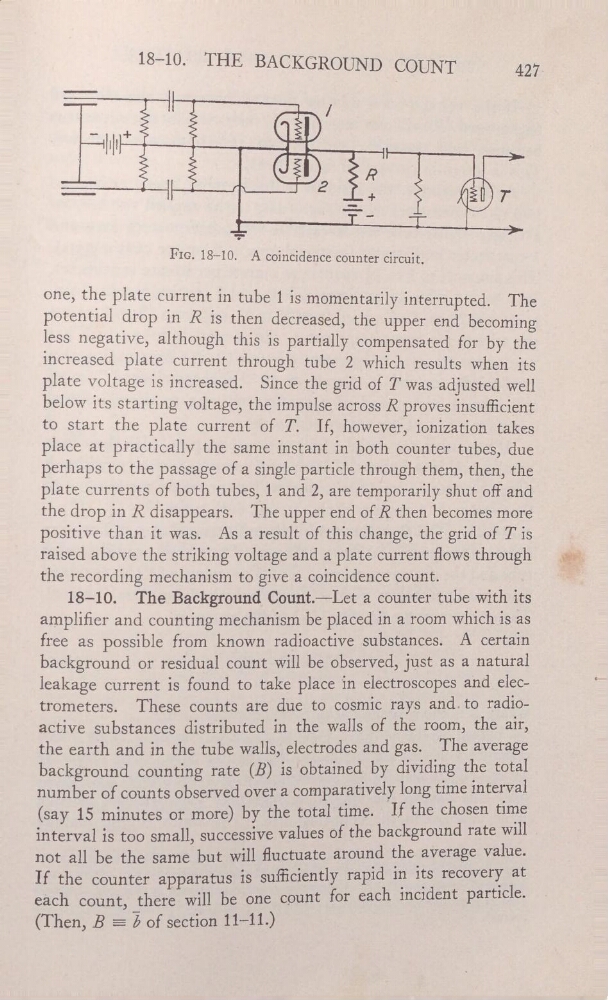
FIG. 18—10.
A coincidence counter circuit.
one, the plate current in tube 1 is momentarily interrupted. The
potential drop in R is then decreased, the upper end becoming
less negative, although this is partially compensated for by the
increased plate current through tube 2 which results when its
plate voltage is increased. Since—the grid of T was adjusted well
below its starting voltage, the impulse across R proves insuicient
to start the plate current of T. If, however, ionization takes
place at ptactically the same instant in both counter tubes, due
perhaps to the passage of a single particle through them, then, the
plate currents of both tubes, 1 and 2, are
OH and
the drop in R disappears. The upper end of R then becomes more
positive than it was. As a result of this change, the grid of T is
.
raised above the striking voltage and a plate current ows through
"
-
.
the recording mechanism to give a coincidence count.
.
_
::
18—10.
The Background Count—Let a counter tube with its
amplier and counting mechanism be placed in a room which is as
.
free as possible from known radioactive substances.
A certain
background or residual count Will be observed, Just _as anatural
leakage current is found to take place in electroscopes and—_eleC‘
_
trometers.
These counts are due to cosmic ray_s and.to radio,
active substances distributed in the walls of the room, the air,
the earth and in the tube walls, electrodes and gas.
average
_
background counting rate (B) is obtained by dividn}g t}_1€
t0tal
number of counts observed over a comparatively long t1me1nterval
(say 15 minutes or more) by the total time. " If the chosen t1me
interval is too small, successive values of the background
rate Wlll
,
_
not all be the
but will uctuate around the_average
value.
If the counter apparatus
is suiciently rapid in its recovery
at
-
'
t for each 1nc1dent particle.
.
each count, there Wlll be one COUD—_
_
(Then, B 5 Z of section
=
;
'
_
THE BACKGROUND COUNT
427.
/
.
}Illl
+
!?
.
-—
2
_
+
7'
FIG. 18—10.
A coincidence counter circuit.
one, the plate current in tube 1 is momentarily interrupted. The
potential drop in R is then decreased, the upper end becoming
less negative, although this is partially compensated for by the
increased plate current through tube 2 which results when its
plate voltage is increased. Since—the grid of T was adjusted well
below its starting voltage, the impulse across R proves insuicient
to start the plate current of T. If, however, ionization takes
place at ptactically the same instant in both counter tubes, due
perhaps to the passage of a single particle through them, then, the
plate currents of both tubes, 1 and 2, are
OH and
the drop in R disappears. The upper end of R then becomes more
positive than it was. As a result of this change, the grid of T is
.
raised above the striking voltage and a plate current ows through
"
-
.
the recording mechanism to give a coincidence count.
.
_
::
18—10.
The Background Count—Let a counter tube with its
amplier and counting mechanism be placed in a room which is as
.
free as possible from known radioactive substances.
A certain
background or residual count Will be observed, Just _as anatural
leakage current is found to take place in electroscopes and—_eleC‘
_
trometers.
These counts are due to cosmic ray_s and.to radio,
active substances distributed in the walls of the room, the air,
the earth and in the tube walls, electrodes and gas.
average
_
background counting rate (B) is obtained by dividn}g t}_1€
t0tal
number of counts observed over a comparatively long t1me1nterval
(say 15 minutes or more) by the total time. " If the chosen t1me
interval is too small, successive values of the background
rate Wlll
,
_
not all be the
but will uctuate around the_average
value.
If the counter apparatus
is suiciently rapid in its recovery
at
-
'
t for each 1nc1dent particle.
.
each count, there Wlll be one COUD—_
_
(Then, B 5 Z of section
=
;
'
_