

4—22
18.
THE DETECTION OF PARTICLES
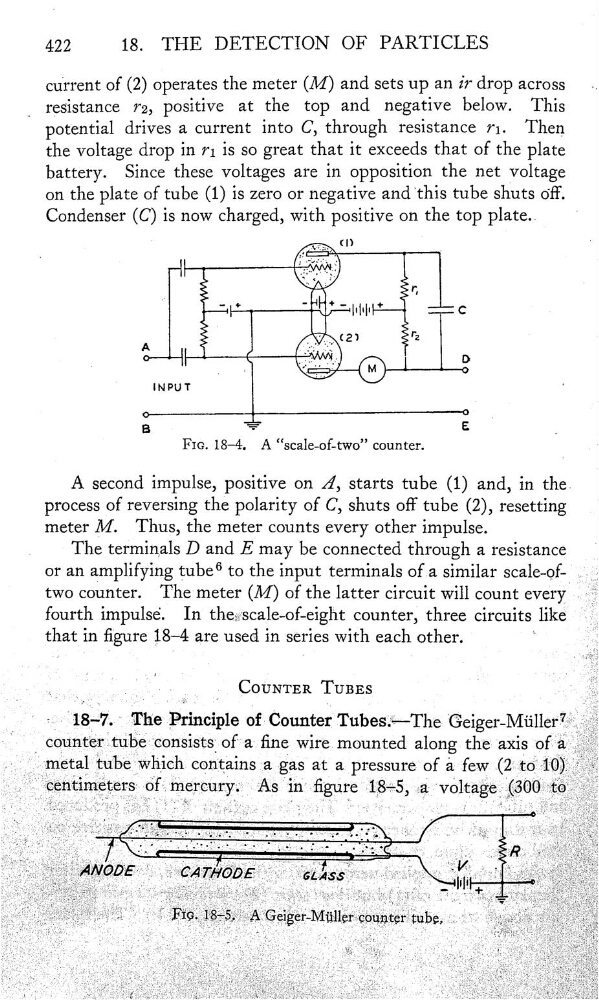
current of (2) operates
the meter (M) and sets up an ir drop across
..
resistance ï2, positive at the top and negative below. This
potential drives a current into C, through resistance m. Then
the voltage drop in r1 is so great that it exceeds that of the plate
battery. Since these voltages are in opposition the net voltage
on the plate of tube (1) is zero or negative and this tube shuts o‘HÎ
Condenser (C) is now charged, With positive on the top plate..
…«.-=:;..__
(|)
_
.,
"
a+ —
…
+
c
A
.
@ @
INPUT
.
'—:—'
E
FIG. 18—4.
A “scale-of-two” counter.
A second impulse, positive on Â, starts tube (1) and, in the
process
of reversing the polarity of C, shuts off tube (2), resetting
meter M. Thus, the meter counts every other impulse.
The terminals D and E may be connected through a resistance
or an amplifying tube6 to the input terminals of a similar
two counter.
The meter (M) of the latter circuit Will count every
fourth impulse'. In
counter, three circuits like
that in gure 18—4 are used in series With each other.
Ï _Î
_
_
_
COUNTER TUBES
_
.
'
'
Ï=18_—'7.
"
The Principle of CounterTubeslf—The Ge1ger-Muller7
;
ne wire mounted along the “axis of a
contains a .gas at a pressure of a few (21td‘10)
ANDE
CATHÛDE
ÎGLAss
:;
18.
THE DETECTION OF PARTICLES
current of (2) operates
the meter (M) and sets up an ir drop across
..
resistance ï2, positive at the top and negative below. This
potential drives a current into C, through resistance m. Then
the voltage drop in r1 is so great that it exceeds that of the plate
battery. Since these voltages are in opposition the net voltage
on the plate of tube (1) is zero or negative and this tube shuts o‘HÎ
Condenser (C) is now charged, With positive on the top plate..
…«.-=:;..__
(|)
_
.,
"
a+ —
…
+
c
A
.
@ @
INPUT
.
'—:—'
E
FIG. 18—4.
A “scale-of-two” counter.
A second impulse, positive on Â, starts tube (1) and, in the
process
of reversing the polarity of C, shuts off tube (2), resetting
meter M. Thus, the meter counts every other impulse.
The terminals D and E may be connected through a resistance
or an amplifying tube6 to the input terminals of a similar
two counter.
The meter (M) of the latter circuit Will count every
fourth impulse'. In
counter, three circuits like
that in gure 18—4 are used in series With each other.
Ï _Î
_
_
_
COUNTER TUBES
_
.
'
'
Ï=18_—'7.
"
The Principle of CounterTubeslf—The Ge1ger-Muller7
;
ne wire mounted along the “axis of a
contains a .gas at a pressure of a few (21td‘10)
ANDE
CATHÛDE
ÎGLAss
:;