

412
17.
SMALL CURRENT TECHNÏQUE
.
un
l »
I
..
i —- =‘ num
—:
|
.Il?
gum _ Â I
WAVE-LENGlH IN ANGSTROMS
“’
WAVE‘LENGTH
…
AHGSTROMS
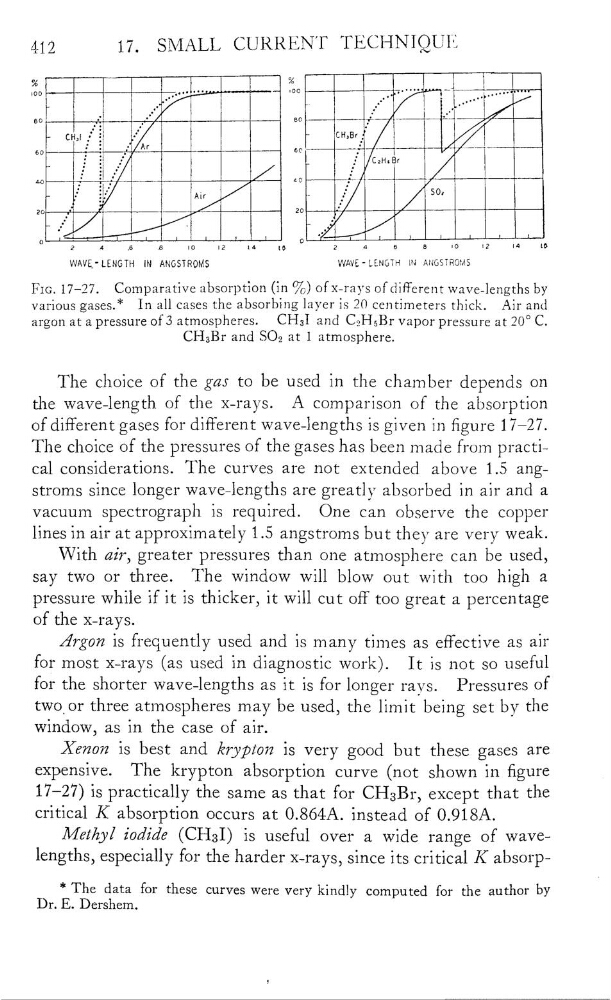
FIG. 17—27.
Comparative absorption (in %) ofx-rays ofdifïere11twave-lengths by
various gases.* In all cases the absorbing layer is 20 centimeters thick.
Air and
argon at a pressure of3 atmospheres.
CH31 and C9H5Br vapor pressure at 20° C.
CH3Br and 802 at 1 atmosphere.
The choice of the gas to be used in the chamber depends on
the wave-length of the x-rays.
A comparison of the absorption
of dilïerent gases
for different wave-lengths is given in gure 17—27.
The choice of the pressures
of the gases has been made from practi—
cal considerations. The curves are not extended above 1.5 angstroms since longer wave-lengths are greatly absorbed in air and a
vacuum
spectrograph is required. One can observe the copper
lines in air at approximately 1.5 angstroms but they are very
weak.
With air, greater pressures than one atmosphere can be used,
say
two or three.
The window will blow out with too high a
pressure while if it is thicker, it will cut OH too great a percentage
of the x-rays.
Ârg0n is frequently used and is many times as eHective as air
for most X—rays (as used in diagnostic work).
It is not so useful
for the shorter wave-lengths as it is for longer rays.
Pressures of
two or three atmospheres may be used, the limit being set by the
window, as in the case of air.
Xenon is best and krypion is very good but these gases
are
expensive. The krypton absorption curve (not shown in gure
17—27) is practically the same as that for CH3Br, except
that the
critical K absorption occurs at 0.864A. instead of 0.918A.
M€Ïhyl i0dide (CH31) is useful over a wide range of wave—
lengths, especially for the harder x—rays, since its critical K absorp—
* The data for these curves were very kindly computed for the author by
Dr. E. Dershem.
17.
SMALL CURRENT TECHNÏQUE
.
un
l »
I
..
i —- =‘ num
—:
|
.Il?
gum _ Â I
WAVE-LENGlH IN ANGSTROMS
“’
WAVE‘LENGTH
…
AHGSTROMS
FIG. 17—27.
Comparative absorption (in %) ofx-rays ofdifïere11twave-lengths by
various gases.* In all cases the absorbing layer is 20 centimeters thick.
Air and
argon at a pressure of3 atmospheres.
CH31 and C9H5Br vapor pressure at 20° C.
CH3Br and 802 at 1 atmosphere.
The choice of the gas to be used in the chamber depends on
the wave-length of the x-rays.
A comparison of the absorption
of dilïerent gases
for different wave-lengths is given in gure 17—27.
The choice of the pressures
of the gases has been made from practi—
cal considerations. The curves are not extended above 1.5 angstroms since longer wave-lengths are greatly absorbed in air and a
vacuum
spectrograph is required. One can observe the copper
lines in air at approximately 1.5 angstroms but they are very
weak.
With air, greater pressures than one atmosphere can be used,
say
two or three.
The window will blow out with too high a
pressure while if it is thicker, it will cut OH too great a percentage
of the x-rays.
Ârg0n is frequently used and is many times as eHective as air
for most X—rays (as used in diagnostic work).
It is not so useful
for the shorter wave-lengths as it is for longer rays.
Pressures of
two or three atmospheres may be used, the limit being set by the
window, as in the case of air.
Xenon is best and krypion is very good but these gases
are
expensive. The krypton absorption curve (not shown in gure
17—27) is practically the same as that for CH3Br, except
that the
critical K absorption occurs at 0.864A. instead of 0.918A.
M€Ïhyl i0dide (CH31) is useful over a wide range of wave—
lengths, especially for the harder x—rays, since its critical K absorp—
* The data for these curves were very kindly computed for the author by
Dr. E. Dershem.