

392
17.
SMALL CURRENT TECHNIQUE
.
The electroscope is essentially a potential measuring instru-‘
ment.
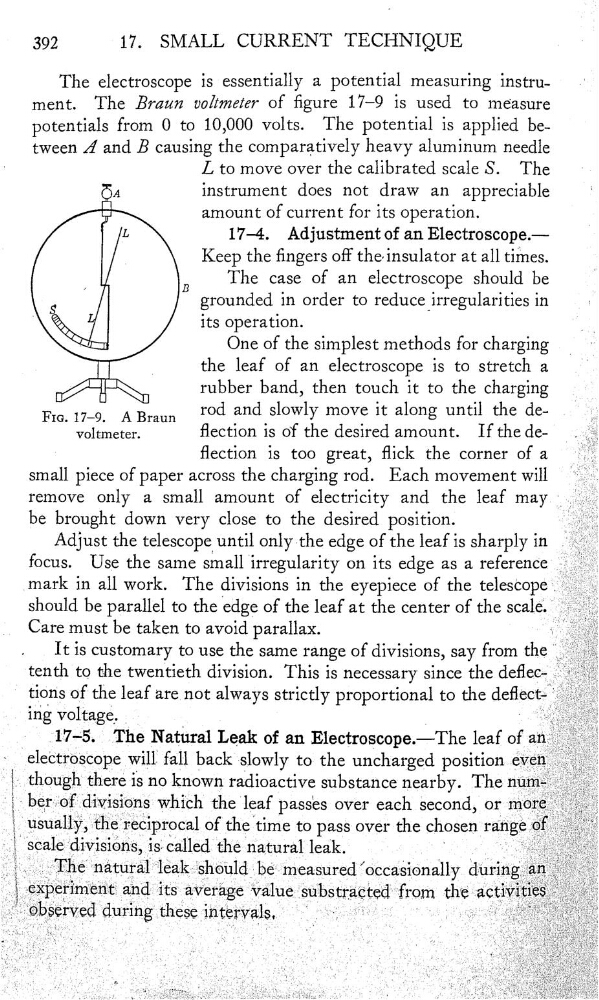
The Braun volfmeler of gure 17—9 is used to measure
potentials from 0 to 10,000 volts. The potential is applied between  and B causing the comparatively heavy aluminum needle
'
L to move over the calibrated scale S.
The
'
.A
instrument does not draw an appreciable
;
amount of current for its operation.
17—4.
Adjustment of an Electroscope.—
Keep the ngers on theinsulator at all tifnes.
13
The case of an electroscope should be
grounded in order to reduce_irregularities in
=
_
‘
its operation.
‘
_
“'—|
One of the simplest methods for charging
_
l
the leaf of an electroscope is to stretch a
,
l/'l'\
rubber band, then touch
it to the charging
‘
Flo. 17_9_
A Braun
rod and slowly move it along until the de.
voltmeter.
ection is of the desired amount.
If the de—
ection is too great, ick the corner of a
small piece of paper across the charging rod. Each movement will
remove
only a small amount of electricity and the leaf may
be brought down very close to the desired position.
Adjust the telescope until onlythe edge of the leaf is sharply in
focus.
Use the same small irregularity on its edge as a reference
in all work.
The divisions in the eyepiece of the teles'cope
should be parallel to the edge of the leaf at the center of the scale
_
Care must be taken to avoid parallax.
“
,
It is customary to use the same range of divisions, say from the
tenth to the twentieth division. This is necessary since the deeÇ:
‘
tions
of the leaf are not always strictly proportional to the deect—
ing voltage,
.
'
1755. The Natural Leak of an Electroscope.—The leaf of an
Î
_eleCtroscope will fall back —slowly to the uncharged position even
”
there is no known radioactive substance nearby. The num—
f i b*“îrOfd1V131ons which the leaf pass'es over each Second, orm0r€
…
{usually,therec1procal of the time to pass over the chosen
natural—' 1æk.,
17.
SMALL CURRENT TECHNIQUE
.
The electroscope is essentially a potential measuring instru-‘
ment.
The Braun volfmeler of gure 17—9 is used to measure
potentials from 0 to 10,000 volts. The potential is applied between  and B causing the comparatively heavy aluminum needle
'
L to move over the calibrated scale S.
The
'
.A
instrument does not draw an appreciable
;
amount of current for its operation.
17—4.
Adjustment of an Electroscope.—
Keep the ngers on theinsulator at all tifnes.
13
The case of an electroscope should be
grounded in order to reduce_irregularities in
=
_
‘
its operation.
‘
_
“'—|
One of the simplest methods for charging
_
l
the leaf of an electroscope is to stretch a
,
l/'l'\
rubber band, then touch
it to the charging
‘
Flo. 17_9_
A Braun
rod and slowly move it along until the de.
voltmeter.
ection is of the desired amount.
If the de—
ection is too great, ick the corner of a
small piece of paper across the charging rod. Each movement will
remove
only a small amount of electricity and the leaf may
be brought down very close to the desired position.
Adjust the telescope until onlythe edge of the leaf is sharply in
focus.
Use the same small irregularity on its edge as a reference
in all work.
The divisions in the eyepiece of the teles'cope
should be parallel to the edge of the leaf at the center of the scale
_
Care must be taken to avoid parallax.
“
,
It is customary to use the same range of divisions, say from the
tenth to the twentieth division. This is necessary since the deeÇ:
‘
tions
of the leaf are not always strictly proportional to the deect—
ing voltage,
.
'
1755. The Natural Leak of an Electroscope.—The leaf of an
Î
_eleCtroscope will fall back —slowly to the uncharged position even
”
there is no known radioactive substance nearby. The num—
f i b*“îrOfd1V131ons which the leaf pass'es over each Second, orm0r€
…
{usually,therec1procal of the time to pass over the chosen
natural—' 1æk.,