

2—7.
THE DUNNINGTON METHOD
29
The quantity Hr occurs freqùently in work with charged
particles. Itis a measure of the case with which the particles
may be deected by a magnetic eld. Equation 2—1 shows that
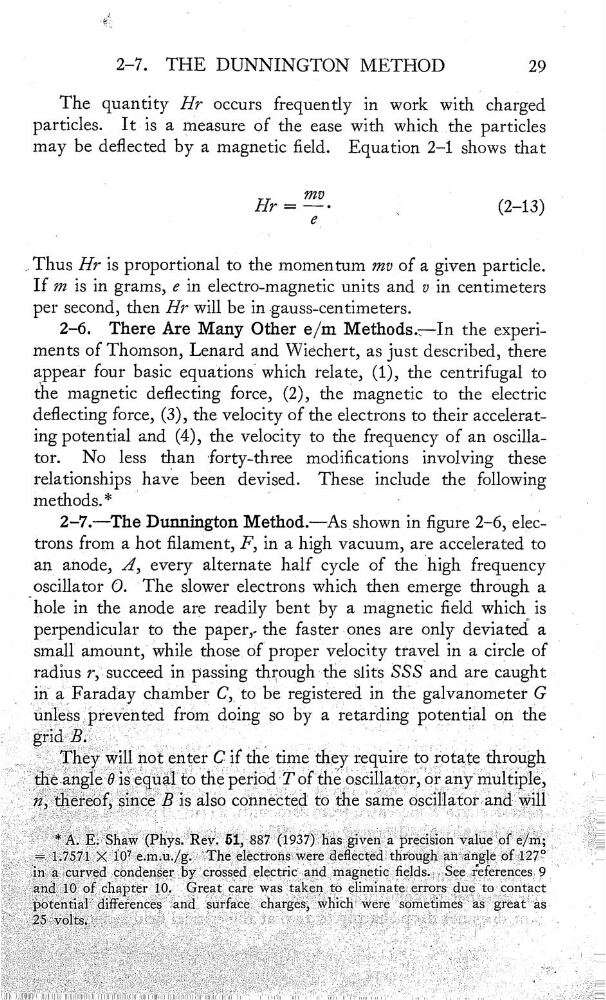
Æ=@—
€.
..Thus Hr is proportional to the momentum mv of a given particle.
If 771 is in grams, e in electro-magnetic units and 0 in centimeters
per second, then Hr will be in gauss—centimeters.
2—6.
There Are Many Other e /m Methods.:——In the experiments of Thomson, Lenard and Wiechert, as just described, there
appear
four basic equations which relate, (1), the centrifugal to
the magnetic deecting force, (2), the magnetic to the electric
deecting force, (3), the velocity of the electrons to their accelerat—
ing potential and (4), the velocity to the frequency of an oscilla—
tor.
No less
than forty—three modications involving these
relationships have been devised. These include the following
methods.*
'
'
_
«
2—7.—The Dunnington Method.—Asshown in gure
'
trons from a hot lament, F
,
in a high vaCuum, are accelerated to
an anode, Â, every alternate half cycle of the high frequency
_oscillator O. 'The slower electrons which then emerge thrOugh a
hole in the anode are readily bent by a magnetic eld Which is
.
perpendicular to the paper, the faster-ones are only deviatecl a
‘
small am0unt, while those of proper velocity travel in a circle of
radins r,ïsucceed in passing through the slits_ 888 and are caught
inaFaraday
to be registered in the galvahometer G
ùn1‘çësgpreveptedfrom doing so by a
potential on “the
.Ï-: grid—B
Ï Ç
‘
,
,
_
'
…
'
'
‘
Theywl ëoftÏÎêtfér C…îf ic timé the? require td.rÿotÿäte fhrosh
'
fÏheangïelsequaltothepe°dT ©Îftheosclator 0ranymultlple
'
,
"‘
=17571X107emu/gTheelectronsweredeectedthroughanangleof127°
macurvedcondenserbycrossedelectricanmagnetlceldsSeereferenœs9
'
andl®ofchapterlo Greatcarewastakento ehmlnateerr°rsduetocontact
THE DUNNINGTON METHOD
29
The quantity Hr occurs freqùently in work with charged
particles. Itis a measure of the case with which the particles
may be deected by a magnetic eld. Equation 2—1 shows that
Æ=@—
€.
..Thus Hr is proportional to the momentum mv of a given particle.
If 771 is in grams, e in electro-magnetic units and 0 in centimeters
per second, then Hr will be in gauss—centimeters.
2—6.
There Are Many Other e /m Methods.:——In the experiments of Thomson, Lenard and Wiechert, as just described, there
appear
four basic equations which relate, (1), the centrifugal to
the magnetic deecting force, (2), the magnetic to the electric
deecting force, (3), the velocity of the electrons to their accelerat—
ing potential and (4), the velocity to the frequency of an oscilla—
tor.
No less
than forty—three modications involving these
relationships have been devised. These include the following
methods.*
'
'
_
«
2—7.—The Dunnington Method.—Asshown in gure
'
trons from a hot lament, F
,
in a high vaCuum, are accelerated to
an anode, Â, every alternate half cycle of the high frequency
_oscillator O. 'The slower electrons which then emerge thrOugh a
hole in the anode are readily bent by a magnetic eld Which is
.
perpendicular to the paper, the faster-ones are only deviatecl a
‘
small am0unt, while those of proper velocity travel in a circle of
radins r,ïsucceed in passing through the slits_ 888 and are caught
inaFaraday
to be registered in the galvahometer G
ùn1‘çësgpreveptedfrom doing so by a
potential on “the
.Ï-: grid—B
Ï Ç
‘
,
,
_
'
…
'
'
‘
Theywl ëoftÏÎêtfér C…îf ic timé the? require td.rÿotÿäte fhrosh
'
fÏheangïelsequaltothepe°dT ©Îftheosclator 0ranymultlple
'
,
"‘
=17571X107emu/gTheelectronsweredeectedthroughanangleof127°
macurvedcondenserbycrossedelectricanmagnetlceldsSeereferenœs9
'
andl®ofchapterlo Greatcarewastakento ehmlnateerr°rsduetocontact