

374
16.
VACUUM TECHNIQUE
_
In using a pressure gauge, itis important to have it connected
as closely as possible to the experimental chamber and to waita
suicient length of time before taking a reading to allow the pres—
sure in the gauge
to reach its new value.
16—15.
Vapors.—Impurities in the system exert a constant
vapor pressure
below which it is difcult to lower the pressure,
even with fast pumps and large tubing.
For instance, if there is
moisture in a tube at20° C:, the lower limit of pressure would be
around 17 mm.
The obvious solution of this very important
vapor tension problem is to eliminate as much as possible the
.
causes of vapors and then to lower the temperature in a portion of
the system.
As water is cooled from 20° C. to -— 20° C., its vapor .
tension drops to 0.9 mm. At the temperature of carbon dioxide
snow
(—78° C.), it is 0.001 mm. and at liquid air temperature
(—195° C. to —'182°.7 C.), it is below 10"6 mm.
It is, therefore,
necessary
to remove water vapor with a tube of phosphorous pen—
'
toxide unless liquid air is available.
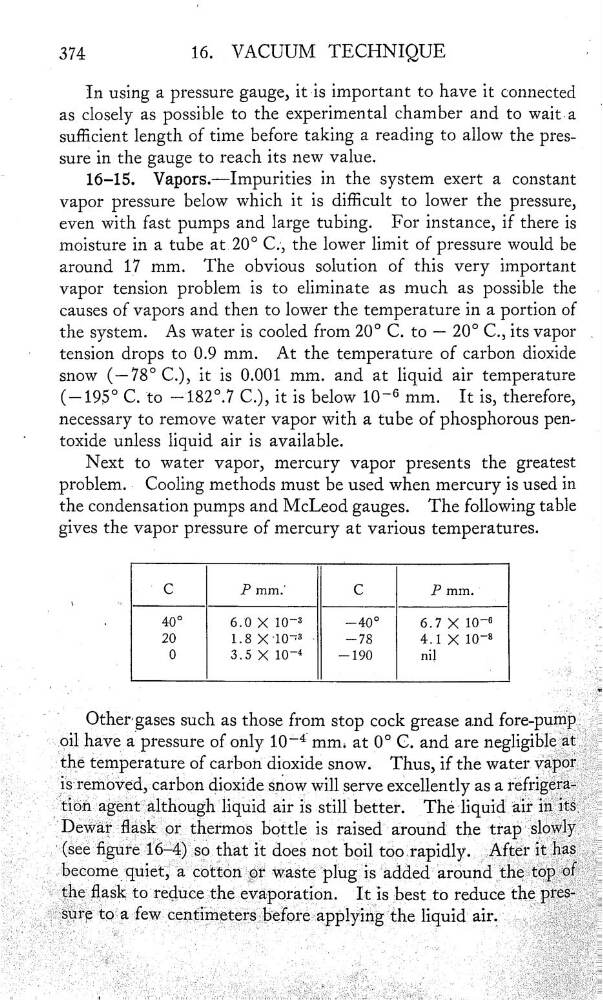
Next to water vapor, mercury vapor presents the greatest
problem. . Cooling methods must be used when mercury is used in
the condensation pumps and McLeod gauges.
The following table
gives the vapor pressure of mercury at various temperatures.
‘
C
P mm.’
C
P mm.
.
40°
6.0 >< 'le—?
—40°
6.7 >< io—6
_
,
“
Ï'20
1.8
——78
4.1 >< 10—8
*
.
0
3.5 >< 10—4
—190
nil
_
.Ï
‘
'
Othergases such as those from stop cock grease and fore—pump
coil have a pressure of only
mm. at 0° C. and are neglrg1bleat
the temperature of carbon dioxide snow. Thus, if the water vapor
dioxide Snow will serve
a refr1gera—
t10n agentalthough “1iq‘u'id air is stillbetter.
a1r 1n1ts
Dewar askÎ'or-thermo's bottle“ israised around the trapslowlÿ
16—4)so that it does nOt boil too,rapidly. Aftar1thas
|_) : ;
or waste «pi‘ugfis
aroundthetop0f
.
theaSk to rèduèef—thd;€VäîPQratiçm. It is best to reduce th€pf€S'
16.
VACUUM TECHNIQUE
_
In using a pressure gauge, itis important to have it connected
as closely as possible to the experimental chamber and to waita
suicient length of time before taking a reading to allow the pres—
sure in the gauge
to reach its new value.
16—15.
Vapors.—Impurities in the system exert a constant
vapor pressure
below which it is difcult to lower the pressure,
even with fast pumps and large tubing.
For instance, if there is
moisture in a tube at20° C:, the lower limit of pressure would be
around 17 mm.
The obvious solution of this very important
vapor tension problem is to eliminate as much as possible the
.
causes of vapors and then to lower the temperature in a portion of
the system.
As water is cooled from 20° C. to -— 20° C., its vapor .
tension drops to 0.9 mm. At the temperature of carbon dioxide
snow
(—78° C.), it is 0.001 mm. and at liquid air temperature
(—195° C. to —'182°.7 C.), it is below 10"6 mm.
It is, therefore,
necessary
to remove water vapor with a tube of phosphorous pen—
'
toxide unless liquid air is available.
Next to water vapor, mercury vapor presents the greatest
problem. . Cooling methods must be used when mercury is used in
the condensation pumps and McLeod gauges.
The following table
gives the vapor pressure of mercury at various temperatures.
‘
C
P mm.’
C
P mm.
.
40°
6.0 >< 'le—?
—40°
6.7 >< io—6
_
,
“
Ï'20
1.8
——78
4.1 >< 10—8
*
.
0
3.5 >< 10—4
—190
nil
_
.Ï
‘
'
Othergases such as those from stop cock grease and fore—pump
coil have a pressure of only
mm. at 0° C. and are neglrg1bleat
the temperature of carbon dioxide snow. Thus, if the water vapor
dioxide Snow will serve
a refr1gera—
t10n agentalthough “1iq‘u'id air is stillbetter.
a1r 1n1ts
Dewar askÎ'or-thermo's bottle“ israised around the trapslowlÿ
16—4)so that it does nOt boil too,rapidly. Aftar1thas
|_) : ;
or waste «pi‘ugfis
aroundthetop0f
.
theaSk to rèduèef—thd;€VäîPQratiçm. It is best to reduce th€pf€S'