

350
15.
COSMIC RAYS
-
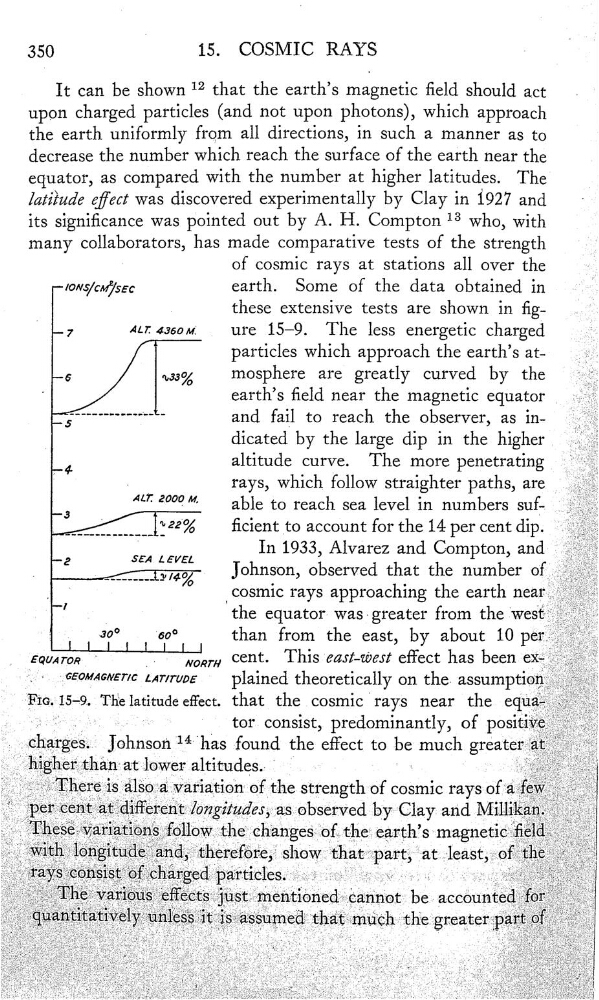
It can be shown
12 that the earth’s magnetic eld should act
-
upon charged particles (and not upon photons), which approach
the earth uniformly from all directions, in such a manner as to
decrease the number which reach the surface of the earth near the
equator, as compared with the number at higher latitudes. The
lati2‘ude eecz‘ was discovered experimentally by Clay in 1927 and
'
its signicance was pointed out by A. H. Compton
13 Who, with
many collaborators, has made comparative tests of the strength
_
of cosmic rays
at stations all over the
/oNs/wÿsgc
earth.
Some of the data obtained in
Y
.
these extensive tests are shown in g'
7
Au: 4360M
ure
15—9.
The less energetic charged
_
particles which approach the earth’s at5
…33%
mosphere are greatly curved by the
'
earth’s eld near the magnetic equator
_;"’“'"““'“
‘
and fail to reach the observer, as in—
dicated by the large clip in the higher
4
altitude curve.
The more penetrating
.
rays, which follow straighter paths, are
3
’“r “°° ""
able to reach sea level in numbers suf—
_
______'_________ Ï22'%
cient _to account for the 14 per
cent dip.
'
In 1933, Alvarez and Compton, and
3
sa LEVEL
_
.
.
________
, ,4%
Johnson,
observed that
the number of
,
'
rays approach1ng the earth near
,
'
_
the equator was — greater from the west
;
»30°
“60°
than from the east, by about 10 per
“
_
.
cent.
This east—west effect has been eX—
»i-*
LAT/TUDE
plained theoretically on the assumpt10n
_
"FÎG‘15—‘9' Th"e latitude effect. that the cosmic
near
the equa—
11r'?“
=n'
-,
tor consist, predominantly, of pos1t1ve
charges l Johnson
found the elïect to be much greaterat
strength of cosmic rays=ofafew
percentaterentlmgztudesasobserved by Clay— and Milhkan
1“aÿSC©nSIS‘EfchargedParticles
.:…
15.
COSMIC RAYS
-
It can be shown
12 that the earth’s magnetic eld should act
-
upon charged particles (and not upon photons), which approach
the earth uniformly from all directions, in such a manner as to
decrease the number which reach the surface of the earth near the
equator, as compared with the number at higher latitudes. The
lati2‘ude eecz‘ was discovered experimentally by Clay in 1927 and
'
its signicance was pointed out by A. H. Compton
13 Who, with
many collaborators, has made comparative tests of the strength
_
of cosmic rays
at stations all over the
/oNs/wÿsgc
earth.
Some of the data obtained in
Y
.
these extensive tests are shown in g'
7
Au: 4360M
ure
15—9.
The less energetic charged
_
particles which approach the earth’s at5
…33%
mosphere are greatly curved by the
'
earth’s eld near the magnetic equator
_;"’“'"““'“
‘
and fail to reach the observer, as in—
dicated by the large clip in the higher
4
altitude curve.
The more penetrating
.
rays, which follow straighter paths, are
3
’“r “°° ""
able to reach sea level in numbers suf—
_
______'_________ Ï22'%
cient _to account for the 14 per
cent dip.
'
In 1933, Alvarez and Compton, and
3
sa LEVEL
_
.
.
________
, ,4%
Johnson,
observed that
the number of
,
'
rays approach1ng the earth near
,
'
_
the equator was — greater from the west
;
»30°
“60°
than from the east, by about 10 per
“
_
.
cent.
This east—west effect has been eX—
»i-*
LAT/TUDE
plained theoretically on the assumpt10n
_
"FÎG‘15—‘9' Th"e latitude effect. that the cosmic
near
the equa—
11r'?“
=n'
-,
tor consist, predominantly, of pos1t1ve
charges l Johnson
found the elïect to be much greaterat
strength of cosmic rays=ofafew
percentaterentlmgztudesasobserved by Clay— and Milhkan
1“aÿSC©nSIS‘EfchargedParticles
.:…